

 The Guardian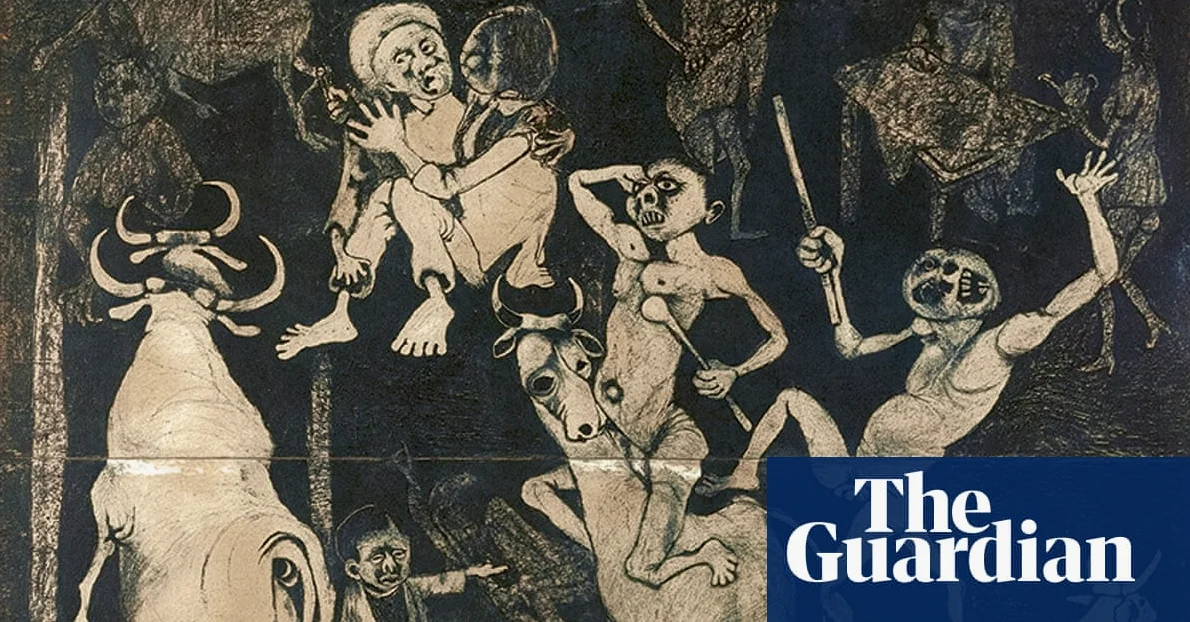
The Reina Sofía Museum in Madrid has revealed a powerful new exhibition that pairs Picasso’s famous Guernica with a lesser-known but equally striking work by South African artist Dumile Feni. African Guernica, a 1967 drawing on yellowing paper, is now displayed exactly opposite Picasso’s monumental canvas, in the same location where Guernica was first shown 34 years ago.
The Power of Contrast
Feni’s work, though smaller in scale, matches Picasso’s in its emotional intensity and thematic depth. The drawing depicts a three-legged man with a grotesque mask, a cow with an engorged udder suckling a baby, and birds pecking at scraps, all set against shadowy figures in the background. According to the museum’s director, Manuel Segade, the placement of African Guernica alongside Picasso’s work is intentional, aiming to challenge long-standing biases in art history.
Segade explained that the new exhibition series, called History Doesn’t Repeat Itself, But It Does Rhyme, seeks to “take works from different cultural and geographical frameworks and put them alongside Guernica.” He emphasized that Western art history has often marginalized African art, reducing it to “handicrafts or to savagery.” The exhibition aims to correct these biases by placing African Guernica in direct conversation with its famous counterpart.
The Artist’s Legacy
Dumile Feni, who died in New York in 1991 after spending nearly 25 years in exile, was known in 1960s Johannesburg as “the Goya of the townships.” Though he had no formal training, Feni was a compulsive drawer from childhood, fascinated by indigenous African art forms such as rock painting and mask-making. His work was deeply influenced by the oppressive environment of apartheid South Africa, which he experienced firsthand.
According to Tamar Garb, a professor of art at University College London and curator of the exhibition, Feni’s work is a “reaction to the violence, the slow violence, and the actual violence of racist tyranny.” She noted that while Picasso’s Guernica was an anti-war cry, Feni’s drawing reflects the dehumanizing effects of a society built on racial oppression.
Garb also pointed out that Feni’s work, created in 1967, was influenced by European modernism, including the works of Goya and Bosch. She said, “It’s important to remember that Picasso’s Guernica itself could not have existed without African sculpture.” However, she emphasized that the exhibition is not about influence but about dialogue between different artistic traditions.
The Context of Resistance
Feni’s African Guernica was created during a time of intense political and social upheaval in South Africa. The artist was deeply aware of the brutal realities of apartheid, which had already been in place for over 30 years by the time he completed the drawing. His work reflects the psychological and physical violence of a system that dehumanized the majority of the population.
Garb explained that Feni’s work was not simply a response to war, but to a form of violence that was more insidious and systemic. “It’s not an equivalent to the kind of bombardment of war,” she said. “And I think that that difference is also important to stress.”
The exhibition also includes five other works by Feni, including a 53-meter-long scroll titled You Wouldn’t Know God if He Spat in Your Eye, which he worked on during his years in London. Another piece, Hector Pieterson, is a large charcoal drawing based on a famous photograph of a 13-year-old boy killed by South Africa’s apartheid-era police.
Garb noted that Feni’s work occupies a unique place in 20th-century art. “This is a modern artist using drawing materials – charcoal, pencil and conté crayon – at a scale almost unheard of globally at that time,” she said. “If you look at drawing practices globally in the 1960s, there are very, very few artists – I can think of hardly anyone – who works at the epic and monumental scale.”
The exhibition is the first in a new series by the Reina Sofía Museum, which aims to bring attention to works from different cultural and geographical backgrounds. The museum hopes that by placing African Guernica alongside Picasso’s masterpiece, it will spark a broader conversation about the history of art and the ways in which it has been shaped by power, race, and violence.



Comments
No comments yet
Be the first to share your thoughts