

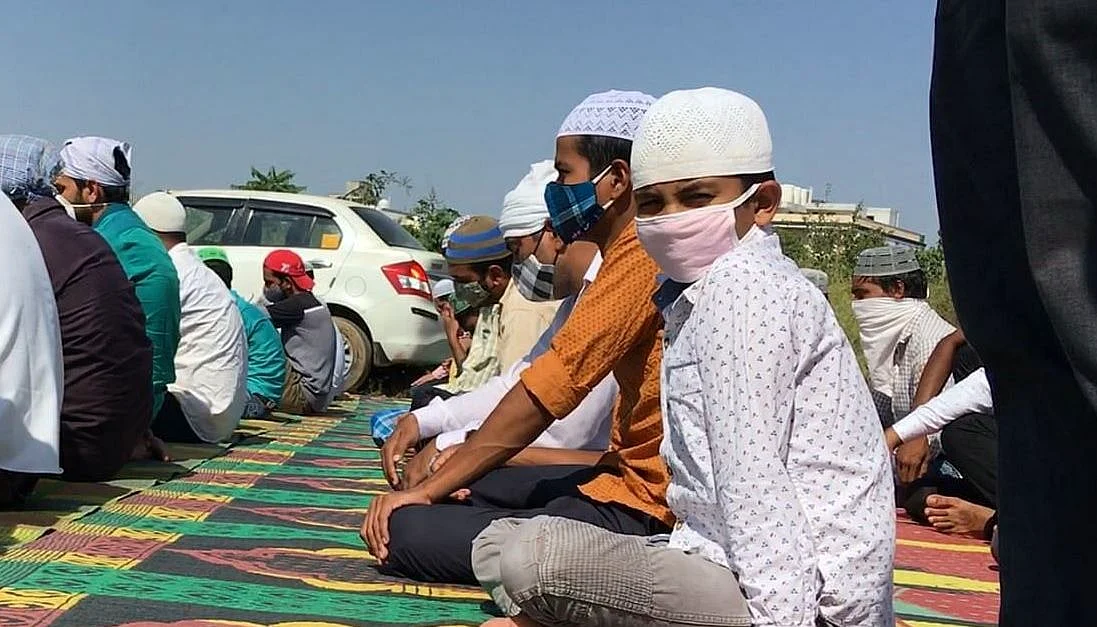
The Allahabad High Court has strongly rebuked local officials in Sambhal for imposing limits on mosque prayers, stating that such actions are unwarranted and in violation of constitutional rights. The bench, comprising Justice Atul Sreedharan and Justice Siddharth Nandan, dismissed the authorities’ justification for restricting the number of worshippers to 20 at a mosque in Gata No. 291, citing law and order concerns. The court emphasized that the right to worship must be protected, regardless of the number of participants.
Impact on Religious Freedom and Community Tensions
The decision comes amid rising tensions in Sambhal, where local authorities had imposed restrictions on prayers in private mosques, citing concerns about public order. The court’s ruling has drawn significant attention from civil society and religious groups, who argue that such measures are being used to suppress religious practices under the guise of maintaining order.
According to the Hindustan Times, the court made it clear that religious communities should be free to worship at designated places without interference, provided the activities are confined to private property. The court also noted that state permission is only required when religious activities spill over into public land or disrupt public order. This clarification has reinforced the argument that the restrictions in Sambhal were unjustified and overreaching.
In its ruling, the court directed the local Superintendent of Police and Collector to either resign from their posts or seek transfer outside Sambhal if they feel incapable of enforcing the rule of law. This statement has been widely interpreted as a strong rebuke of the local administration for failing to manage the situation effectively.
What Analysts Say About the Legal and Social Implications
Legal experts have pointed out that the court’s stance aligns with constitutional principles that emphasize the right to freedom of religion. The decision has been seen as a reaffirmation of the judiciary’s role in safeguarding fundamental rights against arbitrary state actions.
According to Siasat, the court’s remarks have also sparked a broader debate about the role of local authorities in managing religious activities and the potential misuse of law and order concerns to suppress religious practices. The court’s directive to local officials has been interpreted as a warning that any failure to uphold the rule of law may result in administrative consequences.
The court also asked the petitioner, Munazir Khan, to submit photographs and revenue records to prove the mosque’s existence, while directing the state to seek further instructions. The next hearing in the case is scheduled for 16 March 2026, according to court records.
Meanwhile, the controversy in Sambhal has been further complicated by remarks made by a local police officer during a peace committee meeting, which drew sharp criticism from political leaders and community representatives. The officer warned against protests or slogans related to international conflicts and threatened legal action against those offering prayers on roads due to lack of space in mosques. These comments have been seen as an attempt to stoke communal tensions and undermine the right to worship.
Consistency in Judicial Stance on Religious Practices
The court’s ruling in Sambhal is in line with previous decisions, including a recent order that restricted authorities in Budaun from interfering with prayers in a mosque located on private property. The Allahabad High Court has made it clear that there is no legal prohibition against religious prayer meetings in private premises, as long as they do not disrupt public order or spill over into public land.
In the Budaun case, the court explicitly directed the authorities not to interfere with prayers offered within the premises of the petitioners, reinforcing its position that private property should not be subject to unnecessary state interference. This consistency in judicial approach has provided legal clarity and reassurance to religious communities across the region.
However, recent statements by police officials in other districts, such as Meerut, have raised concerns about the uniform application of law. Officials in Meerut have warned of strict action, including passport cancellation, against those offering prayers on public roads. These measures have sparked debate about the protection of constitutional rights and the potential for arbitrary enforcement of administrative rules.
Legal analysts argue that the court’s repeated emphasis on the rule of law and the protection of religious freedoms is a necessary check against potential overreach by local authorities. The court’s position has been reinforced by its consistent rulings across different cases, highlighting the importance of upholding constitutional principles in the face of administrative challenges.
The ruling in Sambhal has also highlighted the need for better coordination between local authorities and the judiciary to ensure that law and order concerns are addressed without infringing on fundamental rights. As the next hearing approaches, the case is expected to have a significant impact on the interpretation of religious freedom and the role of the state in regulating private religious practices.






Comments
No comments yet
Be the first to share your thoughts