

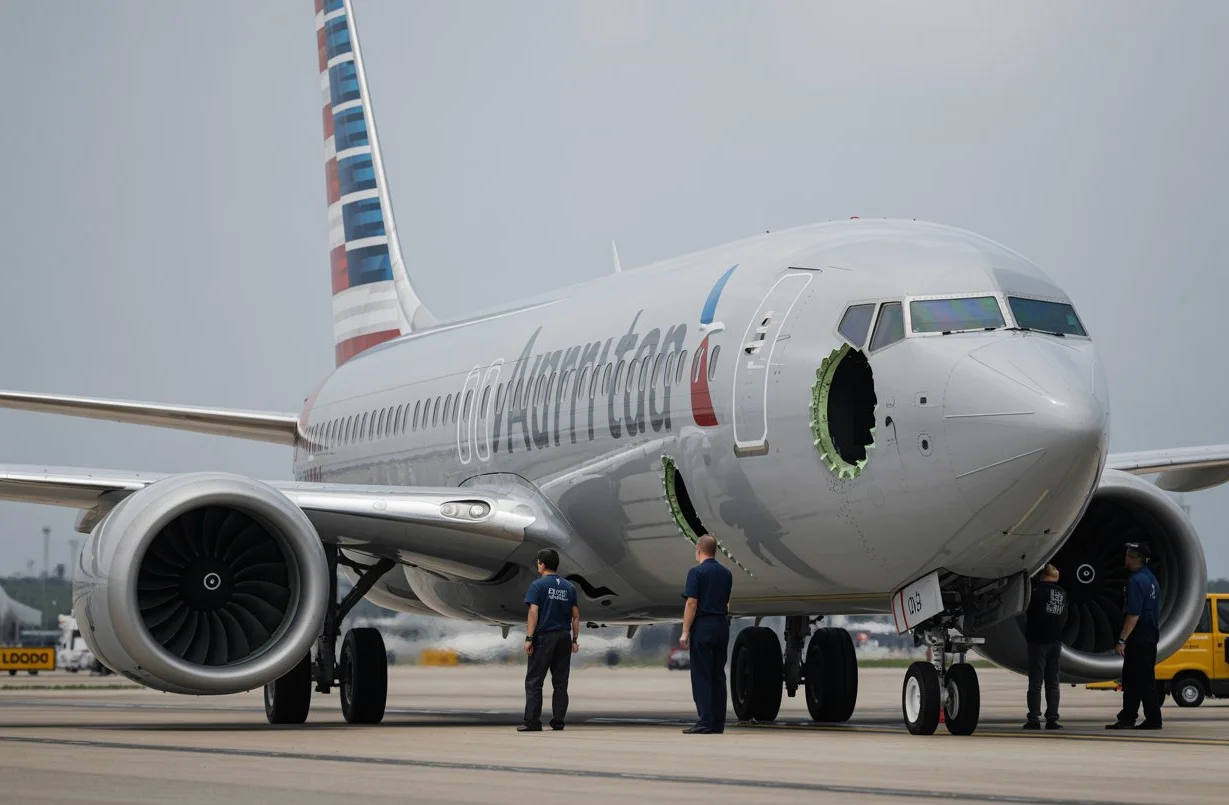
In a rare and startling development, an American Airlines Boeing 737 MAX 8 aircraft that arrived from Medellín, Colombia, was discovered with puncture marks resembling bullet holes after landing at Miami International Airport on Monday, February 23, 2026, following flight AA923/AA924, according to official sources and ongoing aviation safety reports.
Damage Discovered During Routine Inspection
The discovery was first noted by ground maintenance crews during a routine post-flight inspection of the aircraft’s right wing aileron, a crucial flight control surface responsible for roll and lateral balance. The aircraft had completed both legs of the flight without any reported issues from passengers or crew, but the findings have triggered an immediate investigation by Colombia’s Civil Aviation Authority, the Unidad Administrativa Especial de Aeronáutica Civil (Aerocivil), and other relevant authorities to determine exactly how and where the damage occurred.
Late on Monday morning at Miami International Airport, American Airlines personnel detected small puncture marks that extended through the aircraft’s right aileron after the Boeing 737 MAX 8 completed its flight from Medellín’s José María Córdova International Airport. Initial observations by independent aviation sources indicate that the pattern of the perforations is consistent with what would be expected from a ballistic impact—raising immediate concern among investigators.
Investigation Underway, No Confirmation Yet
However, no definitive confirmation of gunfire has yet been publicly released by Aerocivil or by American Airlines officials. The discovery was made only after passengers had disembarked, and no injuries or in-flight anomalies were reported during either the outbound or return legs of the trip, according to confirmed sources.
The Colombian Civil Aviation Authority (Aerocivil) acknowledged awareness of the discovery but stated that, as of now, it has not received a formal incident notification from American Airlines, the U.S. Federal Aviation Administration (FAA), or the U.S. Transportation Security Administration (TSA). Aerocivil said it is in communication with the airline and is prepared to provide or receive information as part of the broader investigation.
Aerocivil emphasized its commitment to transparency and safety oversight, noting that investigations remain ongoing. The agency is the government body tasked with regulating civil aviation and controlling Colombia’s airspace, including oversight of public airports such as José María Córdova in Rionegro, Antioquia.
Aircraft Removed From Service for Inspection
American Airlines removed the Boeing 737 MAX 8 from active service following the discovery of the puncture marks. After temporary structural patching in Miami, the aircraft was flown later that evening to American Airlines’ primary maintenance hub at Dallas-Fort Worth International Airport for a thorough inspection by certified engineers.
Such inspections will include a detailed evaluation of the wing assembly, control systems, hydraulics, and any structural components that may have been affected by the punctures. The airline and maintenance teams emphasize that safety remains paramount and that every procedural standard will be followed before the aircraft returns to scheduled passenger operations.
While definitive conclusions have not yet been released, early indications from multiple investigative reports suggest that officials are considering whether a criminal group or ground-level activity near Medellín may be linked to the incident. Colombian authorities have stressed that their inquiry will focus on a thorough timeline of the aircraft’s last points of departure and arrival, surveillance records, and radar tracking data that could indicate when the puncture occurred.
The FAA and U.S. aviation safety regulators are expected to coordinate with Aerocivil as part of a joint effort to determine the root cause of the damage and any implications for future flight safety. Despite the alarm caused by the discovery, the flight showed no operational issues while airborne, and pilots did not report any unusual conditions to air traffic control during either segment of the journey.
It remains unusual but not unprecedented for aircraft to sustain external damage that goes unnoticed until ground inspections are completed. Across global aviation safety records, incidents where small holes or dents are found post-flight are rare but significant when they occur, prompting rigorous analysis by regulators.
This incident highlights the importance of rigorous post-flight inspections and international cooperation among aviation safety authorities, particularly for flights connecting regions with complex security environments and high volumes of air traffic. Aircraft control surfaces like ailerons are critical to flight stability and control, making any anomaly a priority for immediate investigation and corrective action.
Officials emphasize that while the immediate risk to passengers was minimal in this case, the unexplained punctures could have posed latent risks if undetected, reaffirming the essential role of post-landing inspections and regulator oversight. Authorities in both Colombia and the United States have pledged to continue sharing findings as the investigation progresses.
Colombian officials have stated that further updates on the origin and nature of the punctures will be made available to the public once conclusive data has been reviewed and verified. At present, the investigation remains active, and American Airlines passengers who traveled on the affected flights have been assured that safety protocols were followed and that no one was harmed.






Comments
No comments yet
Be the first to share your thoughts