

 BBC
BBC 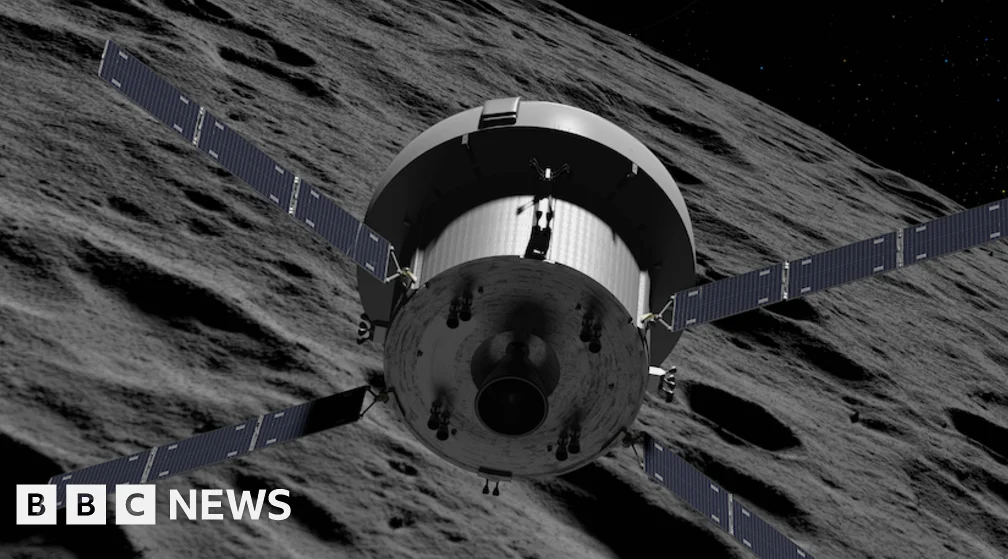
Four astronauts on Nasa’s Artemis II mission are returning home after a historic lunar flyby that saw them travel further from Earth than any other humans, according to the BBC. The crew lost contact with Earth for 40 minutes as they traveled behind the Moon, a planned maneuver to test the spacecraft’s systems.
Setting a New Distance Record
The Artemis II spacecraft, Orion, broke the record for human travel at about 13:56 EDT (18:56 BST) on Monday, beating a record of 248,655 miles (400,000km) held since 1970 by the Apollo 13 mission, according to the BBC. Canadian astronaut Jeremey Hansen acknowledged the achievement with humility, saying, ‘As we surpass the furthest distance humans have ever traveled from planet Earth, we do so in honoring the extraordinary efforts and feats of our predecessors in human space exploration.’
Lunar Flyby and Scientific Observations
As the spacecraft approached the Moon, the astronauts began working through a checklist of things to record on its surface, taking images with an array of digital cameras and making sketches and recording their own audio descriptions of what they saw, according to the BBC. The spacecraft was not planning to land on the Moon but to fly around its far side, the side which is never visible from Earth. Satellites have photographed the far side before, but the astronauts were the first human eyes to see some parts of the far side’s surface and its vast craters and lava plains.
During the six-hour flyby, the crew dimmed Orion’s internal lights to reduce reflections on the windows and improve their view, according to the BBC. NASA’s science team said the audio will matter as much as the imagery: as the astronauts ‘say what they see’ while looking out, trained human eyes can sometimes pick out subtle colors, contrasts, and textures that do not stand out in spacecraft images alone.
Personal Tributes and Emotional Moments
Fellow astronaut Jeremy Hansen made a request to NASA mission control to name two craters they observed on the Moon ‘both with our naked eye and with our long lens.’ One they asked to be called Integrity – the name the astronauts gave to the Orion capsule they are traveling in. The other request was to commemorate Wiseman’s late wife Carroll, who died in 2020 of cancer, according to the BBC.
‘A number of years ago we started this journey… and we lost a loved one and there’s a feature on a really neat place on the moon… at certain times of the Moon’s transit around Earth we will be able to see this from Earth,’ he said in a visibly emotional tribute, according to the BBC. The four astronauts were seen hugging on the live feed from their capsule after the request.
President Trump spoke with the Orion team and congratulated them: ‘Today, you’ve made history and made all America really proud, incredibly proud.’ He went on to ask the four astronauts what the most unforgettable part of their day had been. Commander Reid Wiseman told the President: ‘We saw sights that no human has ever seen, not even Apollo, and that was amazing for us.’
The night’s most nerve-jangling phase came as the Orion craft slipped behind the bulk of the Moon. Its radio and laser connections to Earth were cut off, leaving the four astronauts alone on the lunar far side for about 40 minutes. Just before this ‘loss of signal,’ Pilot Victor Glover had a message for the people of Earth: ‘As we prepare to go out of radio communication, we’re still going to feel your love from Earth. And to all of you down there on Earth and around Earth, we love you, from the Moon. We will see you on the other side.’
When the signal finally did flicker back into life there was a long silence before the voice of Christina Koch crackled back to mission control, evoking memories of the Apollo era. ‘We will explore. We will build ships. We will visit again. We will construct science outposts. We will drive rovers, we will do radio astronomy, we will found companies. We will boost industry, we will inspire. But ultimately, we will always choose Earth. We will always choose each other.’
For NASA, ‘Moon Day’ was not just theatre. It was about putting the Orion spacecraft through its paces and to see if it could cope for future missions. Artemis II is a test flight ahead of more ambitious goals, including landing humans on the Moon for the first time since 1972, and ultimately sending humans to Mars.
The crew now face several quieter days of checks and experiments before a final ordeal: a fiery plunge through the atmosphere at nearly 25,000mph and a parachute splashdown into the Pacific that will test the capsule’s heatshield and recovery systems.






Comments
No comments yet
Be the first to share your thoughts