

 The Guardian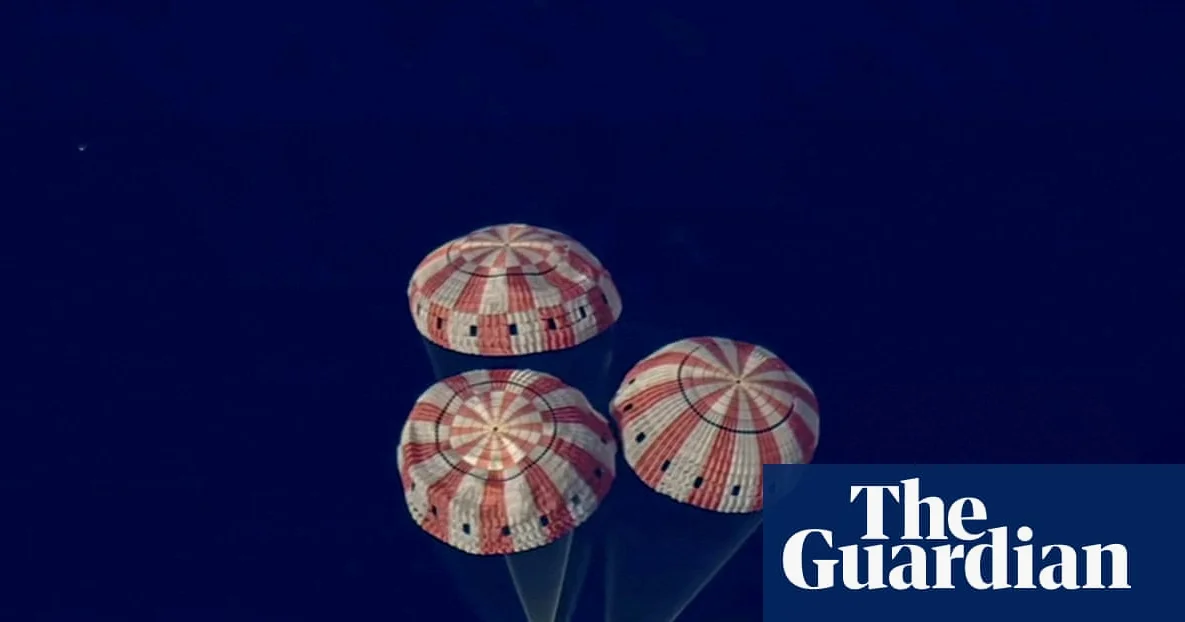
The Artemis II mission, which carried four astronauts aboard the Orion space capsule, concluded with a successful splashdown in the Pacific Ocean off the coast of San Diego on Friday night. All four astronauts were reported to be in good health after their journey around the moon and back.
A New Era of Lunar Exploration
According to NASA’s associate administrator Amit Kshatriya, the mission represents a new phase of lunar exploration. He said at a late-night press conference, “53 years ago, humanity left the moon. This time we return to stay. Let us finish what they started.”
The spacecraft touched down at 5:07 pm (1:07 am BST), completing a journey around the moon and back that officially lasted 9 days, 1 hour, and 32 minutes. The Orion spacecraft traveled 694,481 miles (1,117,659 km), according to NASA. Despite barely passing a ninth day, the mission is recorded as a 10-day journey because the launch day was treated as “flight day one.”
First Humans to the Moon in 53 Years
Commander Reid Wiseman, pilot Victor Glover, and mission specialist Christina Koch of NASA, along with Canadian Space Agency astronaut Jeremy Hansen, have become the first humans to travel to the moon and return to Earth safely since the Apollo 17 mission in December 1972.
They now join an exclusive group of only 24 other humans who have traveled to the moon and returned safely to Earth. As Orion descended below 17,000 miles from the planet’s surface, Wiseman described the Earth as it came into view, saying, “There’s a great blue hue to it. It’s beautiful.”
Sean Quinn, NASA’s exploration ground systems manager, said he received a call from Wiseman before the landing. He said, “It was so great to hear his voice and tell us that all the crew is OK, and we could say that we did our mission. We accomplished what we set out to do.”
A Return to the Moon Is Just the Beginning
After landing in the Pacific Ocean, a recovery crew from the USS John P Murtha stood ready to retrieve the Artemis crew. Crew members were assessed by navy personnel and transferred to the navy ship by helicopter.
NASA administrator Jared Isaacman, speaking from the deck of the USS John P Murtha, praised the crew, saying, “Our crew members that we’ve all had an opportunity to observe over the last 10 days, they’re absolutely professional astronauts, wonderful communicators, almost poets. These were the ambassadors from humanity to the stars that we sent out there right now.”
Isaacman emphasized that the mission is just the beginning. He said, “We are going to get back into doing this with frequency, sending missions to the moon until we land on it in 2028 and start building our base.”
Despite the challenges of the 695,000-mile voyage, the crew faced a few hurdles. Orion’s toilet malfunctioned more than once, necessitating the use of urine collection bags and inflight repairs from Koch, who took on the role of a plumber in the spacecraft.
The mission also included moments of levity, such as an Easter egg hunt on Easter Sunday, where the crew searched for packets of dehydrated scrambled eggs hidden around the spacecraft. A plushie named Rise, the mission’s official mascot, appeared regularly on camera during press conferences.
The most emotional moment came on Monday when the crew proposed to dedicate a previously unnamed moon crater to Carroll Taylor Wiseman, the wife of the Artemis II commander and mother of their daughters, who passed away from cancer in 2020. Hansen struggled to express his feelings, leading to tears and hugs among the crew.
During the mission, the astronauts evaluated Orion’s life support systems, radiation detectors, next-generation spacesuits, and tested operations serious to future deep-space missions. These evaluations are part of NASA’s longer-term plans for the Artemis program, including an ambitious $20 billion moon base to be built within a decade.
Nicky Fox, associate administrator of NASA’s science mission directorate, said the mission’s impact will be long-lasting. She said, “Our four Artemis II astronauts, Reid, Victor, Christina, and Jeremy, took humanity on an incredible journey around the moon and brought back images so exquisite and brimming with science, they will inspire generations to come.”






Comments
No comments yet
Be the first to share your thoughts