

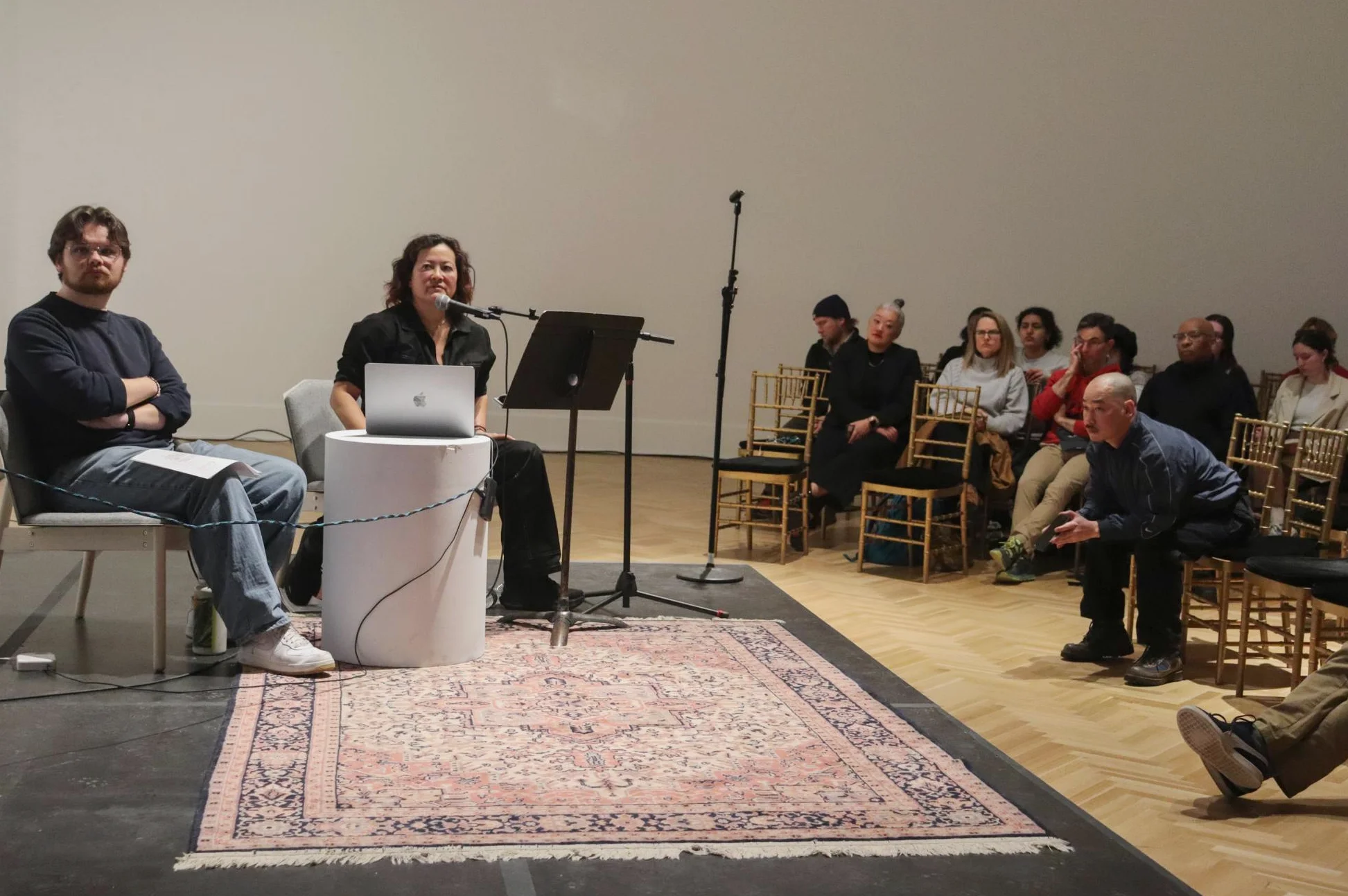
Visual artist Marina Berio presented her self-published work, “Ten Photography Lessons for a Dead President,” on Wednesday night at the Flagg Building, as part of a collaboration with the National Gallery of Art and For Freedoms, an artist residency program at George Washington University. The piece, delivered as a folded envelope containing a poster, a glossary, 15 photographs and a 13-page letter addressed to former President Franklin D. Roosevelt, directly confronts the U.S. government’s 1942 incarceration of over 120,000 Japanese Americans.
Art as a Reckoning with History
Berio, whose family was among those incarcerated during World War II, described the project as a deeply personal journey. She was inspired to examine her family’s history after a 2010 trip to the West Bank, where she witnessed the architecture of restriction and control. That experience prompted her to explore parallels between the systems of control she observed and the internment of Japanese Americans.
“This trip helped me connect viscerally and emotionally to the idea of being closed down, which allowed me to access my family’s history of incarceration during World War II,” Berio said during the presentation.
The work includes chalk renderings of stark scenes from the West Bank, such as the exposed wiring of a discarded mattress repurposed as a makeshift fence. These images, drawn from photographic negatives, serve as a visual metaphor for the mechanisms of control and confinement.
Berio began working on the project in 2022 and completed the piece in the months leading up to President Donald Trump’s 2024 re-election. She draws parallels between the Japanese American internment and modern-day American politics, highlighting the enduring relevance of the issue.
Letter to FDR and the Absence of Documentation
The centerpiece of Berio’s presentation is a letter addressed to FDR, rebuking his role in authorizing Executive Order 9066, which led to the forced removal of Japanese Americans to internment camps. The letter opens with a photograph of an incarceree from the Heart Mountain Relocation Center, depicting guard towers and barracks.
“You incarcerated my family — people who loved me, hugged and kissed me, cooked for me, made up silly bedtime stories for me, sang to me, played with me, and taught me how to knit — and for that, I can’t forgive you,” Berio said, reading excerpts from the letter.
As she read, Berio projected accompanying images on a large TV screen. The photographs, including memos, letters, a guard tower and scenes of life inside the internment camp, punctuated her words. One image of women smiling as they walked around the camp prompted her to question whether the photo was staged, forcing her to examine the background details, such as a man standing on the roof of a nearby barracks.
“The picture makes me feel queasy at the perpetuation of stereotypes of Asian Americans that it conveys when the history of resistance is unhinged, we are left with a pictorial record that overwhelmingly shows compliance and acceptance,” Berio said.
Berio also reflected on the absence of documentation inside the internment camps, noting how much history was lost because the United States treated personal records as contraband. The photographs she included highlight those who risked repercussions to capture daily life within the camps.
“I know you are unconcerned by their pain, a truthful visual record of their one-time experience does not exist, but their suffering settles into my thoughts anyway, as I sit and have my page as they touched evidence, at least, of the administration and bureaucracy of the war,” she said.
Families’ Stories and the Legacy of Internment
Following Berio’s presentation, author-advocate Shirley Ann Higuchi, the daughter of former incarcerees and president of the Bar Association of the District of Columbia, shared family photographs and stories of her parents’ experience at the Heart Mountain Relocation Center. She emphasized how their experiences shaped their behaviors, even though they rarely spoke about the camps.
“My parents didn’t really talk about it much,” Higuchi said. “My dad on the left was at University of Michigan for a long time, and he was pretty much a workaholic, constantly working. And I do believe that the workaholic and perfectionism is a byproduct of his incarceration experience.”
Higuchi also highlighted the Heart Mountain Wyoming Foundation, which aims to educate the public about the incarceration of Japanese Americans at the internment camp. The foundation also hosts the Mineta-Simpson Institute, named after former Sen. Alan Simpson and former U.S. Secretary of Transportation Norman Mineta, who were both affected by the internment.
“They made this an open area where people can come and discuss different views with the idea that we’re coming to the best decisions when the best minds come together,” Higuchi said.
Berio’s work and Higuchi’s insights underscore the importance of remembering and confronting the past. The event serves as a reminder of the ongoing need to address issues of government discrimination and the protection of civil liberties.






Comments
No comments yet
Be the first to share your thoughts