

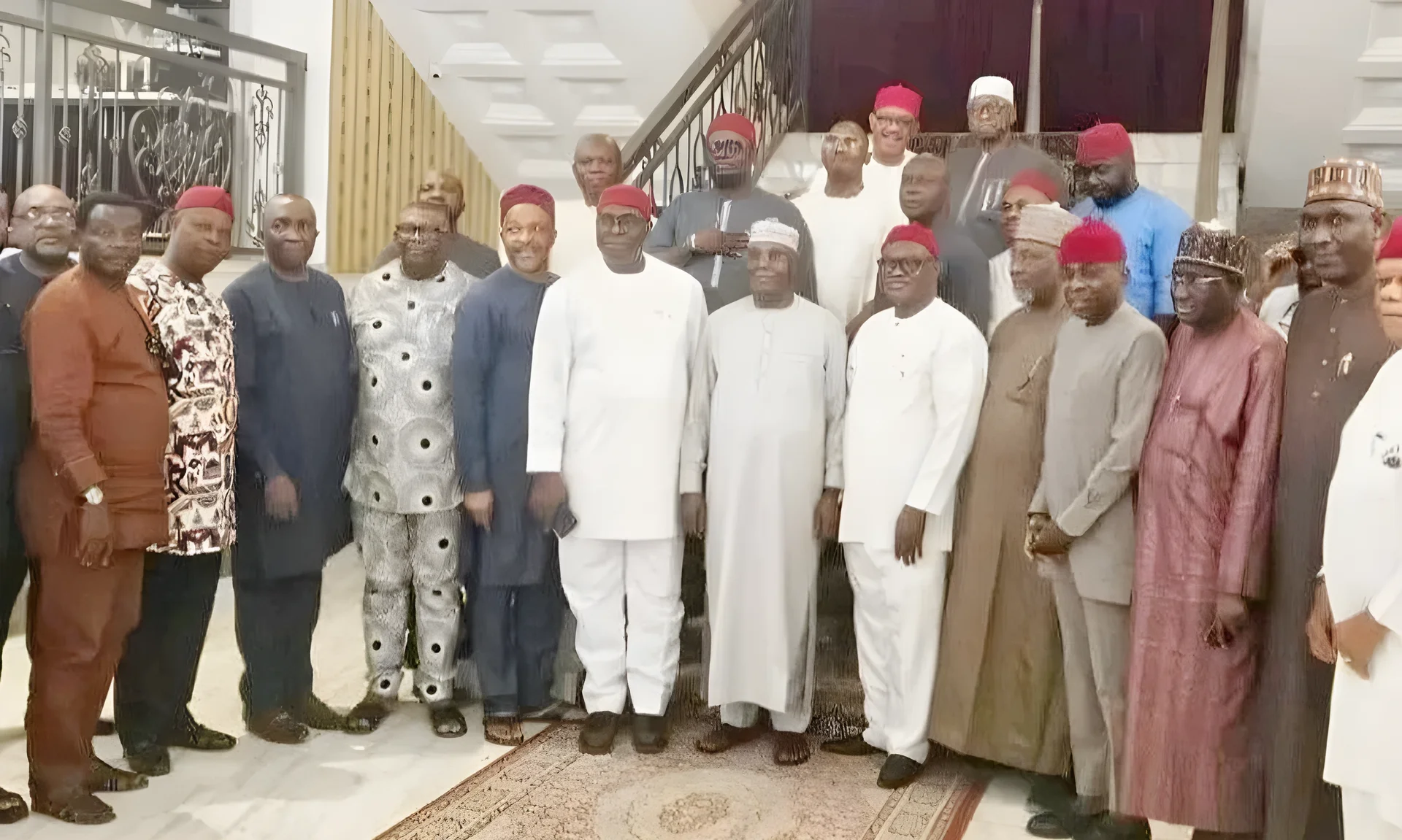
Former Vice President Atiku Abubakar has stepped up his outreach efforts within the African Democratic Congress (ADC), meeting with key leaders from the South-East region in Abuja ahead of the 2027 presidential primary. The high-level engagement, held behind closed doors at the residence of Chikwe Udensi in the Federal Capital Territory, was described by the ADC as ‘crucial’ to its strategic direction and alliance-building efforts.
Strategic Move in a Competitive Field
The meeting, which took place on Tuesday night, involved a strong delegation of ADC stakeholders and influential figures from the South-East. Among those present were Senator Augustine Akobundu, Chief Chekwas Okorie, former Minister of State for Education Emeka Nwajiuba, Dr. Osita Oruche, Prof. Onyi Nwagbara, Chief Uchenna Okogbuo, former ADC National Chairman Chief Ralph Nwosu, and several other prominent members of the party.
While the ADC did not disclose specific outcomes of the discussions, political analysts have interpreted the move as a strategic attempt by Atiku to consolidate support in the South-East. The region is considered politically significant, and its backing is likely to be crucial in any coalition-building effort ahead of the 2027 elections.
Analysts note that Atiku’s outreach is also part of a broader positioning within the opposition, as aspirants prepare for what is expected to be a highly competitive primary season. The ADC, like other major parties, is handling a tight race for its presidential nomination, with several potential candidates vying for the top spot.
Tightened Electoral Timeline Adds Pressure
The consultations come at a time of heightened urgency, as the Independent National Electoral Commission (INEC) has revised the electoral timetable, compressing the window for political parties to conduct their primaries.
Under the new schedule, the Presidential and National Assembly elections are set for January 16, 2027, while governorship and State Assembly polls are fixed for February 6, 2027. This revised timeline, approved by INEC following amendments to the Electoral Act 2026, has forced political parties to accelerate their preparations.
INEC has directed that party primaries, including the resolution of disputes, must be held between April 23 and May 30, 2026. Political parties are also required to submit their digital membership registers at least 21 days before holding any primary, congress, or convention. Failure to comply with these requirements could result in disqualification from fielding candidates.
Mohammed Haruna, INEC’s National Commissioner and Chairman of the Information and Voter Education Committee, stated that the revised timetable was approved after the amendments to the Electoral Act 2026. The changes aim to streamline the electoral process and ensure transparency, according to the commission.
Regional Influence and Electoral Strategy
The South-East region has historically been a key battleground in Nigerian politics, with a strong tradition of political activism and a diverse array of political actors. Analysts suggest that securing the region’s support is essential for any candidate aiming to win the ADC presidential nomination and, subsequently, the general election in 2027.
Atiku, who has long been a prominent figure in Nigerian politics, has built a broad network of alliances across the country. His recent focus on the South-East is seen as an effort to solidify his position within the ADC and ensure that he remains a viable candidate in the upcoming primary.
Political observers note that the ADC is facing a fragmented field, with several potential candidates vying for the party’s nomination. This has created a more competitive environment, forcing aspirants to engage in extensive outreach and coalition-building to secure support.
With the revised electoral timeline now in place, the pressure is mounting on political parties to finalize their internal processes and prepare for the upcoming primary season. The ADC, like other major parties, must handle this tight schedule while ensuring compliance with INEC’s requirements.
As the 2027 election year approaches, the dynamics within the ADC and other political parties will be closely watched by both domestic and international observers. The outcome of the primaries could have significant implications for the political landscape of Nigeria in the coming years.






Comments
No comments yet
Be the first to share your thoughts