

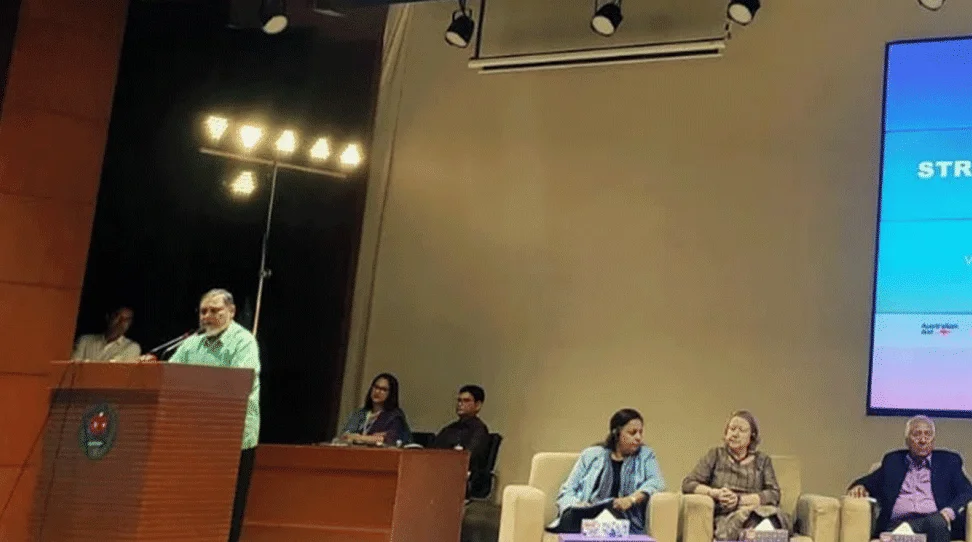
Bangladesh’s Chief Election Commissioner (CEC) AMM Nasir Uddin has stated that the country’s recent national election was held peacefully and credibly through the cooperation of all stakeholders. Speaking at a views-exchange meeting marking International Women’s Day at Nirbachan Bhaban in the capital’s Agargaon, Nasir Uddin emphasized the collective effort that led to the successful conduct of the election. He noted that he had not yet met a single person who claimed they were unable to cast their votes on Election Day.
Smooth Voting Process and Gender Equality
During his visits to polling centers, the CEC personally inquired of voters whether they encountered any difficulties while casting their ballots. Not a single person told him they faced any problems. Even elderly women voters confirmed that they experienced no issues while voting. ‘Everyone said they voted peacefully along with their families,’ he said.
The CEC also reiterated his objection to the use of the term ‘minority.’ ‘We are all Bangladeshis. What minority is there here? We are one nation. Religiously there may be divisions, but I personally believe everyone is equal and everyone has equal rights,’ he said. This statement comes at a time when the country’s political landscape is increasingly scrutinizing the role of different groups in national affairs.
Highlighting the crucial role of women in the country’s economy, the CEC noted that household work done by women is not counted in the calculation of GDP. ‘If the value of women’s household work were monetized, Bangladesh’s GDP would be three times higher than it is now,’ he said. This insight highlights the often-overlooked economic contributions of women in Bangladesh.
Performance of Female Election Officials
The CEC praised the performance of female officials in the recently concluded election. ‘After the election, I received many allegations of irregularities, but interestingly I have not yet received any complaint of bias or irregularity against any female presiding officer,’ he said. He added that there are plans to introduce special awards for female election officials in recognition of their good performance.
Highlighting the success in increasing female voter registration, the CEC said there was previously a gap of around three million between male and female voters. Due to the door-to-door voter list update campaign, that gap has now been reduced to one million. This progress in voter registration reflects a broader effort to ensure more inclusive participation in the electoral process.
The CEC also noted that when elections are conducted well, political objections usually arise after voting, which has become a culture in the country. ‘However, I have not yet heard any complaint that voters at the grassroots level were unable to cast their votes,’ he added. This observation suggests that while political disputes are common, the logistical challenges faced by voters were minimal.
Event Highlights and Key Participants
The event, held under the slogan ‘Ensure equality-men and women together to build the future,’ was chaired by Senior Secretary of the EC Secretariat Akhtar Ahmed. Election Commissioners Abdur Rahmanel Masud, Begum Tahmida Ahmed, and Md Anwarul Islam Sarkar also spoke at the programme. Additional Secretary of the EC Secretariat KM Ali Newaz, UNDP Resident Representative Stefan Liller, UN Women Country Representative Gitanjali Singh, and UNESCO Country Representative Susan Vize were also present, among others.
The CEC’s remarks on the role of women in the economy and the electoral process highlight the broader implications of gender equality in Bangladesh. His emphasis on the contributions of women, both in the household and in the political sphere, signals a growing recognition of their role in shaping the nation’s future. This sentiment is echoed by international representatives present at the event, who have long advocated for gender equality in political processes.
The CEC’s assertion that Bangladesh’s economy largely stands on the contributions of women, and therefore they must never be underestimated, highlights a critical point for policymakers and citizens alike. The success of the recent election, coupled with efforts to increase female voter registration, indicates a positive trajectory for gender inclusivity in the country’s political landscape.
Looking ahead, the CEC’s plans to introduce special awards for female election officials could serve as a catalyst for further recognition of women’s roles in the electoral process. This move aligns with global trends emphasizing the importance of women’s participation in democratic processes.
The event marked an important milestone in Bangladesh’s ongoing efforts to ensure equality and inclusivity in its democratic framework. With the gap between male and female voters reduced to one million, the CEC’s remarks and the event’s theme provide a clear direction for future initiatives aimed at strengthening the nation’s electoral processes and promoting gender equality.



Comments
No comments yet
Be the first to share your thoughts