

 BBC
BBC 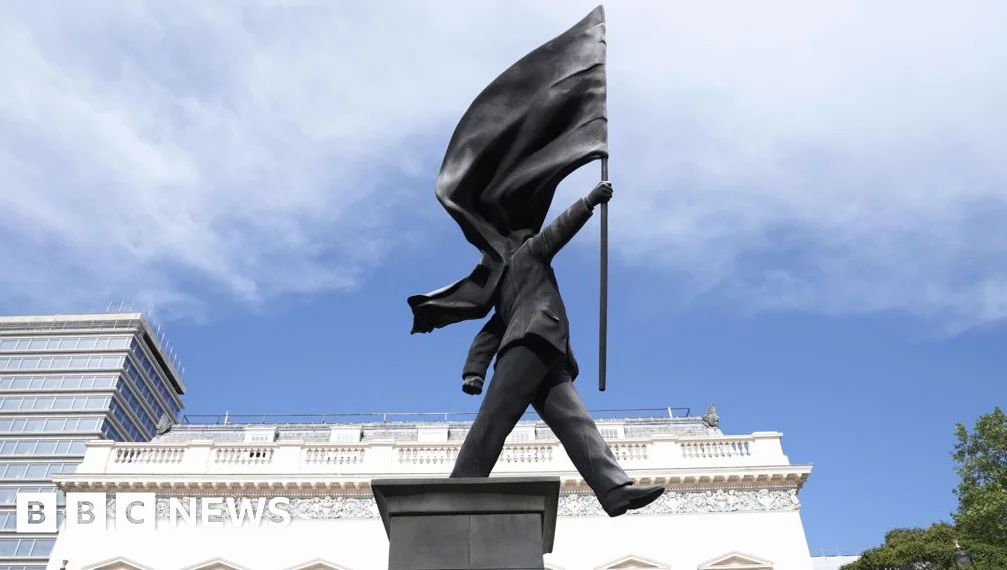
Banksy has placed a new resin statue in central London using a low-loader, traffic cones, and a team of highly experienced individuals, but James Peak, creator of the BBC podcast The Banksy Story, noted the swift installation despite high security in the area.
How the Installation Took Place
According to James Peak. The artwork itself was months in the making, but the actual installation was carried out swiftly; Yellow traffic cones marked off the area while a large vehicle deployed stabilizers. A person in an orange hi-viz vest was briefly seen before the statue was lifted onto the plinth using a hook.
Peak explained that Banksy’s team includes individuals who can set up a Metallica concert in 24 hours, describing them as “groovy folks” who are highly professional and organized. He added that they likely surveilled the area, planned their actions, and installed the statue during the quietest time possible.
Location and Public Reaction
The statue is located in Waterloo Place in St James’s, near Pall Mall and Carlton House Terrace in Westminster — it stands close to other statues, including those of Edward VII, Florence Nightingale, and the Crimean War Memorial. Many government buildings, foreign embassies, and private members’ clubs are located nearby.
Public reaction has been largely positive, with comments on social media describing it as “Classic Banksy” and “Always on point.” One person wrote, “Tell me it’s permanent.” The Western Daily Press noted that the statue’s appearance has made headlines not only in the UK but also around the world.
James Peak highlighted the statue’s clever design, capturing a precise moment in time that most traditional statues fail to achieve. He noted that the statue depicts a puffed-up leader about to fall off a precipice, with the flag obscuring his vision.
Official Responses and Future Steps
Westminster City Council confirmed it did not grant permission for the installation, as Banksy’s team did not provide prior warning. A spokesperson said the council is “excited to see Banksy’s latest sculpture in Westminster, making a striking addition to the city’s vibrant public art scene.”
The council has taken initial steps to protect the statue, ensuring it remains accessible for public viewing. In 2004, another Banksy sculpture, The Drinker, was removed from Shaftesbury Avenue before being returned a decade later. In this case, the local authority is considering its options, with the statue remaining in place for now.
On-site, contractors have begun erecting safety barriers around the work. Ollie Isaac, a 23-year-old student, praised the statue as a response to the resurgence of nationalism and described the suited figure as a politician about to fall from grace. Lynette Cloraleigh, a 55-year-old teacher, came to see the statue after learning about it on Instagram, calling it “intriguing” and well-placed.
James Peak further explained the significance of the statue’s location, noting that Waterloo Place reflects Britain’s imperialistic history. He added that Banksy’s work is always a campaign, with this piece commenting on extreme nationalism and the dangers of blind patriotism.
On Banksy’s Instagram post, one commenter wrote, “I love that he appears when enough time has passed to forget, and arrives with full force unnoticed.” Another added, “As a long-time Banksy collector, this one really hits. Big monument energy, but the idea is brutally simple: a suited figure blinded by its own flag. Classic Banksy. Quiet at first, then impossible to unsee.”
This is not the first time Banksy has made an unexpected appearance in central London. The artist, whose real identity remains unknown, is known for his provocative and often subversive public art that challenges political and social norms.





Comments
No comments yet
Be the first to share your thoughts