

 BBC
BBC 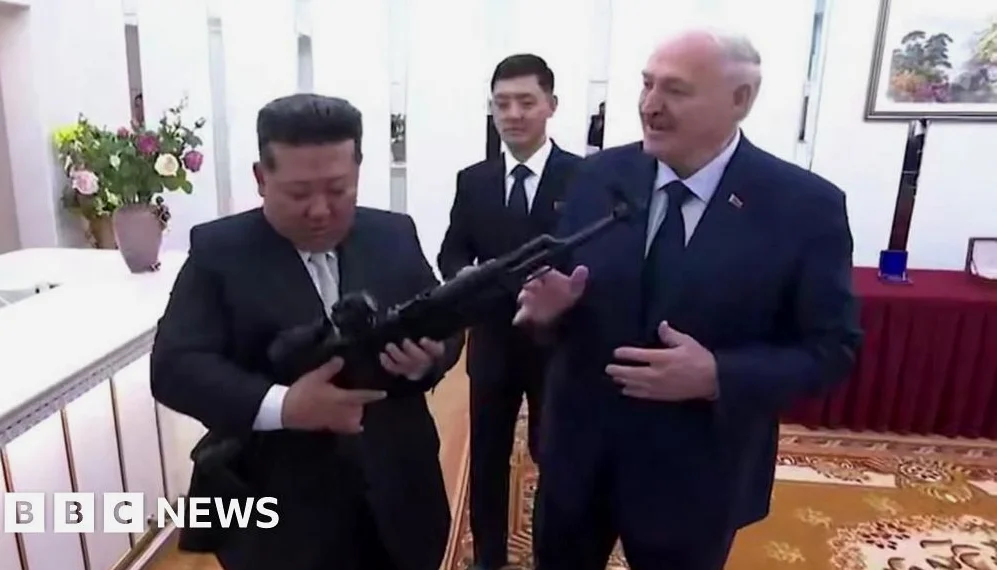
Belarusian President Alexander Lukashenko presented North Korean leader Kim Jong Un with a rifle as they signed a friendship treaty in Pyongyang, according to state media reports. The exchange took place amid growing ties between the two nations, both of which have been sanctioned by the West for their support of Russia’s invasion of Ukraine.
Symbolic Gesture of Solidarity
Lukashenko joked to Kim that he brought him an automatic rifle ‘just in case enemies appear,’ according to a video released by Belarusian state media; the two leaders, who are both staunch supporters of Russia’s war in Ukraine, agreed to deepen cooperation and resist Western pressure.
In return, Kim presented Lukashenko with a sword and a vase featuring a portrait of the Belarusian leader, and the exchange was described by state media as a symbolic gesture of mutual support and solidarity between the two countries.
Lukashenko told Kim. ‘I can tell you as a friend, as a person who has already seen everything in this world: a great future awaits your country with this hardworking, disciplined people,’ according to Belarus news agency Belta. He emphasized the need for countries to cooperate in ‘protecting their sovereignty and improving the well-being of our citizens,’ especially in a time when ‘the norms of international law are openly ignored and violated by powers that be.’
Broader Strategic Agreement
The friendship treaty signed by Lukashenko and Kim includes commitments to cooperate in various sectors such as agriculture, information, and public health, according to North Korean state media KCNA. The agreement marks a new phase in bilateral relations, with Kim stating it would ‘further guarantee the stable development of bilateral relations.’
Both nations have faced heavy Western sanctions over their alleged human rights violations and support for Russia’s military campaign in Ukraine; North Korea, in particular, faces additional sanctions for its nuclear weapons program. Belarus, meanwhile, has been accused by Ukraine of allowing Russian forces to use its territory as a base for attacks on Ukrainian targets.
Kim’s message to Russian President Vladimir Putin this week reaffirmed North Korea’s commitment to supporting Moscow, stating, ‘Pyongyang will always be with Moscow,’ according to KCNA. This sentiment aligns with the broader strategic alignment between the three countries, all of which have been sanctioned by the West for their actions.
Human Cost and Western Concerns
Western officials have expressed concern over the human toll of the war in Ukraine, with reports suggesting that an estimated 1,000 North Korean soldiers died in the first few months of the conflict, according to BBC reports from last year. The involvement of North Korean troops in Russia’s campaign has raised questions about the extent of their participation and the risks they face.
Ukraine has accused Russia of using Belarusian territory as a staging ground for attacks on its targets. This has led to increased tensions between Kyiv and Minsk, with Belarus positioning itself as a key ally of Russia despite its own economic and political challenges.
The friendship treaty between Belarus and North Korea is likely to further entrench their alignment with Russia, despite the economic and political costs of such a partnership. Analysts suggest that the agreement could lead to increased military cooperation and joint efforts to resist Western sanctions.
As the war in Ukraine continues, the growing ties between Belarus and North Korea reveal the complex geopolitical landscape in the region — Both countries, facing international isolation, are seeking to strengthen their positions through strategic alliances.
The symbolic gift of a rifle from Lukashenko to Kim highlights the personal and political dimensions of their relationship. While the gesture may be seen as a display of friendship, it also reflects the broader strategic interests of both nations in resisting Western influence and supporting Russia’s military campaign.
With the signing of the friendship treaty, Belarus and North Korea have taken a significant step toward deeper cooperation, which could have long-term implications for regional stability and international relations. The agreement is expected to be formalized in the coming weeks, with further details to be released by both governments.






Comments
No comments yet
Be the first to share your thoughts