

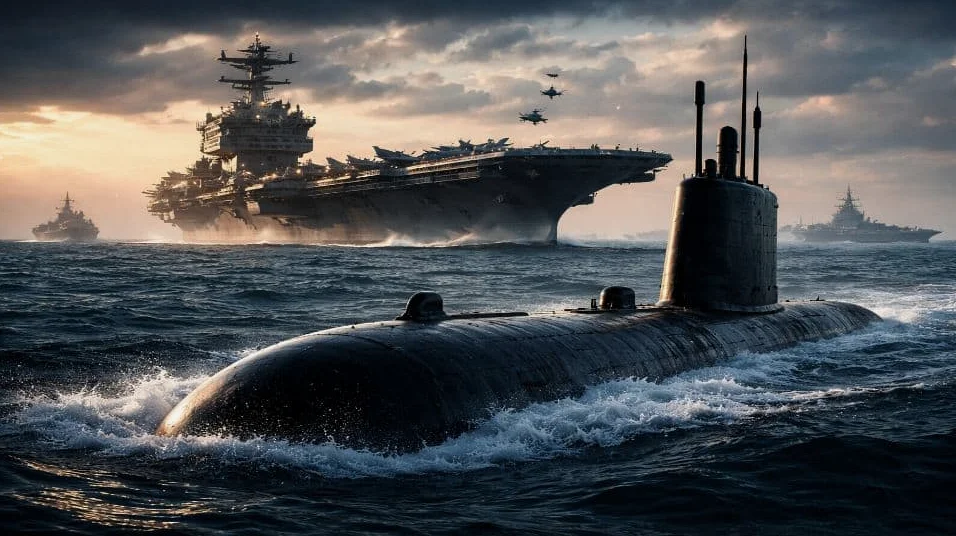
In a striking demonstration of naval warfare, a Canadian Oberon-class submarine managed to simulate the destruction of the US Navy’s USS Dwight D. Eisenhower during a NATO exercise in the North Atlantic. The exercise highlighted how a smaller, stealthy vessel could bypass a heavily defended carrier strike group, raising questions about the effectiveness of current naval defense strategies.
Defensive Layers and Stealth Tactics
The USS Dwight D. Eisenhower, a Nimitz-class aircraft carrier valued at around $5.5 billion, was the centerpiece of the exercise. Typically, such carriers travel with a fleet of destroyers, helicopters, and surveillance aircraft to form a layered defense system. However, the Canadian submarine, which cost about $80 million, demonstrated how a smaller, quieter vessel could evade detection.
According to defense analysts, the Canadian submarine used diesel-electric propulsion, which allows for near-silent operation. This is in contrast to nuclear-powered submarines, which produce more detectable mechanical noise. By switching to battery power, the Canadian vessel reduced its acoustic signature, blending into the natural sounds of the ocean.
Simulated Strike and Strategic Implications
During the exercise, the Canadian submarine tracked the carrier group from a distance, carefully adjusting speed and direction while remaining submerged. Once it reached a position where a torpedo could realistically hit the carrier, the scenario recorded the outcome as a successful attack. The exercise officials declared the American carrier destroyed within the simulation.
While this was not a real combat loss, the simulation underscored the importance of stealth in modern naval warfare. The event has drawn attention from naval planners around the world, emphasizing the need to address vulnerabilities in current defense systems.
Naval strategists study such exercises to identify weaknesses that could be exploited in real conflicts. The simulated sinking of the USS Dwight D. Eisenhower demonstrated how patience and stealth can challenge even the most powerful fleets operating at sea.
Implications for Future Naval Strategies
The exercise has sparked discussions about the balance of power in naval warfare. While size and cost are significant factors, the ability to remain undetected is often more critical. This event has prompted defense officials to reevaluate the effectiveness of current anti-submarine warfare tactics and technologies.
According to defense publications, the incident serves as a reminder that submarines remain one of the most persistent threats to large surface warships. Radar systems cannot detect submarines beneath the ocean’s surface, and a silent submarine can approach without revealing its presence. Even brief lapses in detection can provide an opportunity for an underwater predator to strike.
As naval powers continue to invest in advanced technology, the lessons from this exercise will likely influence future strategies and defense budgets. The focus will shift toward improving sonar systems, enhancing underwater surveillance, and developing new tactics to counter stealthy submarines.
The event also highlights the importance of maintaining a strong and adaptive defense network. While the US carrier group was well-protected, the Canadian submarine’s ability to slip through the defensive perimeter has raised concerns about the need for continuous innovation in naval warfare.






Comments
No comments yet
Be the first to share your thoughts