

 The Guardian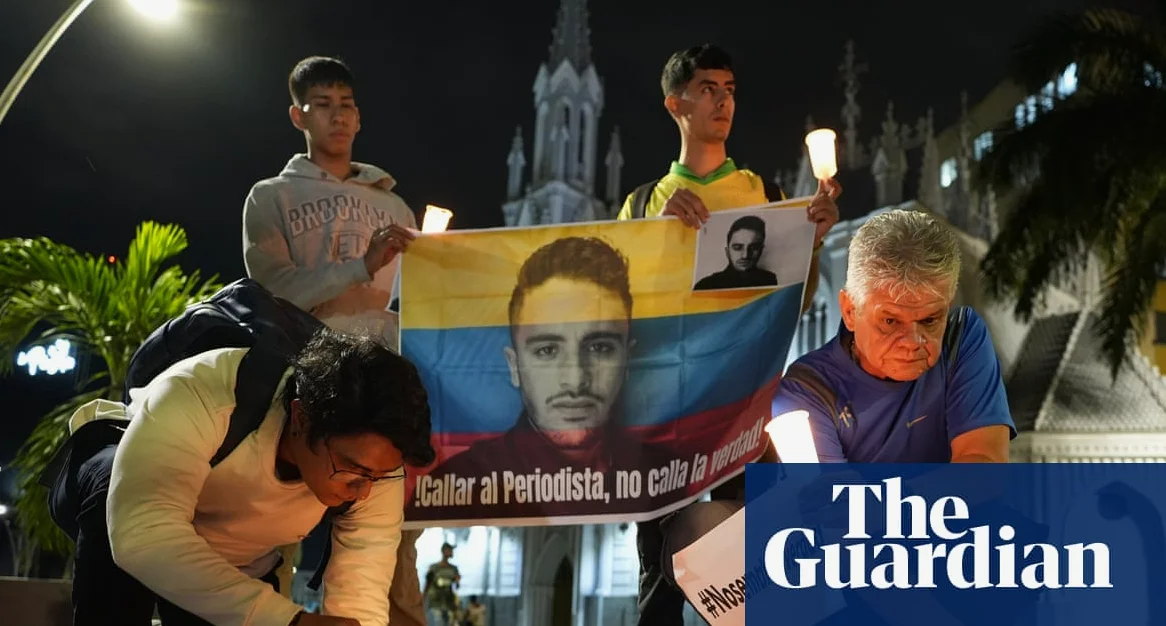
Mateo Pérez Rueda was one internship away from completing a degree in political science. The 24-year-old also worked as a bicycle delivery rider and sold fruit salads and juice to finance his passion: the Colombian independent digital magazine El Confidente.
On 4 May he travelled to Briceño, in the western province of Antioquia, to report on the long-running conflict between the army, paramilitaries and dissidents of the Major Armed Forces of Colombia (Farc).
The next day, he stopped responding to his parents. Three long days of agony followed. With relatives and friends pressing the authorities for information, until a humanitarian mission confirmed what many had feared: Rueda had been kidnapped, tortured and killed by one of the Farc dissident groups, known as the 36th Front.
His case became yet another symbol of the surging political violence that has reached its highest levels in a decade – and that has made the decades-long internal armed conflict central to this Sunday’s presidential election.
Contested Election Proposals
The vote will be a contest between left and right – and two entirely contradictory proposals for dealing with the war that claimed nearly half a million lives.
Colombia’s president. Gustavo Petro. Who under the constitution cannot seek re-election, has backed the leftwing senator Iván Cepeda, 63, who is leading in the polls and is regarded as the architect of the government’s “total peace” effort to sign disarmament deals with all criminal groups. Many security experts consider the plan to have failed, noting that armed factions have taken advantage of temporary ceasefires to continue expanding, but Cepeda remains committed to the plan.
The two main challengers, the far-right lawyer and “outsider” Abelardo de la Espriella, 47, and the rightwing senator Paloma Valencia, 48, promise a return to all-out war as soon as they take office.
During the election period. There has been a surge in guerrilla attacks, homicides, kidnappings, forced displacement and massacres; and last year, the rightwing senator and presidential hopeful Miguel Uribe Turbay was shot during a campaign event and later died. The violence is widely seen as a reminder that although the landmark 2016 peace deal between the government and most of Farc dramatically reduced violence for years, it did not end it for good.
Roots of the Violence
Subsequent administrations slow-walked the implementation of the settlement, while some Farc factions and other rebel groups refused to sign any agreement, instead growing in strength and size.
“Here in Antioquia. The war never ended,” said Jorge Rueda, Mateo’s cousin and godfather, who lived a few blocks away from the journalist in Yarumal, only 33 miles (53km) from where he was killed. Although the various rebel factions claim a political agenda, most of the violence is driven by competition over drug production, retail and smuggling (Colombia remains the world’s biggest producer of cocaine), illegal goldmining, logging and local corruption. “Here, the war is over micro-trafficking and another over the goldmines,” added Rueda.
On Monday, more than 50 people were killed in clashes between two Farc dissident groups on the opposite side of the country, in the southern department of Guaviare. Many of them were children and teenagers forcibly recruited by the crime factions.
Election Uncertainties
Alejandro Chala, a researcher at the Fundación Paz y Reconciliación, argued that although the figures were high, the current moment was not comparable to the period before the peace agreement, when the homicide rate peaked at about 80 per 100,000 inhabitants; it now stands at about 26 per 100,000.
“The violence now is much more territorially concentrated, largely entrenched in the main areas where illegal economic routes operate … It clearly generates a lot of media noise, but it does not have the national reach it had in the past,” he said.
Even so, Espriella has argued that it is necessary to “save Colombia” from crime, while Valencia says that instead of “total peace”, the country needs “total security”.
Until recently Cepeda remained firmly at the top of the polls, with Valencia in second place; but in the past two weeks she has been overtaken by Espriella. With a large share of voters still undecided, the outcome is uncertain: if no candidate wins more than half of the vote, a runoff will be held on 21 June.






Comments
No comments yet
Be the first to share your thoughts