

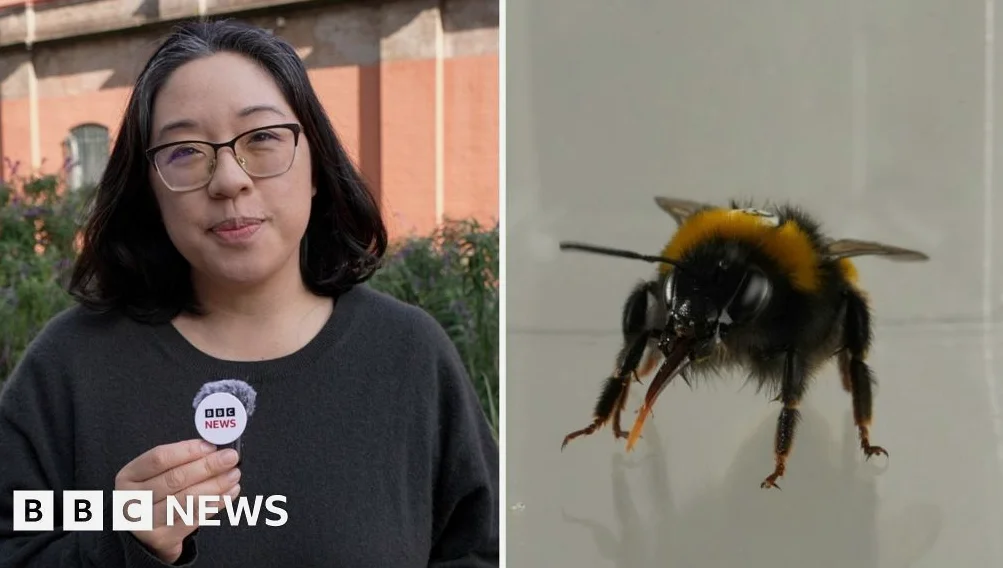
A recent study on bumblebees has uncovered behaviors suggesting the insects may experience emotion-like states, challenging the traditional view of insects as simple automatons. Researchers from Southern Medical University in Guangzhou, China, led by Fei Peng and Cwyn Solvi, observed that bumblebees display distinct facial expressions after consuming sweet, salty, or bitter liquids, according to EurekAlert! and Jambalaya News Louisiana.
Bees show liking and disliking behaviors
Professor Peng stated that many people accept the idea that insects can sense, learn, and make decisions, but fewer consider that they might evaluate things as pleasant or unpleasant. The study found that bumblebees (Bombus terrestris) displayed different orofacial behaviors after tasting sweet, salty, or bitter liquids; Sweet solutions prompted glossa protrusions,similar to “licking their lips”,while salty and bitter solutions led to head shaking and mouth wiping, according to EurekAlert!.
These findings suggest the insects may experience something akin to “liking” and “disliking,” rather than merely reacting to food based on instinct — “We don’t yet understand what the bees truly experience, but we can observe emotion-like behaviors,” said Dr. Andrew Barron, a neuroethologist from Macquarie University in Sydney, according to Jambalaya News Louisiana.
Implications extend beyond bees
Until now. Such emotion-like behaviors had only been observed in mammals, as the study, published in the journal Proceedings of the National Academy of Sciences (PNAS), marks the first time these behaviors have been documented in insects. “This is another step toward showing there’s an inner life to being a bee,” Barron said; the researchers emphasized that while the exact nature of the bees’ experience remains unknown, the observable behaviors offer a measurable window into their internal states.
Professor Barron noted that the implications of the study go beyond bumblebees, suggesting that similar behaviors might be found in other insect species, “We’ve now got a practical read on their inner life that we can work with experimentally,” he said, according to EurekAlert!.
Changing the scientific view of insects
The study challenges the long-held assumption that insects lack the neurological complexity to experience anything resembling emotion, though “There’s always been a tension between thinking of insects as animals or some sort of mini robots,” Barron said. The findings suggest that insects may have more subjective experiences than previously thought, though further research is needed to confirm these conclusions.
Both sources highlight the potential significance of the study for neuroscience and animal behavior research. If insects can experience something akin to positive and negative affect, it could influence how scientists interpret insect behavior and potentially inform future research on the evolution of emotion in animals.






Comments
No comments yet
Be the first to share your thoughts