

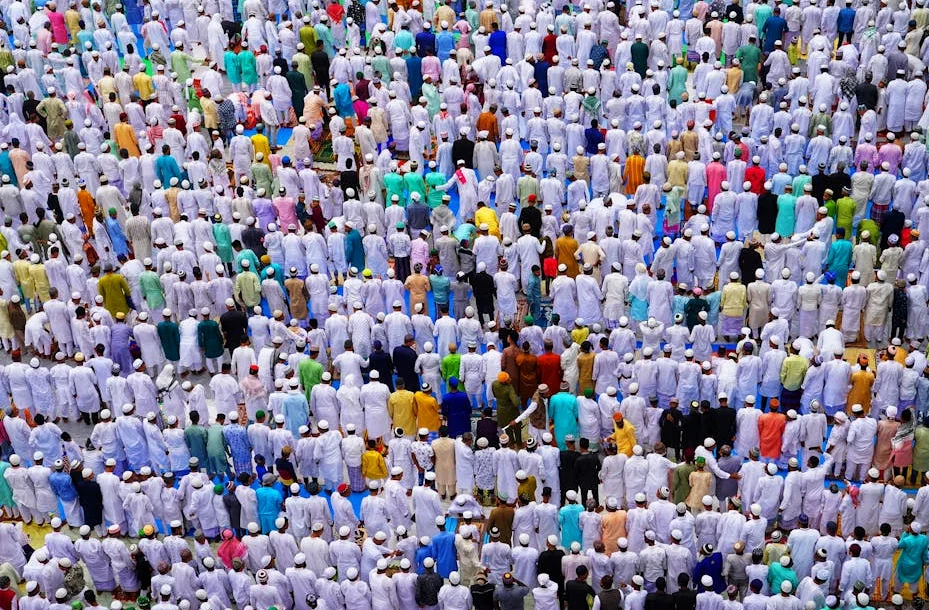
Holy Eid-ul-Fitr, the most important religious festival for Muslims, was celebrated on March 21 across Bangladesh with due religious fervor and gaiety, and the festival marked the end of Ramadan, a month of fasting and spiritual reflection.
Religious Observances at National Eidgah
The main Eid-ul-Fitr prayer. Or jamaat. Was held at the National Eidgah on the premises of the High Court in Dhaka around 8:30 am. President Mohammed Shahabuddin and Prime Minister Tarique Rahman joined the prayer at the National Eidgah Maidan, where thousands of devotees gathered to observe the sacred ritual.
Khatib of Baitul Mukarram National Mosque, Mufti Muhammad Abdul Malek, led the prayers and administered munajat (supplication), seeking peace and welfare for the country and the entire Muslim world. Chief Justice. Cabinet members. Supreme Court judges. Senior political leaders, and high civil and military officials also participated in the prayers.
After the prayers. The President exchanged Eid greetings with Prime Minister Tarique Rahman and other dignitaries; the event was attended by approximately 35,000 people, with separate arrangements made for women. Despite cloudy skies and drizzle, devotees from across the capital arrived early in the morning to participate in the prayers.
Law enforcement agencies, including the police, RAB, and the Special Security Force, were deployed to maintain law and order at the National Eidgah. New water taps were installed for ablution, and two entrances were designated—one for VVIPs through the Supreme Court premises and another for women.
Eid Congregations Across the Country
A total of five Eid jamaats were held at the Baitul Mukarram National Mosque on March 21. The prayers were conducted at 7 am, 8 am, 9 am, 10 am, and 10 am. Senior imams, including Maulana Mizanur Rahman and Mufti Muhibbullahil Baqi Nadvi, led the respective congregations.
An Eid-ul-Fitr congregation was also held at the South Plaza of the National Parliament building at 8 am. Speaker Hafiz Uddin Ahmad, officials from the Parliament Secretariat, and Muslims from various walks of life participated. For the first time this year, separate arrangements were made for women, with Secretary of the National Parliament Secretariat Kaniz Maula taking part.
A separate Eid jamaat was held at the Dhaka International Trade Fair (DITF) adjacent to the Bangladesh-China Friendship Conference Center in Agargaon, under the management of the Dhaka North City Corporation (DNCC). The congregation was led by Maulana Qari Golam Mustafa, with Mufti Maulana Atiqur Rahman as the alternate imam. DNCC Administrator Md. Safiqul Islam Khan offered prayers and later exchanged Eid greetings with the devotees.
Devotees from all walks of life, including DNCC officials and employees, participated in the prayers. After the jamaat, the Imam delivered a sermon and offered prayers seeking Allah’s blessings for forgiveness, the welfare of the country, and the global Muslim community.
Eid Celebrations at Bangabhaban and Other Venues
President Mohammed Shahabuddin exchanged Eid greetings with a cross-section of people at Bangabhaban. Around 10,000 distinguished personalities and guests were invited to the residence on the occasion. The President’s wife, Dr. Rebeka Sultana, and other family members attended alongside high-ranking officials, including the Chief Justice, cabinet members, and foreign diplomats.
The guests were entertained with traditional food items. Prime Minister Tarique Rahman also exchanged greetings with people from all walks of life, including foreign diplomats and educationists, at the State Guest House Jamuna. He first greeted foreign diplomats before meeting cabinet members, members of parliament, and other notable figures.
Earlier in the day, Tarique Rahman offered prayers at the National Eidgah and then visited Sher-e-Bangla Nagar to pay respects at the graves of his late father, Shaheed President Ziaur Rahman, and his late mother, former Prime Minister Khaleda Zia. He and his family recited the fateha and offered prayers for the eternal peace of the departed souls.
As the Chairman of the Bangladesh National Party (BNP), Tarique Rahman placed a floral wreath at the graves on behalf of the party. Meanwhile, the Leader of the Opposition in the Jatiya Sangsad and Bangladesh Jamaat-e-Islami Ameer, Dr. Shafiqur Rahman, offered the Eid prayers at the Monipur Girls’ High School ground in Mirpur.
Later, Dr. Shafiqur Rahman exchanged Eid greetings with diplomats stationed in Dhaka at his official residence and with political leaders and people from various professions. The event highlighted the importance of community engagement and interfaith dialogue during the festival.
Millions of Bangladeshis left the capital earlier to reunite with family and relatives in their village homes for the Eid celebrations. In the port city of Chattogram, the festival was marked with religious fervor and joy. A total of 321 Eid congregations, including three major ones at M A Aziz Stadium and Jamiatul Falah Mosque, were held under the auspices of the Chattogram Central Eid Jamaat Committee (CCEJC) and Chattogram City Corporation (CCC).
In Kishoreganj, hundreds of thousands of people gathered at the country’s largest and most historic Sholakia Eidgah to offer their prayers. The event, which saw the participation of more than six lakh devotees, was completed peacefully with strict security arrangements in place throughout the day.
The 199th congregation, held at 10 am, was led by Mufti Abul Khair Mohammad Saifullah, Khatib of Boro Bazar Jame Mosque. The event was marked by religious solemnity and a sense of unity among the participants.






Comments
No comments yet
Be the first to share your thoughts