

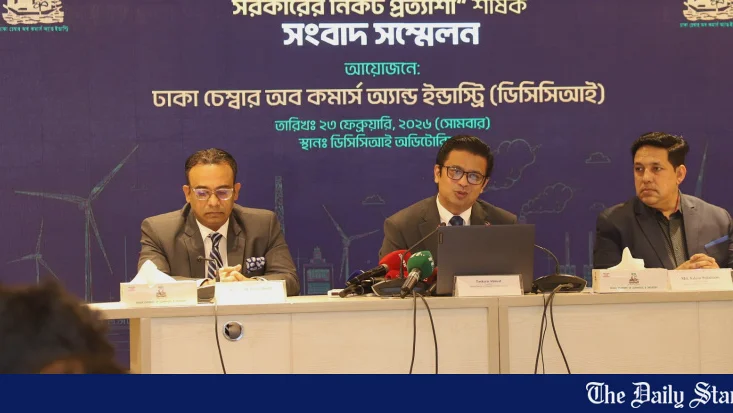
Dhaka, Bangladesh — Extortion has surged by up to 50% since the fall of the Awami League government in the 2024 mass uprising, and corruption has remained entrenched throughout the 18-month interim administration, according to the Dhaka Chamber of Commerce and Industry (DCCI). The chamber’s president, Taskeen Ahmed, warned that if these practices are not curbed, businesses may be forced to shut down and leave the country.
Escalating Extortion and Corruption
At a press conference titled “Expectations from the New Government to Address the Current Economic Situation,” Ahmed stated that businesses are being forced to pay the same level of extortion as before the fall of the Awami League government, with some facing demands up to 50% higher. He said, “If extortion is not stopped, we will have to shut down our businesses.”
He pointed to individuals linked to the ruling party, the police, and revenue authorities as the primary sources of extortion. “They come and say they are from the government party. Whoever is in office, they say they are from that party, and we have to pay,” Ahmed said. “They demand money for events, for neighbourhood events.”
According to Ahmed, the issue of extortion and corruption is “embedded in our blood,” and he urged the new government to send a strong message against such practices. He said that the country’s economic revival depends on energizing the private sector and addressing these challenges.
Economic Challenges and Structural Weaknesses
Private sector credit growth fell to 6.49% in fiscal year 2024-25, the lowest in 22 years, according to Ahmed. Private investment declined to 22.48% of gross domestic product, while credit growth slipped further to 6.10% in December 2025. Export growth slowed to roughly 0.5% during the same month.
These challenges, Ahmed said, are caused by structural weaknesses, including stress in the banking sector, rising import costs, energy shortages, and an unstable law and order situation. He noted that holding the policy rate at 10% has failed to tame inflation and instead driven lending rates above 16%, making bank borrowing costly and unviable for businesses.
He urged authorities to cut the policy rate or provide subsidized credit lines for productive sectors. Non-performing loans (NPLs) have climbed to nearly Tk 6.5 lakh crore, with many classified loans reflecting external shocks rather than wilful default. Ahmed said that around 41% currency depreciation over two years and high interest rates have contributed to this situation.
Energy and Tax Policy Concerns
The DCCI president highlighted the country’s daily gas shortfall of around 30%, disrupting industrial production. Gas prices for new industries are set at Tk 40 per unit and Tk 42 for captive power plants, adding pressure on manufacturers. Despite an installed generation capacity of 27,000 megawatts, actual output is much lower, leading to high-capacity payments.
Ahmed called for a modern and integrated energy policy, noting that the last thorough update was in 1996. He recommended differential pricing to encourage off-peak electricity use and urged the government to implement a clear distinction between large wilful defaulters and firms affected by external shocks.
On tax policy, Ahmed welcomed the BNP government’s plan to raise the tax-to-GDP ratio to 8% but emphasized the need for full automation of the National Board of Revenue (NBR). He said that the current manual system leads to inefficiency and corruption. He also recommended reducing the turnover tax from 1% to 0.6% as businesses recover from prolonged economic shocks.
Ahmed criticized a 41% average tariff increase by the Chittagong Port Authority despite its surplus in fiscal year 2024. With roughly 88% of trade passing through Chattogram Port, he said the hike would raise costs and called for an immediate review. He also pressed for full implementation of the Bangladesh Single Window system to simplify trade procedures and cut time and costs.
The chamber’s president welcomed the decision to defer Bangladesh’s graduation from least developed country status by three years to allow better preparation. He also advised careful evaluation of a recent US trade agreement, stating that if necessary, the agreement should be renegotiated to ensure a win-win outcome.





Comments
No comments yet
Be the first to share your thoughts