

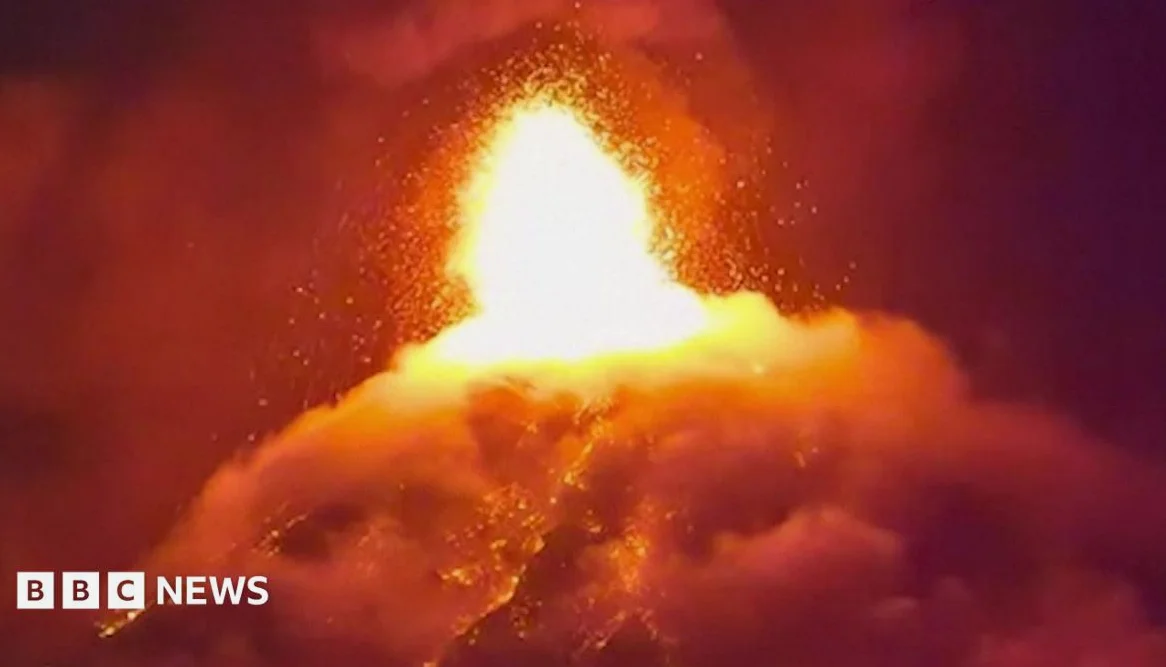
The Fuego volcano in Guatemala has erupted, sending lava and ash into the air and prompting the evacuation of at least two villages on its slopes, according to the BBC and other sources. The active stratovolcano, one of the most active in the Western Hemisphere, began spewing lava and ash on Monday. Pyroclastic currents, rivers of gas, volcanic ash, and rock fragments, continued to flow down Fuego’s south-eastern slope early Tuesday, the government agency monitoring the volcano reported.
Eruption Triggers Orange Alert and School Closures
Guatemala’s disaster management agency, Conred, issued a nationwide orange alert, the second highest level, and warned locals to be prepared for further eruptions that could create additional pyroclastic flows and ash clouds. Conred urged residents to keep windows and doors closed to prevent ash from entering homes. Schools near the volcano have canceled lessons, and authorities warned both tourists and residents to avoid approaching or staying in areas at risk, especially on the volcano’s slopes.
Fuego is located just 16 kilometers (10 miles) west of Antigua, a city known for its UNESCO World Heritage Site and colonial-era architecture — the area is also popular with hikers due to the volcano’s accessibility and activity. Conred emphasized the need for caution, noting the dangers of pyroclastic flows, which are known to move rapidly and with great force.
2018 Eruption Killed More Than 200
The current eruption follows a devastating event in 2018 when more than 200 people were killed, many of them caught in the fast-moving pyroclastic flows that raced down the Las Lajas ravine. That eruption highlighted the deadly potential of Fuego, which has been a consistent source of activity and concern for local authorities and residents.
While no fatalities have been reported from the latest eruption yet, the potential for further destruction remains high; the 2018 tragedy serves as a stark reminder of the volcano’s power and the importance of heeding evacuation orders and safety precautions.
Volcanic Activity in Other Regions
Volcanic activity has also been observed in other parts of the world; In Italy, Mount Etna on Sicily has become active, spewing ash and lava with plumes rising hundreds of meters into the air. According to the Italian National Institute of Geophysics and Vulcanology (INGV), the volcano, which initially showed signs of activity in late July, intensified its eruptions, sending lava chunks as high as 150 meters (500 feet) in the air. Despite the activity, no evacuations have been reported, and the volcano remains a popular site for hikers and farmers who rely on its fertile slopes.
Meanwhile, on the Spanish island of La Palma in the Canary Islands, the Cumbre Vieja volcano has been active for five weeks, spewing smoke, ash, and lava into the air. The volcano, now ejecting significantly more material than at the start of the eruption, has created a record level of activity; Seismic activity, including a 4.8 magnitude earthquake at a depth of 33 kilometers, continues to be recorded. Although the eruption has not resulted in any fatalities, it has destroyed 2,162 buildings, 908 hectares of land, and 66 kilometers of roads — Authorities had warned residents ahead of the eruption based on early earthquake activity, allowing for timely evacuations.






Comments
No comments yet
Be the first to share your thoughts