

What Will Happen During the Impact
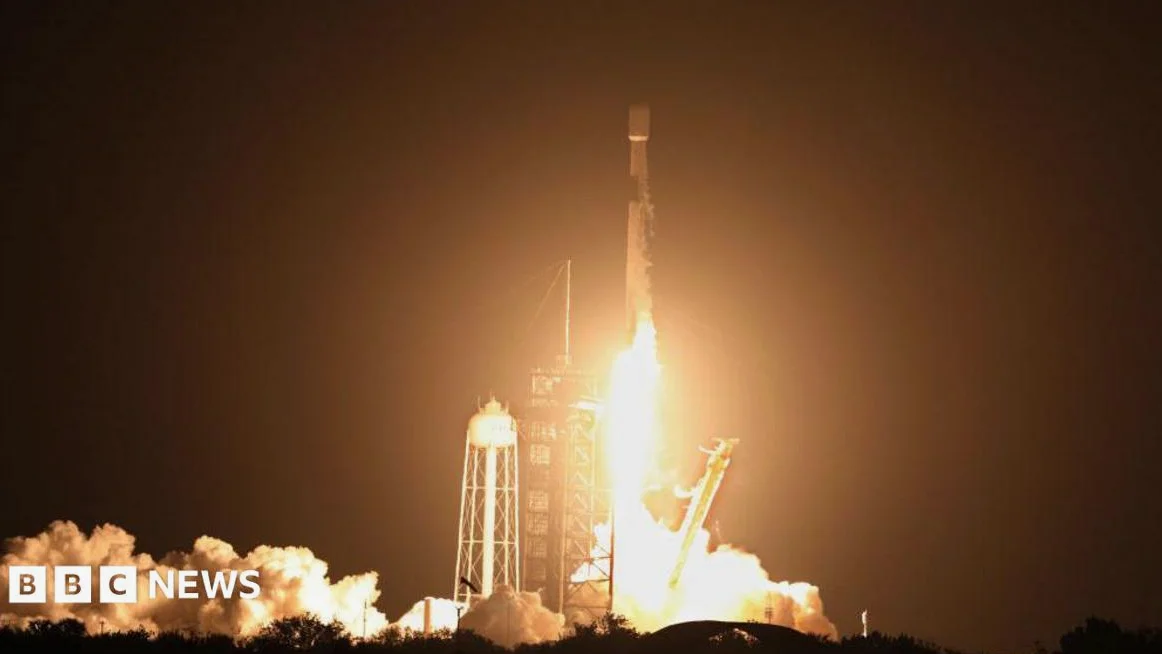
The upper stage of the Falcon 9 rocket, launched in January 2025, has been drifting in a high-Earth orbit for over 18 months, though On 5 August at approximately 6:35 UTC, it will strike the Moon near the Einstein Crater, close to the sunlit edge visible from Earth. The object, about the size of a five-storey building and weighing at least 4,000 kg (8,800 lbs), will hit at a speed of 5,400 mph, releasing energy comparable to several tons of TNT. It could form a crater up to 27 meters (89 feet) wide and loft material up to 100 km into space.
According to a recent study led by Benjamin Fernando of Los Alamos National Laboratory, the rocket stage was abandoned in a moon-crossing high-Earth orbit after its fuel was used up during the mission to deliver two private robotic lunar landers — Firefly Aerospace’s Blue Ghost and ispace’s Resilience, to the Moon. Blue Ghost successfully completed its mission, while Resilience crashed during its landing attempt.
Scientific Observations and Tracking
Scientists will use the event to observe the impact and its aftermath — NASA’s Lunar Reconnaissance Orbiter (LRO) and South Korea’s Danuri lunar orbiter will attempt to image the site both before and after the impact. According to William Cooke, a manager at NASA, the impact will likely be very difficult to see from Earth and may even be impossible to observe visually.
NASA’s CNEOS, as well as independent astronomers, have been tracking the rocket stage using public data; Jimi Russell, a NASA spokesperson, confirmed the event is being monitored for training and scientific purposes. The impact is also being observed by a global network of researchers, with a recent paper published on the arXiv preprint server calling for a collaborative observation campaign.
Space Debris and Future Implications
This event highlights the growing issue of space debris and its potential impact on future lunar and space infrastructure. The Falcon 9 upper stage is not an active rocket or spacecraft carrying people, it is a spent second stage that has remained in a wide orbit around the Earth-moon system since January 2025. SpaceX performed a maneuver to ensure the second stage was safe per regulations, but ultimately, it was not deorbited and instead left to drift.
According to Julianna Scheiman, director of NASA science and Dragon programs at SpaceX, the company has no plans to prevent the impact, but there is no danger to Earth, and the event is not an operational concern for SpaceX. However, it raises questions about the long-term sustainability of space activities and the need for improved tracking and disposal of spent rocket stages and other orbital debris.
While the event has no direct impact on cryptocurrency markets, DeFi, token launches, or centralized exchange operations, it shows the growing security risks for space-based blockchain custody and node deployment. Operators are urged to improve tracking and disposal practices to mitigate future risks.






Comments
No comments yet
Be the first to share your thoughts