

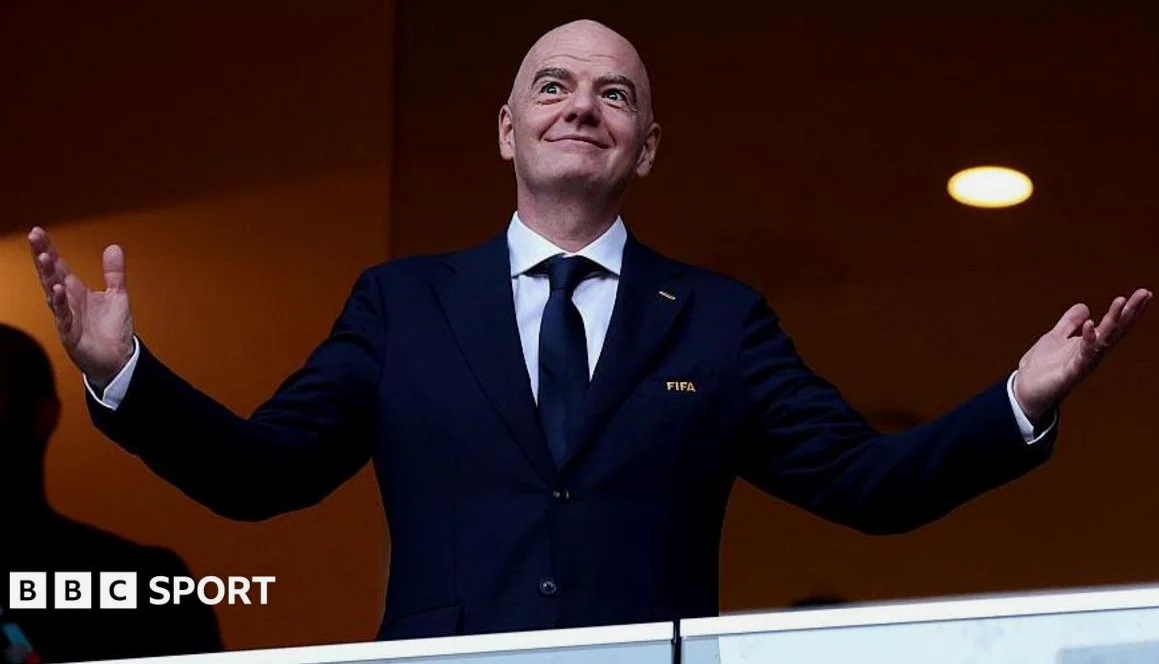
FIFA President Gianni Infantino has expressed support for expanding the World Cup to 64 teams by 2030, emphasizing inclusivity and the global growth of the sport. ‘When organising a World Cup, it’s important to organise it for the whole world,not just Europe and South America, but effectively the entire world,’ Infantino said, according to the BBC. He added that ‘every nation should be allowed to dream of participating in the World Cup.’
Proposed Expansion and Reactions
The idea of a 64-team World Cup was officially proposed by South American governing body Conmebol in April 2025, though no final decision has been reached. The 2030 World Cup will be co-hosted by Spain, Portugal, and Morocco, with the three opening matches taking place in Argentina, Uruguay, and Paraguay to mark the centenary of the competition, according to the BBC. Uruguay hosted the first World Cup in 1930.
Not all football leaders share Infantino’s vision. UEFA President Aleksander Ceferin has dismissed the 64-team proposal as a ‘bad idea’ for both the tournament and the qualifying process, as reported by the BBC. Similarly, Asian Football Confederation (AFC) President Sheikh Salman bin Ibrahim Al Khalifa warned that further expansion would bring ‘chaos.’
Qualifying Process and Distribution
According to The Independent, a 64-team format would require major reforms in the qualifying process. Extra spots would need to be distributed among the confederations. For the 2026 World Cup, the Confederation of African Football (CAF), the Asian Football Confederation (AFC), and Concacaf (governing North and Central America and the Caribbean) saw the biggest gains from the expansion to 48 teams.
European teams, represented by UEFA, received only three additional spots, a 23% increase, which some nations found insufficient. For a 64-team World Cup, Infantino said Europe,currently the most represented continent,would likely see an increase in spots, possibly to at least 20. The Oceania Football Federation would likely gain another automatic berth, despite New Zealand being the only team in the region ranked in the top 100 globally.
Challenges and Opportunities
Infantino emphasized that the 48-team format has been ‘a huge success,’ pointing to the performance of African teams. At the last World Cup, only five African teams reached the knockout stages, but in the 2026 edition, nine of 10 teams advanced. ‘That just goes to show how important it is to include all teams—to give them this opportunity to participate,’ he said, according to the BBC.
The expansion to 64 teams would mean doubling the number of participating nations in just two editions and eight years, according to The Independent. Before 2026, the World Cup had remained at 32 teams since 1998. The increased size could offer opportunities for smaller nations, such as Curacao, Uzbekistan, and Jordan, to qualify, according to The Independent.





Comments
No comments yet
Be the first to share your thoughts