

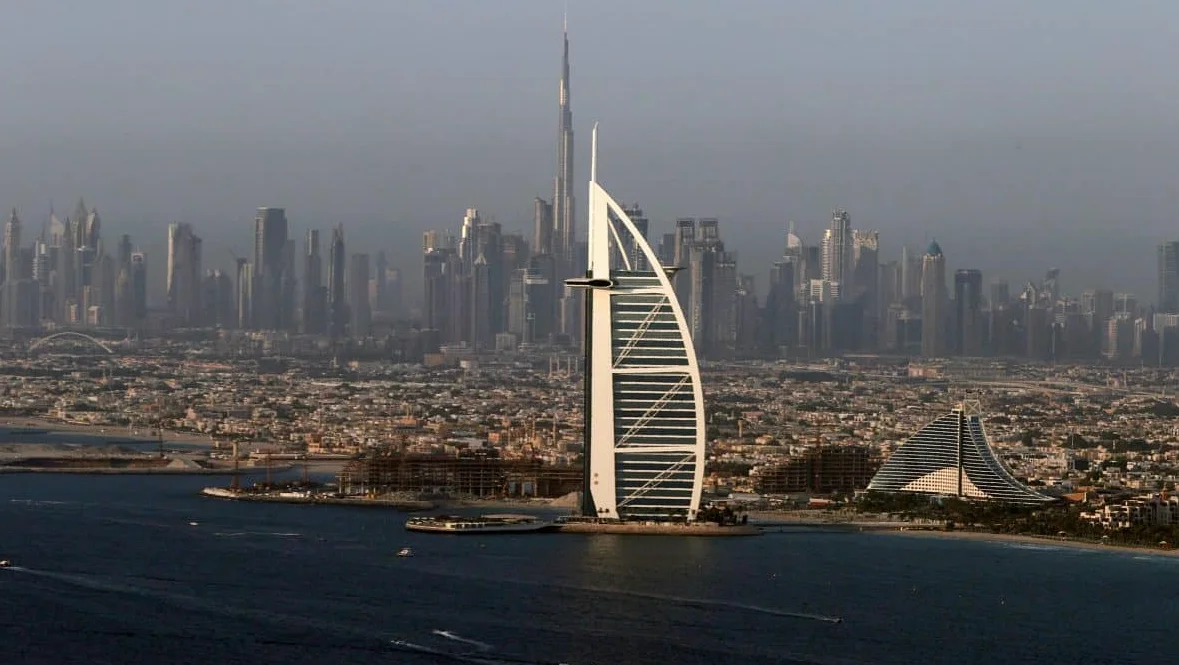
Dubai’s international airport sustained damage as overnight Iranian retaliatory strikes spread across Gulf states and into wider West Asia, extending beyond US bases and interests. The emirate’s media office said four people were injured at the airport, confirming that ‘a concourse at Dubai International (DXB) sustained minor damage in an incident, which was quickly contained,’ without providing further details.
Damage to Iconic Landmarks and Infrastructure
One of the berths at Jebel Ali Port also caught fire after debris fell during an aerial interception, the media office added. Dubai authorities later said a drone had been intercepted, with debris causing a minor fire on the outer façade of the Burj Al Arab, one of the emirate’s most recognisable landmarks.
Opened in 1999 on an artificial island off Jumeirah Beach, the sail-shaped tower has become a global symbol of the city’s luxury branding. The incident, however, marked the first time the landmark had faced direct damage from an aerial attack.
On Saturday, a separate fire broke out near a hotel on Palm Jumeirah, adding to concerns over the scale of the region-wide strikes. Aviation sources told Reuters that one of Dubai airport’s terminals was damaged in the overnight attacks.
Regional Impact and Casualties
In Abu Dhabi, Abu Dhabi Airports initially reported one fatality involving an Asian national and seven injuries after an incident at Zayed International Airport, though the post was later removed. Iran fired missiles at Abu Dhabi, Dubai, and Doha, all major east-west aviation gateways.
Airlines suspended flights across the Middle East on Saturday, including services to and from Dubai and Abu Dhabi. Flight-tracking maps showed large areas of regional airspace almost completely empty, indicating the significant disruption caused by the strikes.
The attacks come amid a long-standing conflict between Iran and the United States, which has seen a series of retaliatory strikes and countermeasures in recent years. Similar incidents occurred in 2019 when Iran launched attacks on US military bases in Iraq, and in 2020 when tensions flared over the killing of Iranian General Qasem Soleimani.
Analysts have warned that such strikes could have long-term implications for regional security and economic stability. The Gulf region, which is a crucial hub for global trade and energy, faces the risk of further escalation if diplomatic efforts fail to de-escalate the situation.
According to aviation analysts, the damage to Dubai International Airport could disrupt air traffic for several days. The airport, which handles over 70 million passengers annually, is one of the busiest in the Middle East. The impact on the region’s economy, particularly in tourism and trade, could be substantial.
The Burj Al Arab, which is a symbol of Dubai’s wealth and global appeal, is expected to undergo extensive repairs. The cost of the repairs could run into millions of dirhams, though officials have not yet released an official estimate.
What’s Next and Forward-Looking Implications
Officials from the Gulf Cooperation Council (GCC) have called for an immediate ceasefire and urged international mediation to prevent further escalation. The United Nations Security Council is expected to hold an emergency meeting in the coming days to address the situation.
Experts warn that the strikes could trigger a broader regional conflict, with potential spillover effects on global oil markets and trade routes. The United States and its allies are likely to respond with further sanctions or military measures, which could further destabilise the region.
The incident highlights the growing risk of direct confrontations between regional powers and the need for a more strong international framework to manage such crises. As the situation unfolds, the world will be watching closely to see whether diplomatic efforts can prevent a full-scale conflict.



Comments
No comments yet
Be the first to share your thoughts