

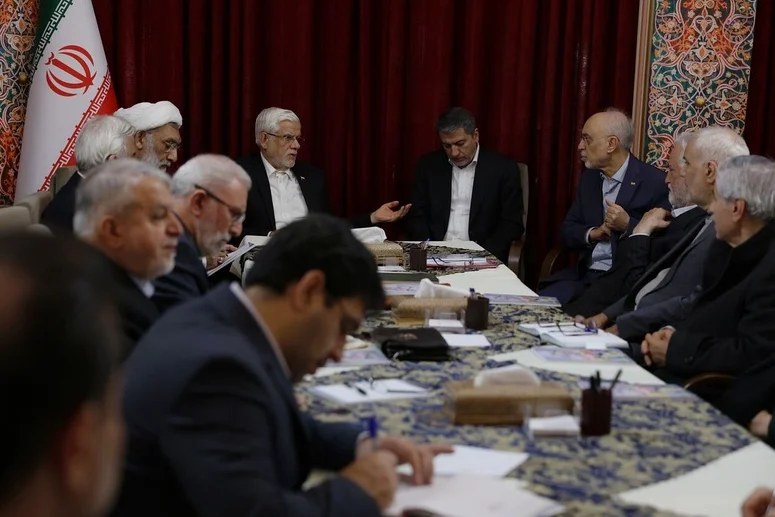
TEHRAN — Iran’s First Vice President Mohammad Reza Aref declared Thursday that the nation’s military and economic preparedness has markedly improved compared to the time of the 12-day war. He described this progress as vital support for Iran’s team in nuclear talks with the United States.
Aref made the comments during a meeting with members of the Association of Former Iranian Ministers. The gathering focused on ways to bolster social capital and improve ties between the government and citizens, according to the Iranian news agency IRNA.
“Using the experiences and perspectives of former managers is a serious program of the government to improve the quality of decision-making and increase efficiency,” Aref said. He stressed the 14th government’s pledge to deepen dialogue with elites and experts.
Turning to foreign policy, Aref highlighted indirect negotiations between Iran and the U.S. “The Islamic Republic of Iran is proceeding along this path within the framework of a strategy of ‘dignity, interest, and wisdom,'” he stated.
The 12-day war refers to a brief but intense conflict in 2024 between Iran and Israel, which ended after 12 days of exchanges that included missile strikes and airstrikes. That episode heightened regional tensions and drew international attention to Iran’s defensive capabilities.
Aref’s remarks come amid ongoing U.S.-Iran discussions aimed at reviving elements of the 2015 nuclear deal, formally known as the Joint Thorough Plan of Action. Those talks, held indirectly through European mediators in locations like Oman and Vienna, have seen slow progress over multiple rounds.
Iranian officials have repeatedly tied their negotiating stance to domestic strength. Aref’s emphasis on enhanced readiness highlights Tehran’s position that it enters talks from a place of resilience, not weakness. The vice president did not provide specific metrics on military or economic gains but framed them as a direct contrast to the wartime period.
The meeting with former ministers reflects broader efforts under President Masoud Pezeshkian’s administration, which took office in July 2024. Pezeshkian, a reformist, has promised more inclusive governance while maintaining hardline stances on national security and nuclear rights.
Association members present included ex-ministers who served under previous presidents, offering input on policy implementation. Aref welcomed their contributions as a means to refine government operations amid economic pressures from sanctions.
Iran’s economy has faced challenges from U.S. sanctions reimposed after the 2018 withdrawal from the nuclear deal. Recent reports indicate growth in non-oil exports and domestic production, which officials credit for the improved readiness Aref described.
On the military front, Iran has showcased new missile systems and drone technology since the 12-day war. State media frequently highlights these developments as deterrents against potential aggression.
Aref’s statement arrives as nuclear talks face a critical juncture. The U.S. administration under President Joe Biden seeks a diplomatic off-ramp before the November 2024 election, while Iran insists on sanctions relief as a precondition for limits on uranium enrichment.
Officials from both sides have expressed cautious optimism after recent rounds, though gaps remain on verification and compliance issues. Aref’s endorsement of the negotiating team’s position signals unified leadership support in Tehran.
Comments
No comments yet
Be the first to share your thoughts