

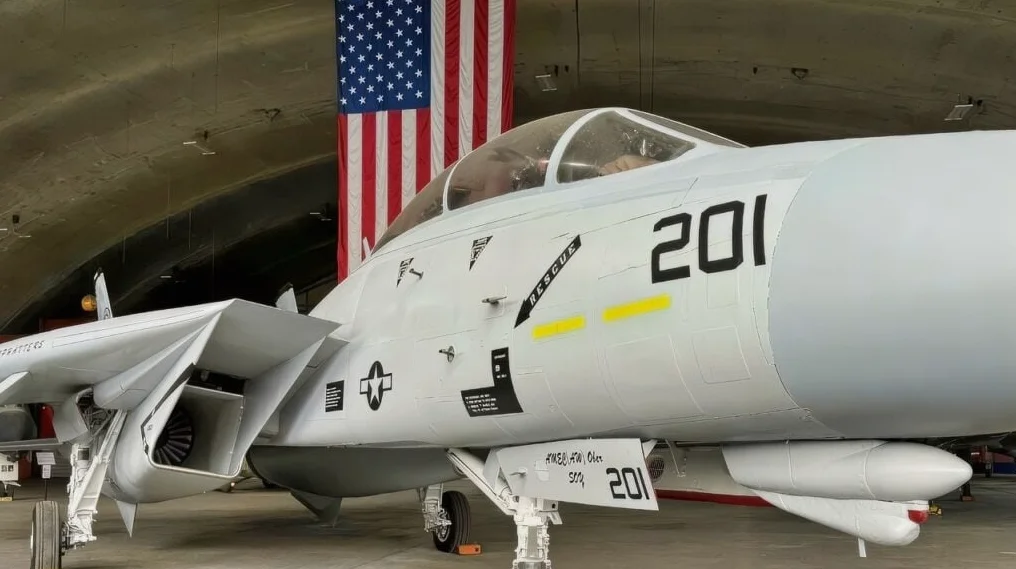
The F-14 Tomcat, once a symbol of air superiority, was secretly designed to function as a bomber, a role it finally fulfilled in its final years before retirement in 2006. This lesser-known history, now being revisited by defense analysts, reveals that the iconic jet was always capable of carrying and deploying bombs — a fact that only became widely recognized after its use in combat as a ‘Bombcat’ during Operation Deliberate Force in 1995.
The Hidden Bombing Capability of the F-14
The F-14 Tomcat, introduced in the mid-1970s, was primarily designed as an air superiority fighter, capable of engaging enemy aircraft at long ranges with its AIM-54 Phoenix missile. However, its AWG-15 fire-control system was equipped with the Constantly Computed Impact Point (CCIP) mode, which allowed it to carry and deploy unguided bombs, according to aviation historian Tom Cooper.
Flight testing of the Tomcat’s bombing capabilities began as early as 1973-1974, with the VF-32 squadron conducting exercises with bombs shortly after the aircraft entered service. Despite this, the Navy did not use the Tomcat for bombing missions until the latter part of its operational life.
The Iranian Connection and the ‘Bombcat’ Legacy
The F-14’s dual role as both an air superiority fighter and a bomber became more pronounced when Iran received 80 of these jets from the United States during the reign of Shah Mohammad Reza Pahlavi. Unlike the U.S. Navy, which delayed using the Tomcat as a bomber, Iran was the first to deploy the F-14A as a ‘bomber,’ according to Cooper.
The Iranian government had also sought to purchase the Rockwell International AGM-53 Condor, a long-range TV-guided missile, but the program was canceled due to cost. The F-14s delivered to Iran were, however, equipped with the necessary systems to carry and deploy bombs — a capability that would later be used in U.S. Navy operations.
Despite its original design as an air superiority fighter, the F-14 was eventually cleared to carry a variety of ordnance, including unguided free-fall bombs such as the 500-lb Mk-82, 1,000-lb Mk-83, and 2,000-lb Mk-84. Precision-guided munitions, including the Paveway II laser-guided bombs, were later added to the Tomcat’s arsenal.
Combat Proven in Operation Deliberate Force
The Tomcat’s bombing capability was finally tested in combat during Operation Deliberate Force in 1995, a NATO-led operation targeting Bosnian Serb forces under the command of Radovan Karadzic and Gen. Ratko Mladic. The operation aimed to halt ethnic cleansing and other atrocities against Bosnia’s Muslim population.
VF-41 squadron, flying F-14 Tomcats, used both unguided and precision-guided munitions during the campaign. According to Stefano D’Urso, a colleague of Cooper, the Tomcat had a distinct advantage over the F/A-18 Hornet in its ability to carry a full load of laser-guided bombs back to the carrier without jettisoning any ordnance, a requirement for the Hornet.
“At that time, the Bombcat was missing a self-designating capability, so they flew in mixed sections of F/A-18s and F-14s, with the Hornets buddy-lasing the targets,” D’Urso said. “One major benefit that the Tomcat had was its capability to bring it back aboard the carrier its entire heavy load of laser-guided munitions if they weren’t used in combat, while the Hornet was forced to jettison them to meet the weight requirements before landing back on the carrier.”
Cooper noted that the F-14’s transition from air superiority to multirole fighter was a gradual process. Initially, the Tomcat was limited to unguided bombs, but it eventually carried cluster bombs and precision-guided munitions, proving its worth in combat.
The legacy of the F-14 as a ‘Bombcat’ is now being revisited by historians and defense analysts, who argue that its capabilities were underappreciated during its operational life. The aircraft’s ability to carry a heavy load of ordnance without compromising carrier operations was a key factor in its effectiveness during Operation Deliberate Force.
While the F-14 was officially retired in 2006, its role as a multirole fighter has been recognized in recent years. The F-15 Eagle, which remains in service with the U.S. Air Force, has also evolved into a ‘bomb truck’ role, similar to the Tomcat’s late-career transformation.
The history of the F-14 Tomcat serves as a reminder of the adaptability of military aircraft and the importance of recognizing the full potential of existing platforms. As the U.S. military continues to modernize its fleet, the lessons learned from the Tomcat’s transition may inform the development of future multirole fighters.






Comments
No comments yet
Be the first to share your thoughts