

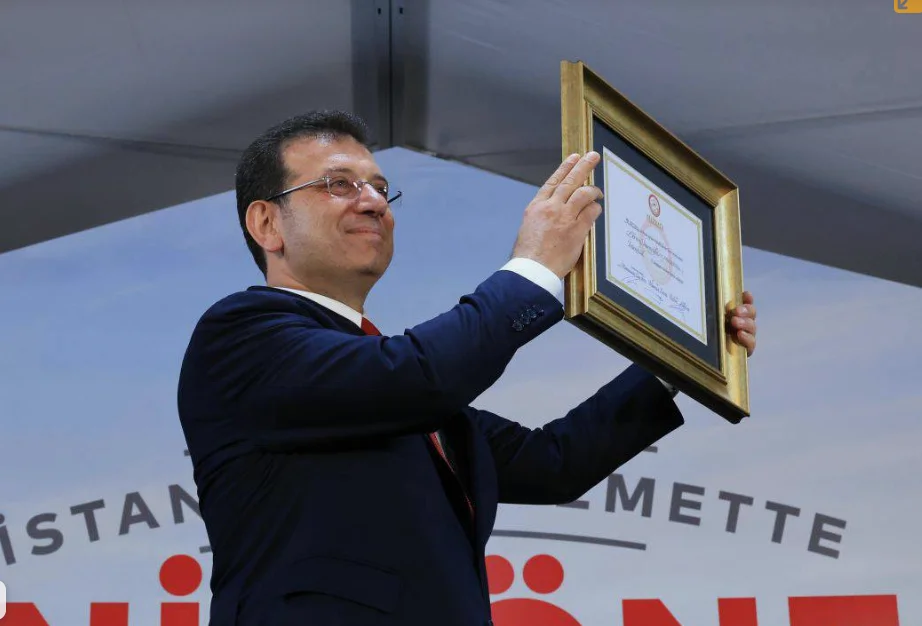
An Istanbul appellate court has denied Ekrem İmamoğlu’s request to suspend the enforcement of a lower court ruling that upheld the cancellation of his university diploma, marking another legal setback for the jailed opposition leader and CHP presidential candidate. The 7th Administrative Litigation Chamber of the Istanbul Regional Administrative Court ruled that İmamoğlu’s appeal for a stay of execution would not be granted, allowing the diploma annulment to remain in force while his appeal continues.
The Legal Battle Over a Diploma
The case stems from a March 18, 2025, decision by Istanbul University to revoke İmamoğlu’s degree, citing irregularities in his 1990 transfer from a university in northern Cyprus into its Faculty of Business Administration. The move immediately sparked political controversy, with critics labeling it a significant step against one of President Recep Tayyip Erdoğan’s most prominent rivals.
Under Article 101 of Turkey’s Constitution, presidential candidates must have completed higher education. As long as the annulment remains in effect, the case continues to cast a shadow over İmamoğlu’s eligibility to run for the presidency. The legal challenge has unfolded alongside a broader political crackdown surrounding the Istanbul mayor, who was detained on March 19, 2025, one day after the university’s decision.
Political and Legal Implications
İmamoğlu was formally jailed pending trial on March 23, 2025, as part of corruption-related proceedings he denies. He has since remained behind bars at Marmara Prison in Silivri, while the CHP moved ahead with endorsing him as its candidate for the next presidential election. His legal team will now assess whether the case can be escalated to the Council of State (Danıştay) within 30 days under Article 46, which allows further appeal in certain administrative cases.
Turkish case materials indicate that some diploma or graduation-related disputes do reach Danıştay, but whether this specific file qualifies for that route may depend on how the court legally classifies the dispute. İmamoğlu’s lawyer had previously stated that, if necessary, they would also pursue applications to Turkey’s Constitutional Court and then the European Court of Human Rights. However, those options would generally come after exhausting domestic remedies, not as an immediate way to halt the latest ruling.
The appellate court’s latest refusal does not close the file, but it does keep the diploma annulment active at a politically sensitive moment. Supporters argue the sequence of judicial and administrative actions has been designed to sideline Erdoğan’s strongest challenger, while the government insists that Turkey’s courts are acting independently.
What’s Next in the Legal Process
As the case continues, the next critical step will be whether İmamoğlu’s legal team can successfully appeal the decision to the Council of State within the 30-day window. If that appeal is denied, the case may then be taken to the Constitutional Court or the European Court of Human Rights, though these options are typically pursued after all domestic remedies have been exhausted.
The annulment of İmamoğlu’s diploma not only affects his personal eligibility for the presidency but also has broader implications for the upcoming election. If the annulment stands, it could challenge the CHP’s ability to field a legitimate candidate and potentially reshape the political landscape in Turkey. Analysts say the case has become a symbolic battle over the rule of law and the independence of the judiciary in the country.
While the court ruled against İmamoğlu’s request for a stay, the legal process is far from over. The case remains under review, and the outcome could have far-reaching consequences for both İmamoğlu and the political dynamics in Turkey.






Comments
No comments yet
Be the first to share your thoughts