

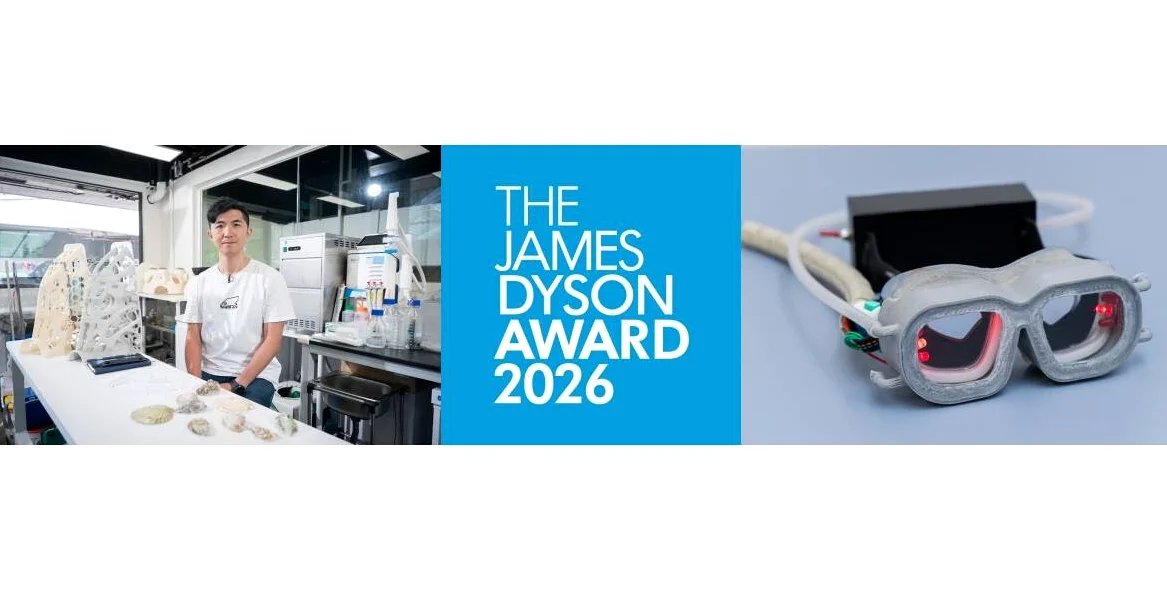
HONG KONG – The James Dyson Award, a renowned global design engineering competition, has launched its 2026 edition, inviting current and recent design and engineering students from 28 countries and regions to submit their innovative solutions to real-world challenges. The competition, which has supported more than 400 inventions since its inception in 2002, offers a platform for young inventors to gain recognition and funding to bring their ideas to life.
Global Recognition and Financial Support
Submissions for the 2026 competition are now open, with the deadline set for midnight on 15 July 2026. Shortlisted entries will be evaluated by national panels of design and engineering experts, including Dyson engineers. National winners will receive £5,000 and the opportunity to advance to the international stage, where Sir James Dyson will select global winners to receive £30,000 each.
The prize money is intended to provide the necessary momentum for young inventors to accelerate their projects towards commercialisation. Winners also gain media exposure and international recognition, which can significantly enhance the visibility of their work and attract further investment or collaboration opportunities.
Impact on Innovation and Entrepreneurship
Sir James Dyson, founder of the award, emphasized the importance of encouraging young problem-solvers. ‘I established the James Dyson Award to encourage young ‘doers’ who are focused on solving the problems they see in the world,’ he said. ‘It has been inspiring to see so many brilliant ideas from young design engineers, many of whom have gone on to build businesses and take their problem-solving ideas to people and markets all over the world.’
The 2025 edition of the competition received over 2,100 inventions from students across the globe. These projects addressed a wide range of issues, including health screening, household waste management, and disaster relief. One notable example was the 2025 Hong Kong winner, ‘Reef of Hope,’ a modular, 3D-printed artificial reef designed to restore oyster habitats. The invention, created by Dean Chan, a PhD candidate at Hong Kong Polytechnic University, has already seen real-world application in Tolo Harbour and has received support from the HKSAR Government and universities.
‘Winning the James Dyson Award has significantly boosted media exposure for my marine conservation mission, providing a powerful platform to connect with much wider audiences and inspire real change,’ Dean Chan said.
Success Stories and Future Prospects
Another successful case is the 2022 Hong Kong winner, ‘O-Oley,’ a smart-goggle technology designed to support eye health and wellness. The team behind the project, Kin Nam Kwok, Minji Seo, Yuen Yin Leung, and Kwun Chung Chan, officially launched their product in June 2025 and have since expanded their impact by delivering community screenings with NGO partners. They have also established a dedicated research centre in Tsuen Wan to support ongoing testing and development.
‘Honestly, starting a company wasn’t even on our radar,’ the team said. ‘Winning the James Dyson Award gave us the confidence to take O-Oley from a project to a startup, strengthening our engineering mindset and giving us the credibility to be taken seriously from day one.’
The competition’s impact extends beyond individual success stories. The James Dyson Foundation, which runs the award, is an international education charity with a mission to inspire the next generation of engineers. The foundation has invested over £155 million in charitable causes to date and continues to support medical research and innovation.
Entries for the 2026 competition can be submitted via the James Dyson Award website. Eligible participants include university students and recent graduates in design and engineering. The best entries are those that address a clear global problem, demonstrate a thoughtful design process, and showcase originality and technical feasibility.
The competition is part of a broader commitment by Sir James Dyson to demonstrate the power of engineers to solve the world’s problems. As the deadline approaches, the global design and engineering community is expected to submit a wide array of innovative solutions that could shape the future of technology, sustainability, and healthcare.






Comments
No comments yet
Be the first to share your thoughts