

PHNOM PENH — Japan solidified its role as Cambodia’s top development ally over five decades, channeling funds into post-war reconstruction and modern projects that link rural roads to regional trade routes.
Assistance kicked off in earnest after the 1991 Paris Peace Accords ended decades of civil war and Khmer Rouge devastation. Japan established the Japan International Cooperation Agency office in Phnom Penh in 1993, ramping up aid for emergency rehabilitation. Volunteers had arrived as early as 1966 under the Japan Overseas Cooperation Volunteers program, but conflict halted deeper ties until peace returned.
Bridges stand as enduring symbols of that partnership. Japan financed the Chroy Changvar Bridge, Kizuna Bridge and Neak Loeung Bridge, spanning key rivers to boost internal connectivity. Upgrades to National Roads 1, 5, 6 and 7 covered hundreds of kilometers, easing trade and travel from farms to cities. Recent pledges run into hundreds of millions of dollars for Phnom Penh’s water systems and transport networks, officials said.
These efforts blended concessional loans with grants, sparking private investment and tourism. Beyond concrete, Japan built 18 primary schools, eight secondary schools and facilities like the Institute of Technology of Cambodia. Health infrastructure grew too: eight hospitals and centers, including the National Maternal and Child Health Center, now serve remote provinces.
Governance got a lift from projects like the 1999 Legal Development Initiative, which rebuilt civil law frameworks shattered by war. Thousands of Cambodians trained abroad or through scholarships, building expertise in everything from agriculture to administration.
As Cambodia’s economy surged — hitting low-middle-income status with strong GDP growth — Japan’s focus sharpened on future needs. Agriculture and irrigation projects target food security. A National Data Centre pushes e-government services. At Sihanoukville Autonomous Port, Japan’s only international deep-sea facility, new terminals NCT-2 and NCT-3 will handle 1.45 million TEUs annually, according to JICA plans.
On July 30, 2025, Public Works and Transport Minister Peng Ponea oversaw a signing for the port’s Master Plan to 2050. JICA’s Sanui Kazumasa led the team. The 24-month effort aims to cut shipping costs, sharpen regional competition and align with Cambodia’s 2050 upper-middle-income goal.
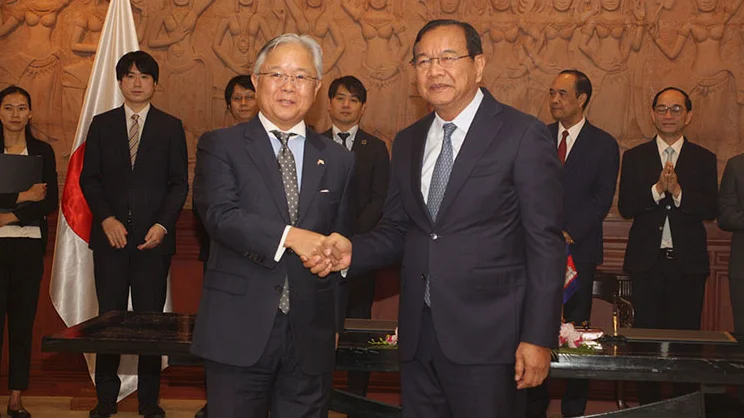
Earlier, on January 12, Ambassador Atsushi Ueno and Foreign Minister Prak Sokhonn inked $18 million in grants. About $7 million — or 1.14 billion yen — equips the port with X-ray scanners to handle rising cargo from global supply chains, the Japanese foreign ministry stated. The rest funds mine clearance near the port.
These moves position Sihanoukville as a logistics powerhouse, drawing factories and lowering trade barriers. Japan’s aid evolution mirrors Cambodia’s path from ruins to regional player, with ties rooted in 1950s diplomacy now a full strategic partnership.



Comments
No comments yet
Be the first to share your thoughts