

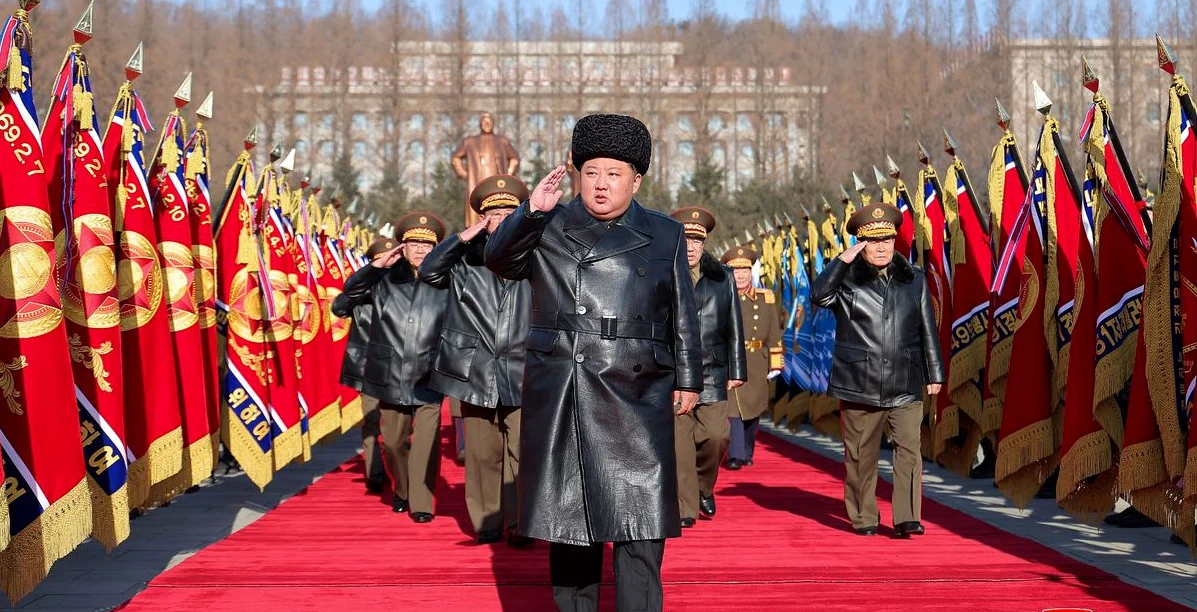
North Korean leader Kim Jong-un has issued a stark warning to South Korea, claiming his nation could ‘completely destroy’ its southern neighbor if threatened, according to state media reports. The statement came during a rare broadcast of the Workers’ Party Central Committee congress, which concluded earlier this week in Pyongyang. Kim also reiterated his rejection of inter-Korean diplomacy but left the door open for potential dialogue with the United States.
Regional Rhetoric and Military Ambitions
During the congress, Kim outlined his country’s military and nuclear strategy for the next five years, emphasizing the development of new weapons systems, including intercontinental ballistic missiles (ICBMs) capable of underwater launches and an expanded arsenal of tactical nuclear weapons. These systems, according to the Korean Central News Agency (KCNA), are aimed at bolstering North Korea’s military capabilities and asserting a more dominant regional role.
KCNA reported that Kim also called for the development of advanced military technologies, such as artificial intelligence-equipped attack drones, improved electronic warfare systems, and more sophisticated reconnaissance satellites. The military is also expected to deploy additional nuclear-capable artillery systems against South Korea in phased increments over the coming years.
Kim’s comments follow a pattern of increasingly hard-line rhetoric toward South Korea, which he has characterized as a ‘permanent enemy’ since 2024. That year, he abandoned the long-standing goal of peaceful reunification between the two Koreas, shifting focus to military and nuclear development. Analysts suggest this stance is not necessarily a prelude to immediate military action but rather an effort to solidify North Korea’s strategic position in the region.
Inter-Korean Tensions and Diplomatic Deadlock
South Korea’s Unification Ministry expressed regret over Kim’s continued hostile stance toward inter-Korean relations, stating that Seoul would ‘patiently’ pursue efforts to stabilize peace. The ministry’s response highlights the deepening rift between the two Koreas, which has been exacerbated by North Korea’s rejection of diplomatic overtures aimed at curbing its nuclear program.
The diplomatic impasse can be traced back to 2019, when Kim’s second summit with then-U.S. President Donald Trump collapsed, stalling progress on denuclearization talks. Since then, North Korea has refused to resume negotiations with Washington and Seoul, despite repeated calls to resume diplomacy. Kim has indicated that U.S.-North Korea relations will depend on Washington’s willingness to engage, with Kim stating that his country is prepared for either peaceful coexistence or permanent confrontation.
Kim’s disdain for South Korea is also evident in his domestic policies. He has launched aggressive campaigns to suppress the influence of South Korean culture and language within North Korea, aiming to strengthen his family’s grip on power. During the congress, he criticized South Korean President Lee Jae Myung’s calls for engagement, dismissing them as deceptive and accusing successive South Korean governments of seeking the North’s collapse.
Kim asserted that there is ‘absolutely nothing to discuss’ with an ‘enemy state’ and that the North would ‘permanently exclude’ the South from the notion of a shared nation. He stated that South Korea’s only path to safety is to ‘abandon all ties’ with North Korea and avoid provoking it, a statement that reflects the deepening divide between the two Koreas.
Future Developments and Regional Implications
Tensions could escalate further in the coming months, particularly as South Korea prepares for its annual joint military exercises with the United States. North Korea has historically viewed these drills as invasion rehearsals and has used them as a pretext to increase its own military demonstrations. Analysts expect the North to continue developing and testing advanced weapons systems, as outlined in Kim’s 2021 congress, including solid-fuel ICBMs, tactical nuclear systems, and purported hypersonic weapons.
Kim’s latest congress has set new goals for the next five years, focusing on the advancement of nuclear forces, faster production of nuclear warheads, and a broader range of delivery systems. Emphasizing naval capabilities, Kim called for ICBMs that could be launched from underwater platforms, indicating potential plans to integrate these weapons onto the nuclear-propelled submarines currently under development.
North Korea also claims progress in building a nuclear-propelled submarine and has launched its first military satellite in 2023. These developments suggest an ongoing commitment to enhancing its military and strategic capabilities, which could have far-reaching implications for regional security and international relations.
As the situation continues to evolve, the international community will be closely watching for any shifts in North Korea’s stance toward the United States and its military ambitions. The coming months will be critical in determining whether Kim’s hard-line rhetoric translates into concrete actions or if diplomatic efforts can be revived.






Comments
No comments yet
Be the first to share your thoughts