

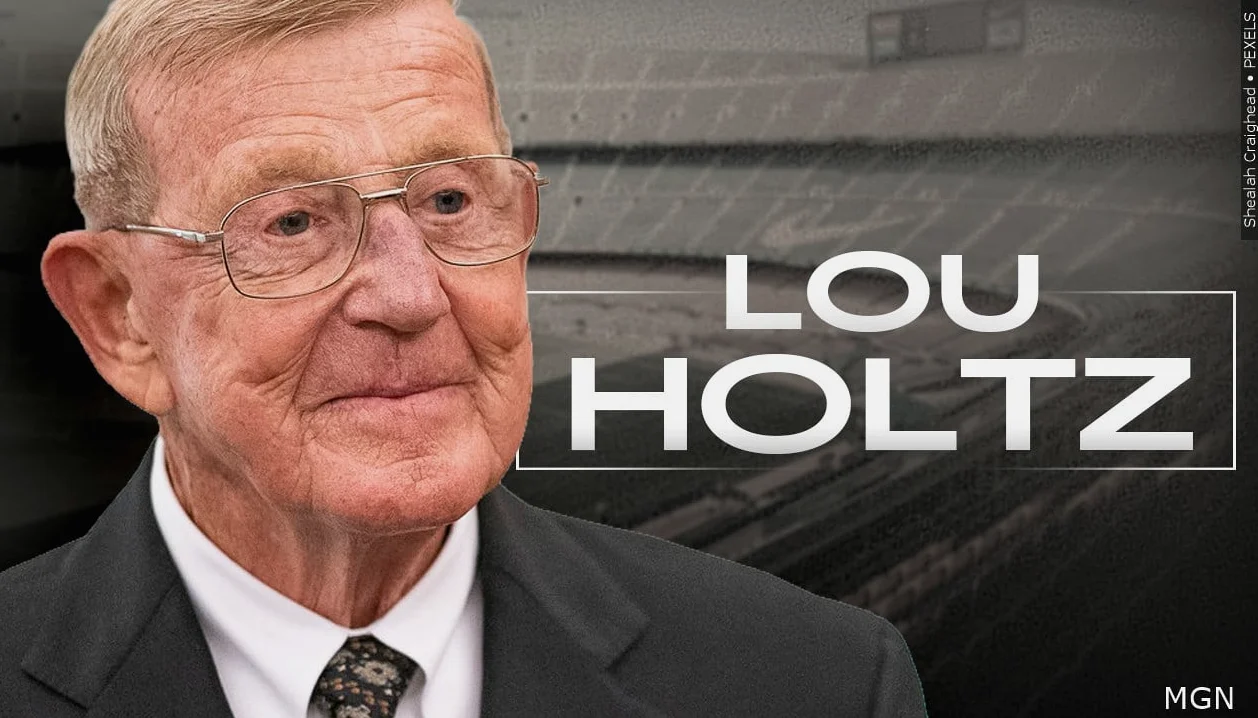
Lou Holtz, the legendary college football coach who led Notre Dame to a 1988 national title and built winning programs at multiple schools, has died at 89 in Orlando, Florida, according to Notre Dame officials.
Restoring Notre Dame’s Glory
Holtz, known for his fiery personality and unrelenting work ethic, revitalized Notre Dame’s football program after years of mediocrity. When he took over as head coach in 1986, the Irish had finished with a 3-8 record the previous season. Under Holtz, Notre Dame quickly regained its national prominence, reaching the Cotton Bowl in Year 2 and winning the national title in 1988.
His 1988 team defeated West Virginia in the Fiesta Bowl to secure the national championship. That season also included a memorable 31-30 win over Miami, a key moment in the so-called ‘Catholics vs. Convicts’ rivalry of the 1980s. Holtz’s teams from 1988 to 1989 won a school-record 23 consecutive games, including victories over three teams ranked No. 1: Miami in 1988, Colorado in 1989, and Florida State in 1993.
“Lou and I shared a very special relationship,” said current Notre Dame coach Marcus Freeman, who led the Irish back to the national title game in 2025. “Our relationship meant a lot to me as I admired the values he used to build the foundation of his coaching career: love, trust and commitment.”
A Career Spanning Multiple Schools
Holtz’s coaching career spanned 33 seasons and included stints at Minnesota, Arkansas, South Carolina, and Notre Dame. He finished with a record of 249-132-7, with his Notre Dame tenure alone producing a 100-30-2 record. Before Notre Dame, he had coached at William & Mary, North Carolina State, and briefly in the NFL with the New York Jets, where he failed to make an impact and famously stated, “God did not put Lou Holtz on this earth to coach in the pros.”
His time at Arkansas was particularly successful, with his teams making 18 appearances in the AP Top 25, eight of which were in the top 10. After Notre Dame, Holtz transitioned to broadcasting, working for CBS and later ESPN for 11 seasons. He promised he would never coach again, but eventually took an open job at South Carolina, where he had previously served as an assistant coach.
Despite a 0-11 debut season with the Gamecocks, Holtz led the team to a 17-7 record over the next two seasons. He beat then-No. 9 Georgia in 2000 and earned two victories over Ohio State in the Outback Bowl. He left the sidelines in 2004 and returned to the airwaves, where he remained until his retirement.
Philosophy and Legacy
Holtz was known for his unique coaching philosophy, which emphasized trust, commitment to excellence, and caring for others. He once said, “I think you have to go in there with a vision of where you want to go and a plan of how you’re going to get there. You have to hold people accountable, and you have to believe it can be done.”
His unconventional methods sometimes drew criticism, such as when he tackled quarterback Tony Rice during practice or grabbed a player by the facemask after a personal foul in 1991. He later apologized for the latter incident. Despite this, his teams often performed well under pressure, such as when he suspended his leading rusher and receiver before a game against Southern California and still won 27-10.
Holtz’s ability to recruit top talent was another key to his success. Notre Dame’s 1990 recruiting class included five future first-round NFL draft picks. He also had a unique way of motivating his players, often starting each practice with, “Boy, what a great day to work.”
“The first thing I said at every practice was, ‘Boy, what a great day to work,'” Holtz recalled. “It could be raining. It could be whatever. I’d be, ‘Boy, am I glad to be here. No place I’d rather be than here.'”
Born on January 6, 1937, in Follansbee, West Virginia, Holtz aspired to be a high school football coach. His first marriage ended in 1960, but he later married Beth Barcus, with whom he shared a 50-year partnership. Beth inspired Holtz to set personal goals, including attending a White House dinner, appearing on ‘The Tonight Show,’ and seeing the Pope.
“She said, ‘Gee, that’s nice. Why don’t you add get a job,'” Holtz once said. “So we made it 108.”
In 2008, Holtz was inducted into the College Football Hall of Fame, and Notre Dame placed a statue of him outside its home stadium. He had long expressed a desire to be buried on campus, saying, “The alumni buried me here every Saturday.”
His son, Skip Holtz, who also became a coach, posted on X that his father had passed away and was “resting peacefully at home.”
“He was successful, but more important he was Significant,” Skip Holtz wrote.




Comments
No comments yet
Be the first to share your thoughts