

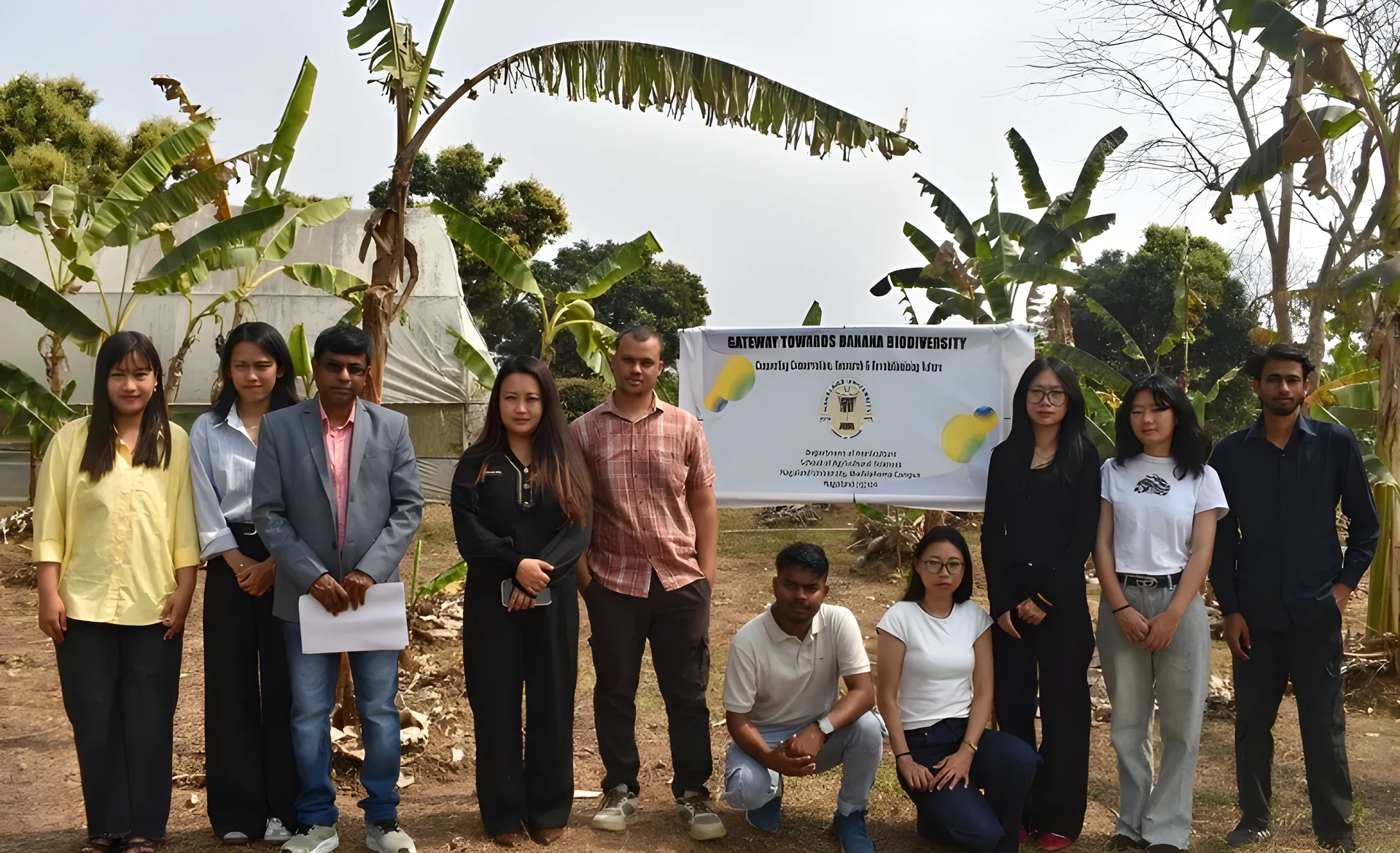
Nagaland University researchers have uncovered a wild banana species with significant genetic diversity that could enhance global banana breeding efforts as climate change poses increasing risks to crop production. The species, known as Musa sikkimensis, or the ‘Darjeeling banana,’ is native to the Eastern Himalayas and is valued for its resilience rather than its fruit.
Genetic Resilience in a Changing Climate
The study, published in the peer-reviewed journal Flora and Fauna, details the genetic potential of Musa sikkimensis, a wild-seeded species found in remote regions of Nagaland. Researchers highlight its traits such as disease resistance, stress tolerance, and climate adaptability, which are crucial as global banana production faces growing threats from climate change.
According to the study, titled “Exploring the Genetic Diversity of Musa sikkimensis Land Races in Nagaland, India,” the research was co-authored by K. R. Singh, S. Walling, and A. Sarkar. The findings underscore the importance of conserving native plant species to develop future banana cultivars that can withstand extreme weather conditions and pests.
Biodiversity Under Threat
Nagaland is part of the Indo-Burma biodiversity hotspot, home to a wide range of indigenous banana genotypes. However, deforestation, land-use changes, and the widespread shift toward hybrid banana varieties have accelerated the loss of traditional and wild germplasm.
Animesh Sarkar, an associate professor in the Department of Horticulture at Nagaland University, emphasized the urgency of preserving local banana genotypes in remote forest areas. He noted that challenges such as difficult terrain, limited accessibility, and low awareness among farmers have hindered field exploration efforts.
The research team collaborated with experts from institutions such as the Jawaharlal Nehru Tropical Botanic Garden & Research Institute in Kerala and the Bidhan Chandra Krishi Viswavidyalaya in West Bengal. These partnerships enabled the documentation of several previously unclassified genotypes, expanding the understanding of the region’s biodiversity.
Climate-Resilient Agriculture and Food Security
The study suggests that the genetic resources of wild bananas like Musa sikkimensis could support the development of high-yielding, disease-resistant banana cultivars. These cultivars would be better suited to the changing climatic conditions across banana-growing regions globally.
Researchers also pointed to potential value-added uses beyond fruit production, such as fiber-based materials and health beverages. Indigenous communities in Nagaland have historically used different parts of the plant for food, fiber, medicine, and cultural practices, with reported medicinal uses including treatments for dysentery, ulcers, diabetes, and microbial infections.
In response to conservation concerns, Nagaland University has established the Banana Biodiversity Corridor at its Department of Horticulture. This corridor functions as a living field gene bank, integrating in situ and ex situ conservation methods to support genetic, molecular, and climate-resilient breeding research.
Vice-Chancellor Jagadish K. Patnaik described the initiative as a “significant scientific breakthrough,” stating that the biodiversity corridor reflects the university’s commitment to safeguarding indigenous germplasm and strengthening nutritional security in a changing climate.
The corridor is expected to support student training, national germplasm security efforts, and future crop improvement programs rooted in local genetic resources. Animesh Sarkar has also established a biotechnology research network on banana biodiversity in Nagaland, with funding support from the Department of Biotechnology (DBT), Government of India.
Collaborating scientists include K. K. Sabu from Kerala, S. Debnath from West Bengal, Moaakum from Kohima Science College, and S. Banik from Nagaland University. As climate volatility intensifies across banana-growing regions worldwide, the conservation of wild species like Musa sikkimensis could prove critical in protecting one of the world’s most important food crops.






Comments
No comments yet
Be the first to share your thoughts