

 BBC
BBC 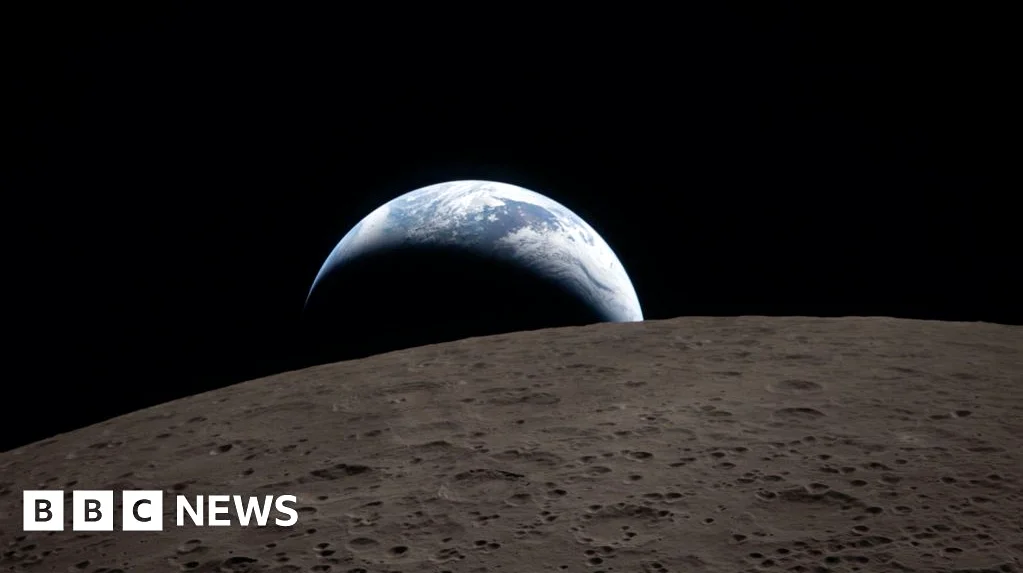
Earthset Echoes a Historic Image
The first image shows an ‘Earthset’ as the astronauts glimpsed our home planet peeking out beyond a cratered lunar landscape. This photo carries echoes of the famous Earthrise photograph taken by Bill Anders aboard Apollo 8 in 1968, which was captured during a moon fly-by that preceded the historic first human landing on the Moon the following year.
The Earthset photo was taken through the Orion spacecraft window at 18:41 Eastern Daylight Time (2341 BST) on Monday. NASA described the image. Noting that the dark portion of Earth is experiencing nighttime, while on Earth’s day side, swirling clouds are visible over the Australia and Oceania region.
Solar Eclipse Seen from the Moon
The second photograph shows the spectacular solar eclipse to which the astronauts were treated as the Moon blocked out the Sun, while the bright spot to the left of the frame is Venus. The astronauts experienced nearly 54 minutes of totality due to the Orion spacecraft’s proximity to the Moon, a stark contrast to the fleeting few minutes of solar eclipses seen from Earth.
In the image, the Sun’s corona can be seen around the Moon’s edge. Victor Glover described the eclipse as ‘sci-fi’ and ‘unreal,’ also describing the view of the corona of the Sun. ‘This continues to be unreal,’ he said. ‘The Sun has gone behind the Moon and the corona is still visible. It’s bright and creates a halo almost around the entire moon.’
Glover added, ‘The Earth is so bright out there and the Moon is just hanging in front of us.’
Unique Perspective from the Moon
While satellite photographs have been taken of the Moon’s far side in the nearly five decades since the last human landing in 1972, NASA said that the astronauts seeing it with their own eyes during the flyby was invaluable. The crew recorded audio descriptions of what they were seeing, and NASA’s scientists will be poring over these notes for new information.
The following photograph shows Earthrise as our planet came back into the astronauts’ view after their time behind the Moon — this image was taken during a six-hour flyby, including a period of radio silence when their capsule was behind the Moon.
NASA did not specify which of the astronauts took the photographs, as they are on their return journey to Earth after the fly-by. The images were captured during the Artemis II mission, which is a critical step in NASA’s plan to return humans to the Moon and eventually send astronauts to Mars.
The Earthset and solar eclipse images highlight the unique perspective offered by the Artemis II mission. The astronauts’ view of the Earth and the Sun during the fly-by provided a rare and valuable opportunity for scientific observation and public engagement with space exploration.
NASA has emphasized the importance of these images, not only for their visual appeal but also for the scientific data they provide. The photographs will be used to study the Moon’s surface features and the behavior of the Sun’s corona, contributing to a deeper understanding of our solar system.
The Artemis II mission is part of a broader initiative to establish a sustainable human presence on the Moon, with plans to build a lunar base and conduct extensive scientific research. The images from the fly-by are a testament to the technological advancements that have enabled such missions and the continued exploration of space.






Comments
No comments yet
Be the first to share your thoughts