

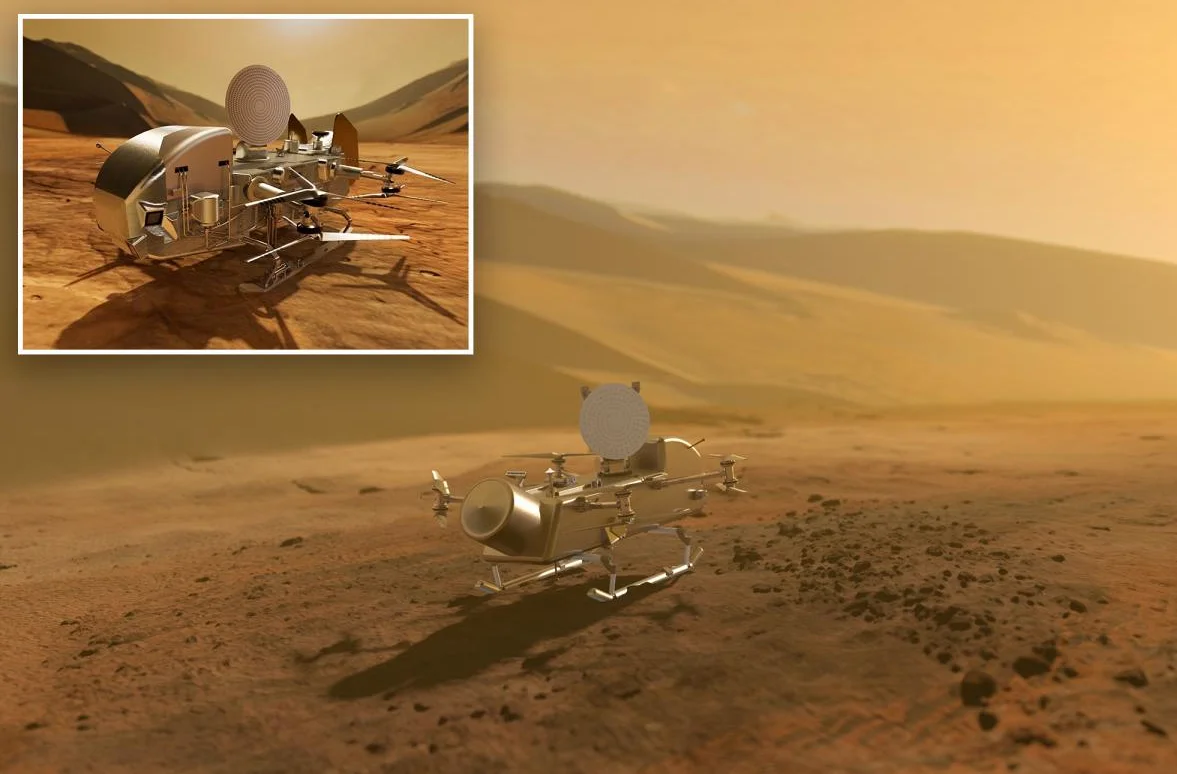
NASA is on the verge of launching a major mission to Saturn’s moon Titan, a mission that could offer unprecedented insights into the chemical processes that may have led to life on Earth. The Dragonfly rotorcraft, a small octocopter equipped with four pairs of counter-rotating, three-bladed rotors, is scheduled to launch in July 2028 and arrive at Titan in December 2034. The mission, which will last 3.3 years, aims to explore the moon’s surface and analyze its complex organic chemistry.
Unique Atmosphere and Organic Chemistry
Titan is the only moon in the solar system with a dense atmosphere, which is actually thicker than Earth’s. The atmosphere is primarily composed of nitrogen, similar to Earth’s, but also contains methane. This creates a rich environment for complex organic molecules, which scientists believe could provide clues about the chemical steps that led to life on Earth.
According to Dr. Zibi Turtle of the Johns Hopkins University Applied Physics Laboratory, Titan’s atmosphere and surface are unlike any other in the solar system. ‘Titan is a very interesting target, very unique in our solar system. It’s the only moon that has a dense atmosphere,’ she said. ‘The atmosphere is actually denser than Earth’s, and it’s mostly nitrogen, like ours, but it also contains methane.’
The moon’s crust is composed of water ice, and scientists believe that in the past, areas where the crust melted could have allowed complex carbon molecules to mix with liquid water for extended periods. This process is similar to what may have occurred on Earth before the emergence of life.
Dragonfly’s Mission and Flight Plan
The Dragonfly rotorcraft is designed to fly multiple times during its mission, covering up to 70 miles across Titan’s surface. Each flight will take place over a Titan day, which lasts about 16 Earth days. The mission is planned to last 3.3 years, with the rotorcraft making one flight every one to two Titan days.
According to NASA, Dragonfly will stop at various geological sites to collect samples of surface material for analysis using a suite of scientific instruments. The moon’s surface, which includes organic dunes similar to those on Earth, offers a unique opportunity to study its geology and chemical composition in detail.
‘Flying several miles each flight through the yellowish, smoggy haze of Titan’s nitrogen-rich atmosphere, Dragonfly will stop at a variety of geologic sites, where it will collect samples of surface material for analysis inside the rotorcraft by a suite of scientific instruments,’ NASA stated in a release.
Preparing for Extreme Conditions
Titan’s surface temperature is an extremely cold 94 Kelvin, which is equivalent to -290 degrees Fahrenheit. Despite these harsh conditions, the rotorcraft is designed to withstand the environment, with advanced insulation to maintain a stable internal temperature for its instruments and electronics.
The Dragonfly mission is expected to provide scientists with data that could reveal information about Titan’s past, including how its environment may have resembled Earth before the development of life. The findings could help scientists understand the chemical processes that led to the emergence of life on our planet.
Experts believe that Titan’s surface and atmosphere may hold clues to the origins of life. ‘This mission has the opportunity for scientists to learn unprecedented information dating back thousands of years, and could teach us what Earth looked like before the emergence of biology,’ a NASA statement said.
The mission is a major step in the exploration of our solar system and represents a significant technological advancement in space exploration. With its launch in 2028, Dragonfly will be the first rotorcraft to explore another world, opening new possibilities for future missions to other moons and planets.






Comments
No comments yet
Be the first to share your thoughts