

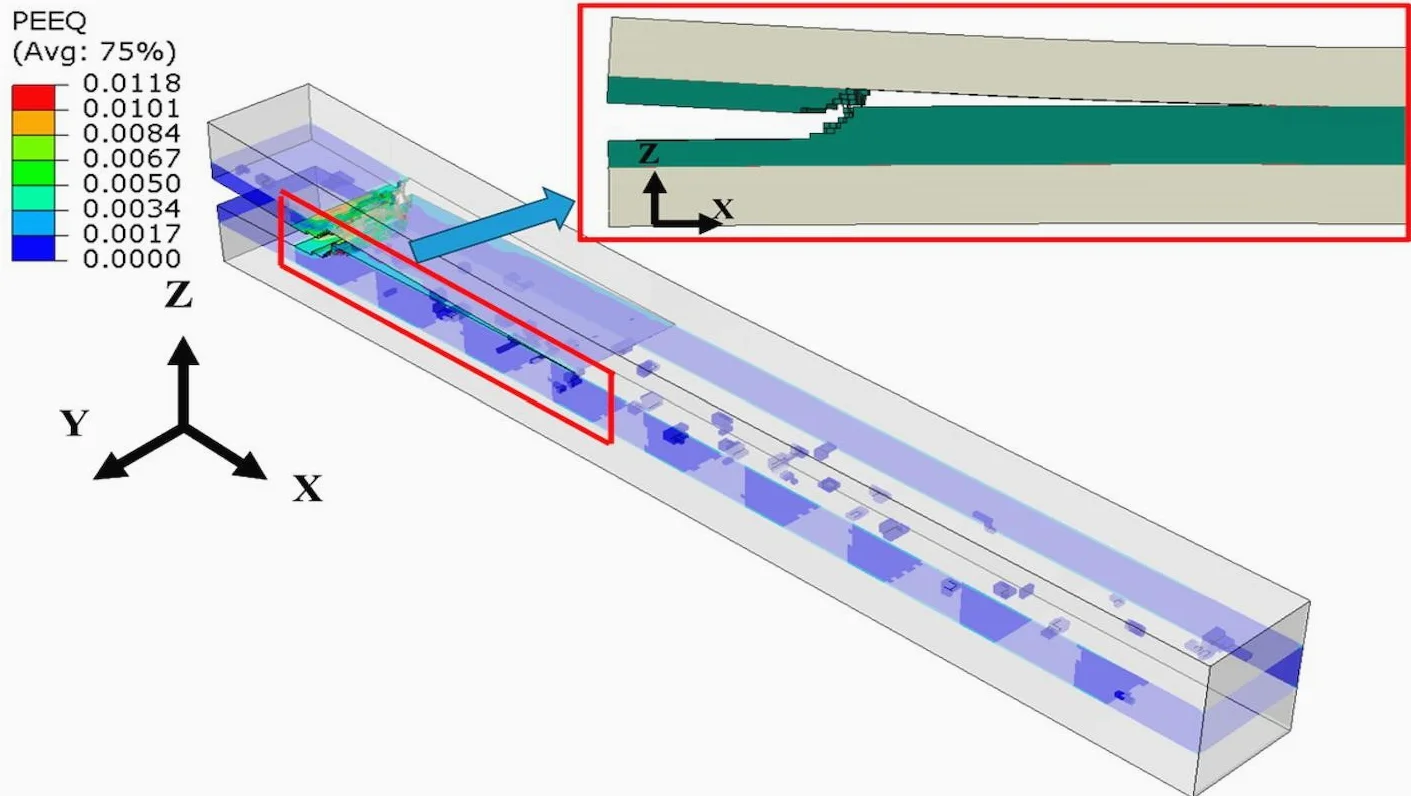
A new study from École Polytechnique Fédérale de Lausanne (EPFL) sheds light on the complex behavior of cracks in thick adhesively bonded composite joints, a critical component in wind turbine blades. The research, published in the Journal of Composites Science, combines computational modeling with experimental testing to analyze how cracks propagate in glass fiber reinforced polymer (GFRP) joints under Mode I loading conditions.
Focus on Wind Turbine Blade Trailing Edges
The study specifically targets the trailing edges of wind turbine blades, where adhesive joints are crucial for structural integrity. These joints, often made with a 10-mm thick epoxy adhesive, are prone to crack formation due to the high stresses experienced during operation. The research team conducted Double Cantilever Beam (DCB) tests to simulate these conditions in a controlled environment.
Finite Element (FE) models were developed to represent the composite and adhesive layers, with special attention given to the interface between the GFRP and the adhesive. The researchers also explicitly modeled voids, which are common in thick adhesive layers and can significantly affect crack behavior.
Modeling Interfaces and Voids
Using a cohesive zone model, the team simulated the fracture along the composite/adhesive interface. For the adhesive layer, a Drucker-Prager plasticity model was combined with a ductile damage model to capture the material’s behavior under stress. The results showed that crack kinking in the simulations was primarily influenced by the lower fracture resistance at the composite/adhesive interface compared to the bulk adhesive.
Voids, with a total volume fraction of about 1%, were modeled by randomly removing cubic elements from the adhesive layer. These voids, which are typically found in thick adhesive joints, were shown to influence crack paths. Simulations revealed that voids located above or below the adhesive midplane caused cracks to deflect toward the nearest interface.
When both the composite/adhesive interface and voids were included in the models, cracks were consistently redirected toward the composite/adhesive boundary near the voids. These findings align closely with experimental results, validating the accuracy of the computational approach.
Implications for Wind Turbine Design
The research provides new insights into the failure mechanisms of trailing-edge adhesive joints in wind turbines. Understanding how cracks propagate in these joints is essential for improving the durability and reliability of wind turbine blades, which are subjected to significant mechanical stress over their operational lifetime.
According to the study, the findings establish a foundation for more accurate modeling and better design practices in composite joints. This could lead to the development of more strong adhesives and joint configurations that minimize the risk of crack initiation and propagation.
Wind turbines are a key component of the global renewable energy transition. Improving the structural integrity of their blades could reduce maintenance costs, extend service life, and increase overall energy output. The EPFL study contributes to the growing body of research aimed at enhancing the performance of composite materials in critical engineering applications.
The research team emphasized that the combination of computational modeling and experimental validation is a powerful tool for understanding complex failure mechanisms. This approach could be applied to other composite structures in aerospace, automotive, and civil engineering sectors.
As the global demand for wind energy continues to rise, innovations in materials science and structural engineering will play a vital role in ensuring the reliability and efficiency of wind power infrastructure. The EPFL study represents a significant step forward in this effort.






Comments
No comments yet
Be the first to share your thoughts