

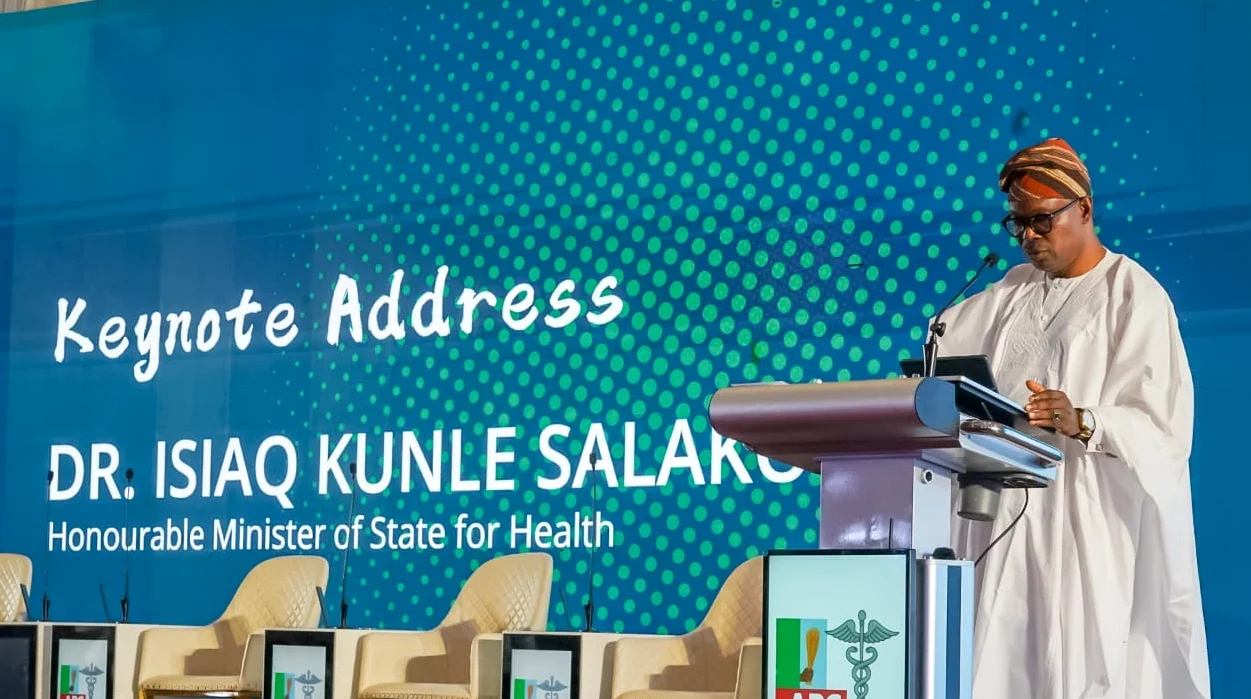
The Nigerian government has announced plans to enforce mandatory health insurance across federal ministries, departments, and agencies in a bid to reduce the country’s high out-of-pocket health spending, which currently accounts for 71% of total health expenditure. The move was announced by the Minister of State for Health and Social Welfare, Iziaq Salako, during his address at the APC Medical Council Health Roundtable Conference in Abuja.
Health Financing Reforms and Coverage Goals
Salako stated that despite a national health insurance coverage of between 10 and 13% of the population, the high out-of-pocket expenditure remains a critical issue. He described the situation as unsustainable, noting that it pushes millions of Nigerians into poverty annually.
Government health expenditure currently stands at 5.2% of GDP, far below the 15% benchmark set by the African Union’s Abuja Declaration. Per capita health expenditure from all sources is approximately $43, while external financing accounts for 21% of total health spending.
The federal government is pushing for health financing reforms to ensure the release of funds under the Basic Health Care Provision Fund (BHCPF), improve capital expenditure implementation, and meet obligations tied to the Health Infrastructure Bond. States are being encouraged to meet health budget benchmarks and release counterpart funding to match donor-supported programs.
Expanding Health Insurance Coverage
Salako noted that over 20 million Nigerians have been enrolled into health insurance through formal sector contributions, vulnerable group programs, and BHCPF integration pathways. He attributed the expected acceleration in coverage to a recent executive order by President Bola Tinubu mandating the implementation of health insurance across federal MDAs, including entities involved in public procurement and the defined benefits scheme for retirees.
The government aims to exceed its 2027 target of 20% coverage by expanding enrolment, scaling up the inclusion of vulnerable groups, and broadening benefit packages to cover catastrophic illnesses, non-communicable diseases, mental health, and emergency services.
The convergence of the BHCPF and the National Health Insurance Authority (NHIA) framework provides a strong mechanism to drive universal health coverage, provided states enforce mandatory subscription.
Health Sector Renewal and Workforce Challenges
Beyond financing, the administration is implementing the Nigerian Health Sector Renewal Investment Initiative (NHSRII), launched in December 2023, under a Sector-Wide Approach (SWAp). The initiative rests on four pillars: governance reform, equitable and quality service delivery, unlocking the healthcare value chain, and strengthening health security using the 7-1-7 framework.
Salako acknowledged that Nigeria continues to grapple with workforce shortages, with a doctor-to-population ratio of 1:5,000 compared to the World Health Organisation’s recommended 1:600, and a nurse-to-population ratio of 1:2,000 against the recommended 1:300. Although over 37,000 health workers have been recruited since 2023, brain drain, urban concentration of personnel, and industrial disputes remain challenges.
Citing preliminary results from the 2023 Nigeria Demographic and Health Survey, Salako said maternal mortality stands at 512 deaths per 100,000 live births, down from 576 in 2018, while under-five mortality is 110 per 1,000 live births. Skilled birth attendance has risen to 53%, and full immunisation coverage to 39%.
He added that Nigeria has recorded zero wild poliovirus cases since 2020, and HPV vaccination has reached over 15 million girls aged nine to 14. Laboratory capacity for PCR testing has expanded from five to 129 laboratories, with emergency operations centres established in 32 states and real-time surveillance systems deployed nationwide.
Despite what he described as notable progress, Salako said reforms are not happening at the pace required for Nigeria’s population of over 230 million. He called for stronger political commitment to prioritising health in national and subnational budgets, the timely release of allocated funds, improved accountability, and sustained collaboration across sectors.
“The resilient health system we seek is one where every Nigerian, regardless of location or income, can access quality healthcare without financial hardship,” he said.






Comments
No comments yet
Be the first to share your thoughts