

Bergen County Academies is at the forefront of student-led scientific innovation, with projects ranging from assistive devices for the deaf to major research in cancer biology and biotechnology. The school’s Mechatronics Research Laboratory, led by instructor Carlos Nodarse, has become a hub for students to develop and refine their ideas, many of which have led to patents and real-world applications.
Nodarse maintains an “idea vault” with over 14 years of student inventions, including detailed instructions for building each project. One notable example is a device developed by a culinary student to control edema, a condition that affected a family member. The invention earned the student top honors at the district’s science expo and eventually led to participation in the Regeneron International Science and Engineering Fair.
The idea vault began when a student created a device to help deaf drivers detect emergency vehicles through vibration and a digital display. After the student’s father requested the device, Nodarse and the student created detailed instructions for building the device. This experience inspired the inclusion of “instructables” in all research projects, a practice that has since become a cornerstone of the Mechatronics Lab.
Recent projects have pushed the boundaries of scientific research. 2024 graduate Muhammed El-Sherbiny designed a system using lasers to cut “windows” into chicken eggs, allowing researchers to study embryos without damaging their protective membranes. This method could revolutionize drug testing for diseases. El-Sherbiny’s work earned him the Regeneron ISEF 2023 Grand Award in Biomedical Engineering and is currently under patent review.
El-Sherbiny and Nodarse spent nearly four years refining the project, using mostly recycled materials. The system includes a quad laser, an incubator with a camera, and testing kits, all aimed at making the research process more efficient and cost-effective.
Bergen County Academies Superintendent Howard Lerner emphasized the school’s commitment to supporting innovation. “We know our students come to us highly motivated to make meaningful contributions in the fields they’re pursuing,” he said. “We help students build a foundation through their learning and offer a range of resources, including dedicated staff, but the students take control to bring their ideas to life.”
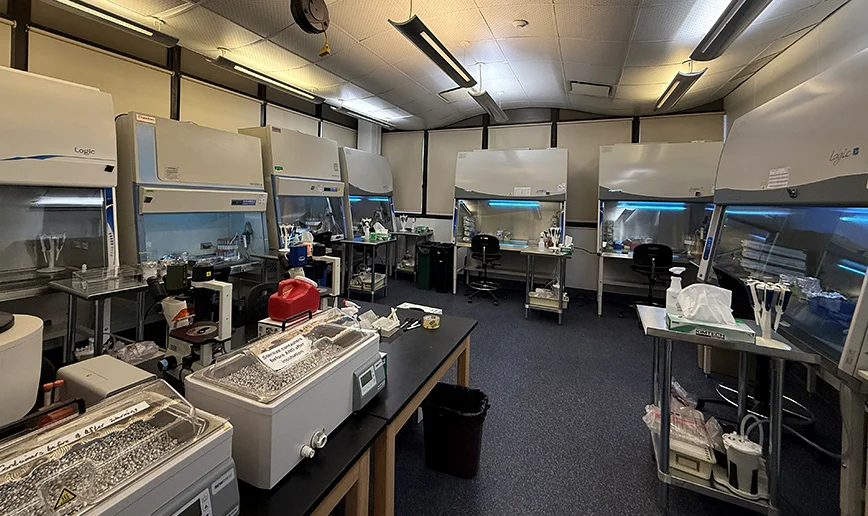
Student-led research has also made strides in cancer biology. Senior Uyen Tran, a semifinalist in the Regeneron Science Talent Search, is investigating the role of sex hormones in lung cancer. Using human lung cancer cells in the school’s Bioresearch Lab, she tested how estrogen and the anti-estrogen drug Tamoxifen affected cancer cell growth. Tran found that estrogen slowed cancer cell proliferation, a finding that challenges existing research and highlights the complexity of cancer biology.
Tran’s research mentor, Dr. Ericka Smith-Worley, noted the school’s access to advanced equipment and funding, including support from local, county, state, and federal sources. “The Bioresearch Lab is equipped with compounds, cell lines, and other materials needed for high-level research,” she said.
Across New Jersey, vocational-technical schools are evolving to prepare students for careers in science. Passaic County Technical Institute recently opened the John Currie Biotechnology Innovation Center, the first DNA Learning Center in New Jersey, in partnership with Cold Spring Harbor Laboratory, a hub for Nobel Prize-winning DNA research. The center provides students with access to advanced technologies and DNA labs, offering hands-on experience with CRISPR gene-editing tools.
Biotechnology program supervisor Michael Petruccelli said the partnership with Cold Spring Harbor is a game-changer. “Having Nobel Prize winners and pioneers in DNA research on campus is a significant opportunity for our students and staff,” he said. The first class of biotechnology students, now juniors, will begin a Capstone research project next year, a requirement for students pursuing dual credits and an associate degree while in high school.
Dr. Ganna Osetska, a biotechnology instructor, emphasized the program’s hands-on approach. “Students learn how to approach a problem, structure the research, set controls, and troubleshoot both failures and successes,” she said. The program’s integration of academic theory with practical skills prepares students for real-world research challenges.






Comments
No comments yet
Be the first to share your thoughts