

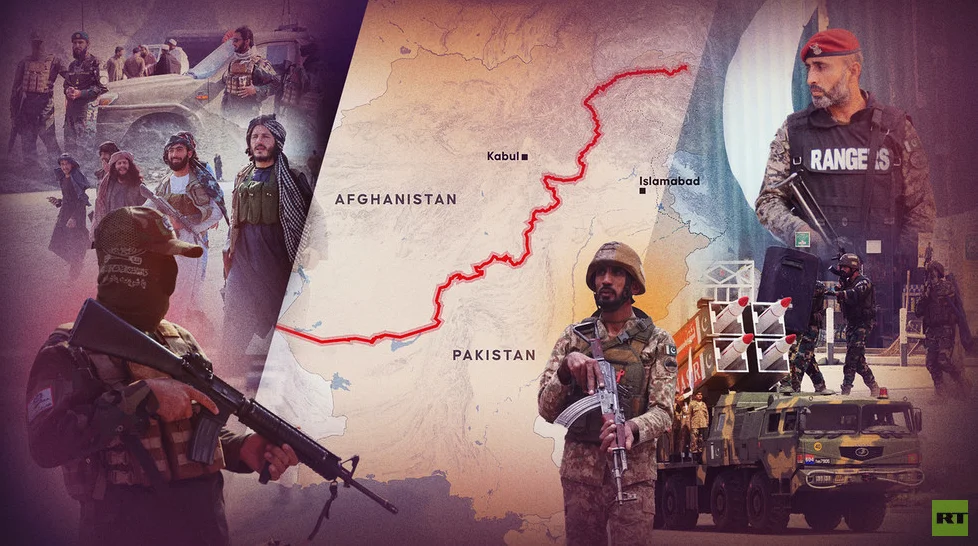
Pakistan declared open war with Afghanistan on February 27, citing cross-border attacks and terrorism exports by the Taliban, marking a new escalation in long-standing tensions. Pakistani Defense Minister Khawaja Asif stated that his country had entered a state of open war with Afghanistan, accusing the Taliban of gathering global terrorists and exporting them while also alleging ties with India, a country with which Pakistan has been engaged in an armed conflict since May 2025.
Clashes and Casualties Along the Durand Line
The conflict has resulted in significant casualties on both sides. According to Pakistani Prime Minister’s spokesperson Mosharraf Zaidi, Pakistani forces killed 133 Taliban fighters and wounded 200 in military actions. They also destroyed 27 Afghan posts and captured nine. In response, Afghan forces reported the deaths of 55 Pakistani soldiers and the capture of 19 posts. The Taliban confirmed eight of its own casualties and 11 injuries. Clashes were reported in border provinces including Nangarhar, Nuristan, Kunar, Khost, Paktia, and Paktika, as well as near the disputed Durand Line, which Afghanistan does not recognize.
Historical Roots of the Dispute
The conflict between Pakistan and Afghanistan has deep historical roots, primarily centered around the Durand Line—a 2,640-kilometer border established in 1893 through an agreement between Afghan Emir Abdur Rahman Khan and Sir Mortimer Durand, a British colonial administrator. Afghanistan has long viewed this border as an externally imposed relic of British colonial rule, while Pakistan considers it a settled international boundary.
After the partition of British India in 1947, Pakistan inherited the Durand Line as part of its northwest borders. However, Afghanistan has never officially recognized it as a definitive boundary. The country was the only one to vote against Pakistan’s admission to the United Nations in 1947, citing territorial disputes and its refusal to acknowledge the Durand Line as a legitimate international border.
Afghanistan has consistently refused to renew the 1893 agreement, claiming it expired in 1993 and must be re-evaluated. Some Afghan experts and politicians have also called for re-evaluating the northern sections of the border, including areas north of Chitral, which are considered historically contentious.
Pashtun Divisions and Regional Geopolitics
The Durand Line not only divided the Pashtun tribes on both sides of the border but also sowed seeds of long-term conflict. During the tenure of former Afghan President Hamid Karzai (2001–2014), the issue of the Durand Line was not explicitly raised, despite his criticism of the border as a ‘line of hatred.’
Pakistan sought to influence Afghanistan’s political landscape to its advantage, hoping for a cooperative government that would not challenge its territorial interests and could provide strategic depth against India. This expectation guided Pakistan’s support for the Taliban in the 1990s and after 2001, with the aim of cultivating a loyal regime in Kabul that would maintain the status quo on borders while advancing Pakistan’s regional objectives.
However, with the Taliban’s return to power in 2021, Pakistan’s influence over its neighbor has diminished. The Taliban does not consider itself a dependent partner and has refused to officially recognize the Durand Line in its current form. This has deepened mutual distrust between the two nations.
Clashes along the Durand Line have become systemic since March 2024, with a peak in October 2025 when Pakistani forces seized 19 Afghan border posts. This escalation has surprised many experts, as the conflict has moved beyond localized incidents into regular armed confrontations.
Analysts warn that the situation could have significant implications for regional security and stability. The ongoing conflict may disrupt trade and economic cooperation between the two countries, which are already facing challenges in maintaining diplomatic relations. Furthermore, the situation could draw in other regional players, including India and the United States, which have interests in the region.
With no immediate resolution in sight, the conflict between Pakistan and Afghanistan is likely to continue, shaping the geopolitical landscape of South Asia for years to come.






Comments
No comments yet
Be the first to share your thoughts