

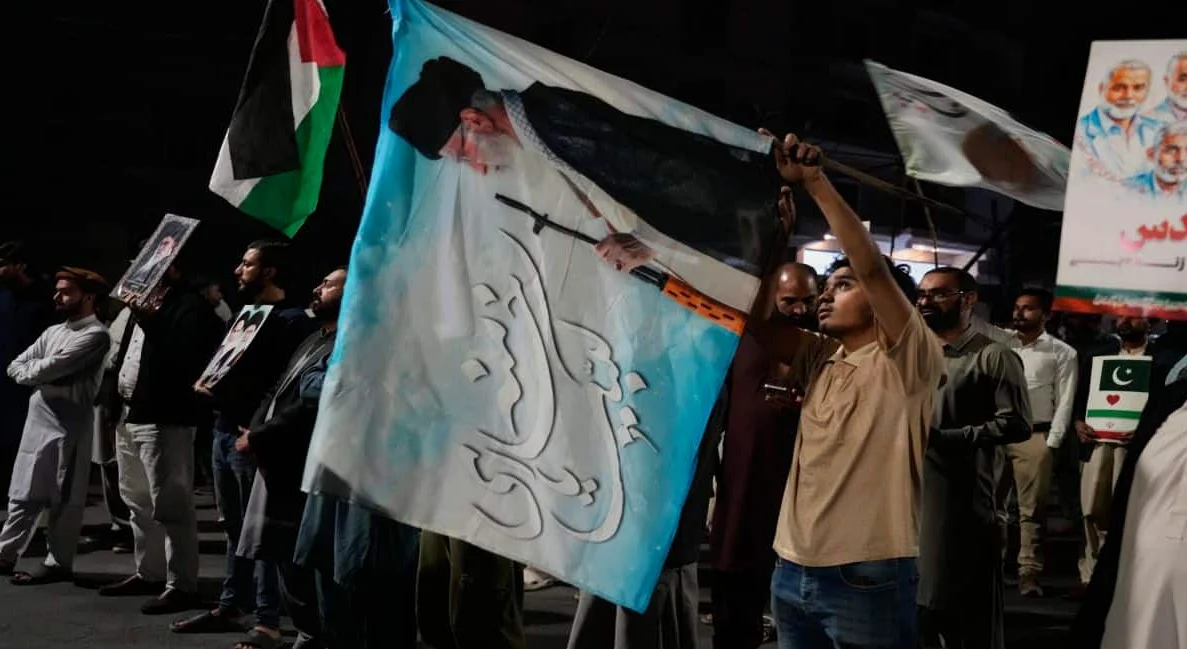
Pakistan is on high alert after violent protests erupted across the country following the reported death of Iran’s Supreme Leader, Ayatollah Ali Khamenei, in a joint U.S.-Israel air strike on Tehran. The incident has triggered widespread unrest, with 22 people killed in the ensuing clashes, and has placed Islamabad at a critical crossroads in its foreign policy.
Violence and Casualties in Major Cities
According to officials, 22 people have died in the violence that followed the news of Khamenei’s death. Ten of the victims were killed in Karachi, eight in Skardu, and two in Islamabad. Protests reached their peak in Islamabad, where thousands gathered near the Red Zone, a heavily fortified area housing government buildings, the parliament, and the U.S. embassy.
Protesters chanted anti-U.S. slogans, calling those who align with Washington “traitors” and demanding “revenge against Israel.” Security forces responded with tear gas, rubber bullets, and in some cases, live rounds. Witnesses reported hearing gunfire as the crowds attempted to breach the barricades surrounding the Red Zone.
Violence also spread to Karachi and Lahore, where protesters targeted the U.S. consulate and set parts of the premises on fire. In Skardu, a United Nations office was set ablaze, and nearby buildings were damaged. The unrest has left the government scrambling to contain the situation and prevent further escalation.
Pakistan’s Official Response and Diplomatic Outreach
Pakistan’s Prime Minister Shehbaz Sharif expressed “grief and sorrow” over the death of Khamenei in a social media post. He called for the protection of state leaders, stating, “It is an age-old convention that the heads of state/government should not be targeted.”
Foreign Minister Ishaq Dar condemned the attacks on Iran and called for an immediate halt to the conflict through diplomatic means. Interior Minister Mohsin Naqvi urged citizens to “record their protest peacefully” and not to take the law into their own hands.
Interestingly, Pakistan also condemned Iran’s retaliation against Saudi Arabia, Bahrain, Jordan, Kuwait, Qatar, and the UAE, calling the attacks “blatant violations of sovereignty.” The prime minister held talks with Jordan and Bahrain’s leaders, and the foreign minister engaged with counterparts in Oman and Iraq to address the regional tensions.
Strategic Dilemma in a Complex Region
The death of Khamenei has placed Pakistan in a precarious position, as it maintains close ties with both the United States and Iran. Islamabad has cultivated strong relationships with U.S. President Donald Trump, who has referred to Prime Minister Shehbaz Sharif as a “friend.” Pakistan also relies heavily on the U.S. for defense equipment, including its F-16 fighter jets, and for counterterrorism cooperation.
At the same time, Pakistan shares deep historical, cultural, and economic ties with Iran. The two countries have maintained bilateral engagement on regional issues, and Tehran has publicly acknowledged Pakistan’s support during past crises. This complex relationship has left Islamabad in a difficult position as tensions between Iran and Israel, as well as the U.S., escalate.
Compounding the situation, Pakistan has a strategic mutual defense agreement with Saudi Arabia, which stipulates that “an attack on one is an attack on both.” This raises fears that if Saudi Arabia were to retaliate against Iran, Pakistan could be drawn into the conflict.
Adding to the challenge, Pakistan is already engaged in what its defense minister has called an “open war” with Afghanistan, limiting its military capacity to manage a potential confrontation with Iran. The country shares a long and porous border with Iran, making a direct military clash extremely risky.
As the situation unfolds, Pakistan is expected to continue its balancing act, seeking to maintain its relationships with both the U.S. and Iran while avoiding direct involvement in the escalating conflict. The coming days will be crucial in determining how Islamabad handles this volatile regional landscape.



Comments
No comments yet
Be the first to share your thoughts