

 The Guardian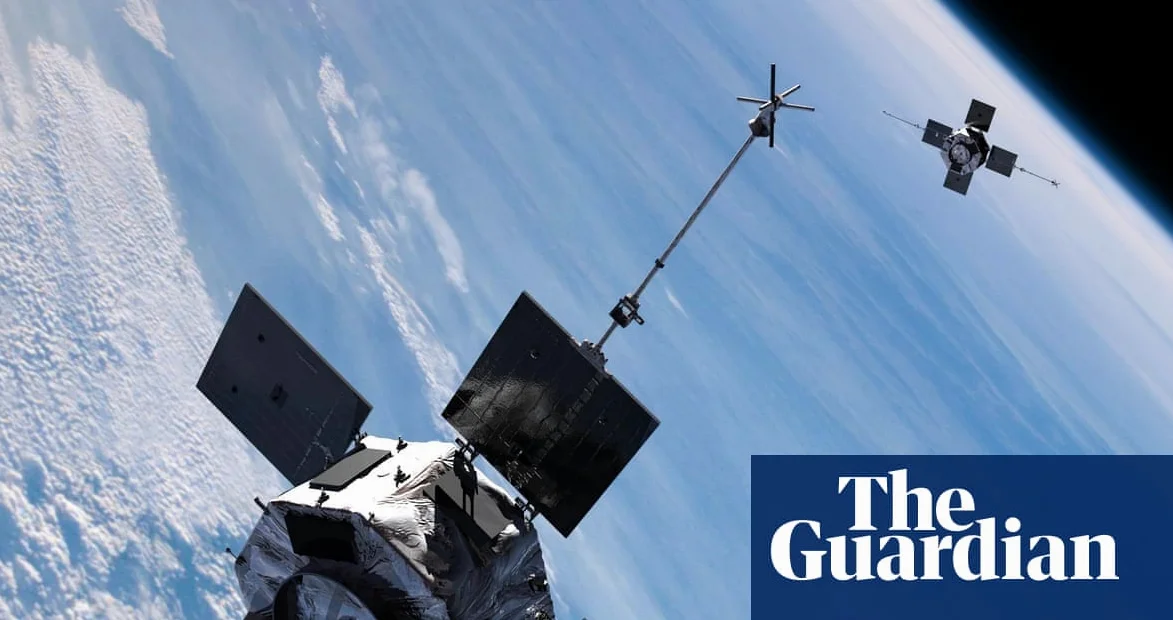
Parts of a giant NASA satellite are set to crash into Earth on Tuesday evening, but the risk of injury is extremely low, according to the US Space Force. The spacecraft, weighing approximately 1,323 pounds (600 kilograms), was launched in 2012 to study the Van Allen radiation belts. It is expected to re-enter Earth’s atmosphere at around 7:45 p.m. EDT, with most of the satellite burning up during re-entry.
Re-entry Predictions and Survival Odds
The US Space Force released a prediction on Monday, stating that while most of the satellite will disintegrate upon re-entry, some components are expected to survive. The chance of any person being harmed is estimated at 1 in 4,200, according to the agency. Officials emphasized that the re-entry time has an initial uncertainty of plus or minus 24 hours.
According to a 2009 report by Wired, over 5,400 tons of space debris are thought to have survived re-entry over a 40-year period. However, the odds of being hit by such debris are low because about 71% of Earth’s surface is covered by water. A 2011 report by space.com stated that the overall chance of anyone being hurt was 1 in 3,200, and for any given individual, the risk is even smaller.
Mark Matney, a scientist in the orbital debris program office at NASA’s Johnson Space Center in Houston, told space.com that the odds of any individual being struck by space debris are about one in several trillion. ‘The odds are quite low for any particular person,’ he said.
Historical Precedents and Personal Impact
Despite the low risk, historical precedents show that space debris can reach Earth. In January 1997, Lottie Williams, a resident of Tulsa, Oklahoma, was struck by a six-inch chunk of metal while walking through a park. The fragment was later confirmed by NASA to be consistent with the re-entry of the second stage of a Delta rocket. Although Williams was not injured, she remains the only known person to have been struck by manufactured space debris.
On Sunday, a meteor crashed through the roof of a house in Germany, one of an estimated 15,000 to 17,000 meteorites to reach Earth annually. However, the majority of these objects end up in the ocean, significantly reducing the risk to populated areas.
Origins and Mission of the Van Allen Probe
The satellite in question is Van Allen Probe A, one of two twin probes launched from Cape Canaveral, Florida, on August 30, 2012. The mission aimed to investigate the Van Allen belts, regions of charged particles trapped by Earth’s magnetic field. The probes were deactivated in 2019 when they ran out of fuel and could no longer orient themselves toward the sun.
Initial calculations suggested the probes would re-enter Earth’s atmosphere in 2034, but these estimates proved inaccurate. The second probe is not expected to return before the end of the decade. NASA and the Space Force continue to monitor the re-entry and update predictions as more data becomes available.
While the re-entry of space debris is not uncommon, the event involving parts of the Van Allen Probe A highlights the ongoing challenge of managing space junk. As more satellites are launched into orbit, the risk of uncontrolled re-entries may increase. However, for the general public, the likelihood of being affected remains extremely low.
Experts continue to emphasize that the vast majority of space debris burns up upon re-entry, with only a small fraction surviving to reach the Earth’s surface. The Space Force and NASA remain committed to tracking such events and providing timely updates to the public.






Comments
No comments yet
Be the first to share your thoughts