

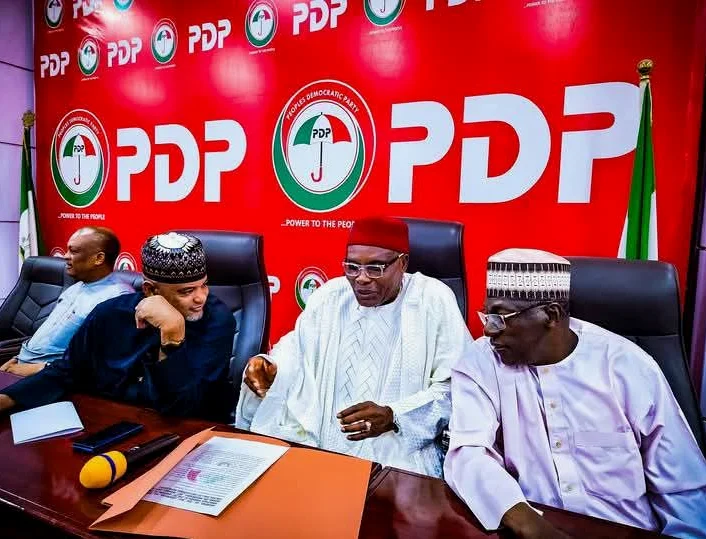
The Peoples Democratic Party (PDP), once Africa’s largest political party, now controls just two states after a dramatic decline in influence. What was once a dominant force in Nigerian politics, with control over 30 states as recently as 2007, now holds power in only Oyo and Bauchi following the 2023 general elections.
The Rise and Fall of a Political Giant
The PDP was founded in 1998 and played a key role in Nigeria’s return to democracy in 1999. At its peak, it held power in 24 states between 1999 and 2003 and expanded to control 30 states by 2007. Its influence was so strong that then National Chairman Chief Vincent Ogbulafor once declared the party would rule Nigeria for the next 60 years.
Ogbulafor’s confidence was rooted in the party’s leadership, which included political heavyweights like former President Olusegun Obasanjo, Vice President Atiku Abubakar, and other prominent figures. The PDP’s dominance was further solidified by its control of the presidency, the National Assembly, and various state legislatures.
However, the PDP’s trajectory began to shift in 2013 with the emergence of the All Progressives Congress (APC), which gradually eroded the PDP’s influence. By 2023, the party had lost control of 10 of its previously held states, with only Oyo and Bauchi remaining under its control.
A Defection Crisis and Internal Strife
The decline of the PDP has been marked by a series of high-profile defections. Between 2025 and 2026, six PDP governors, including Sheriff Oborevwori of Delta and Umo Eno of Akwa Ibom, left the party to join the APC. The latest defection was that of Gov. Dauda Lawal of Zamfara, who cited internal party crisis and the need for stronger unity to address security and development challenges as reasons for his move.
Political analysts attribute the PDP’s decline to a lack of internal cohesion, misgovernance, and power struggles. Laolu Afolabi, a political analyst, noted that the party was plagued by weak discipline, thin ideology, and power struggles managed by elite consensus rather than internal democracy.
The build-up to the 2023 general elections marked a turning point. The idea of zoning the presidential ticket to the Southern part of the country was initially proposed but was later abandoned after political heavyweights like Atiku Abubakar and Bukola Saraki insisted that the presidential ticket should be open to all.
According to the then PDP National Chairman, Dr Iyorchia Ayu, the party would have to step down if a Northern candidate emerged, allowing a Southerner to take over the party’s leadership. However, Ayu refused to step down after Atiku Abubakar was selected as the presidential candidate, deepening the party’s crisis.
Leadership Struggles and Legal Challenges
The internal strife culminated in the withdrawal of support from several governors, including Nyesom Wike of Rivers, Seyi Makinde of Oyo, and others. These leaders, known as the G5 governors, argued that the presidency should rotate from the North to the South to uphold the principles of inclusivity and rotational leadership.
Following the 2023 elections, Wike and other G5 governors publicly supported the APC presidential candidate, Bola Tinubu, even as they retained their PDP membership. Tinubu’s victory led to Wike’s appointment as FCT Minister, while Makinde later fell out with Tinubu, becoming the leader of a faction within the PDP.
The ongoing power struggles have led to legal entanglements, including the recent Court of Appeal judgment affirming the nullification of the PDP’s national convention in Ibadan in November 2025. The convention had produced a leadership team loyal to Makinde and his Bauchi counterpart, Bala Mohammed.
Political analysts suggest that the legal challenges, combined with the reported alignment of Makinde and Mohammed with the ADC (Alliance for Democracy and Change) coalition, may mark the final collapse of the once-mighty PDP. The party’s decline has also prompted calls for the APC to learn from the PDP’s missteps and ensure internal cohesion and democratic practices.
The PDP’s free fall from Africa’s largest political party to a party controlling just two states is a stark reminder of the fragility of political power in Nigeria. As the party continues to face internal and external challenges, its future remains uncertain, with many believing it will take miracles for the PDP to regain its former influence.






Comments
No comments yet
Be the first to share your thoughts