

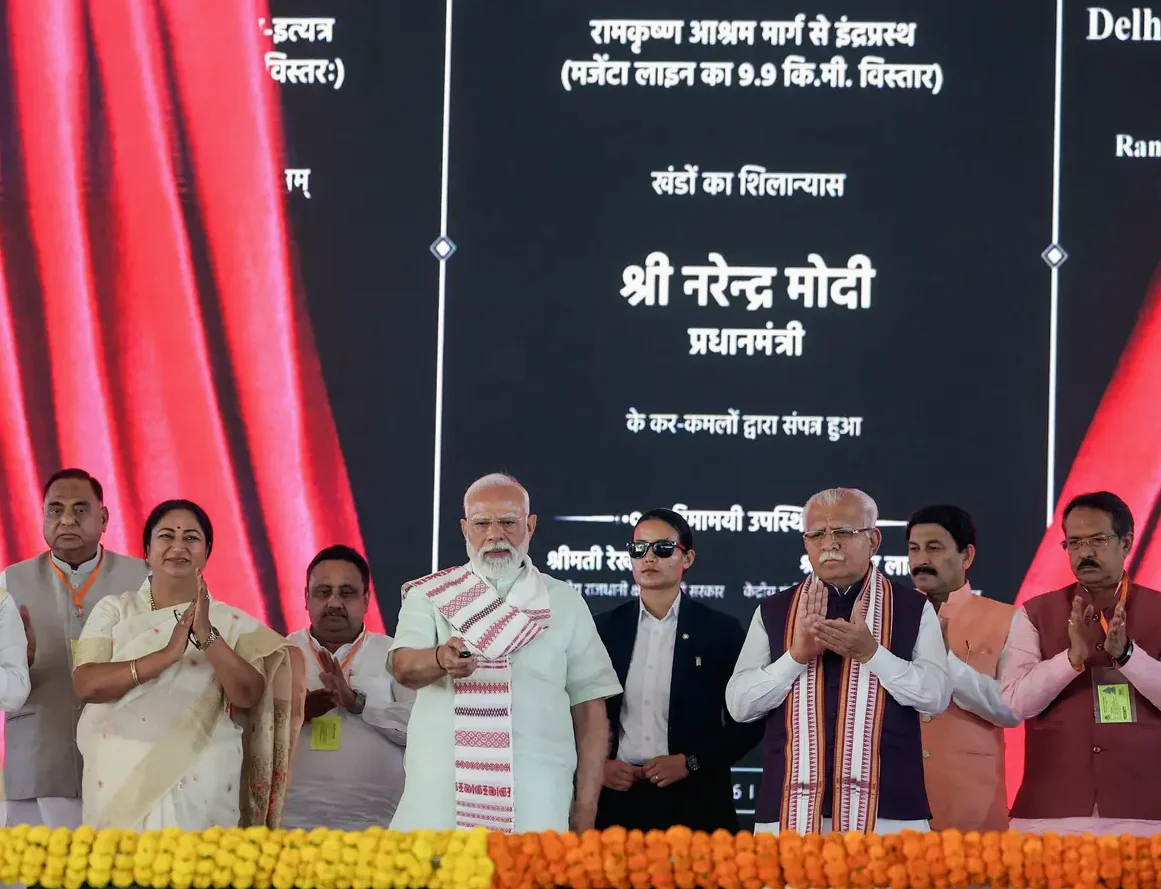
Prime Minister Narendra Modi on Sunday inaugurated two new corridors of the Delhi Metro, including the first ‘Ring Metro’ of the country that runs across large parts of the city. The inauguration includes the Majlis Park-Maujpur Babarpur section of the Pink Line, which is around 12.3 km, and the Deepali Chowk-Majlis Park stretch of the Magenta Line, which spans around 9.9 km.
The Ring Metro: A New Era for Delhi Commuters
The Majlis Park-Maujpur-Babarpur corridor consists of eight elevated stations, which form part of the Majlis Park-Shiv Vihar Pink Line, which is already active. In addition, the Pink Line has stretched to almost 71.56 km, marking it the first fully operational ‘Ring Metro’ of India.
The stations on this corridor are Majlis Park, Burari, Soorghat, Nanaksar-Sonia Vihar, Jharoda Majra, Jagatpur-Wazirabad, Khajuri Khas, Bhajanpura, Yamuna Vihar and Maujpur-Babarpur. The corridor also includes a newly built bridge over the Yamuna, along with a double-decker viaduct that carries both a metro line and a road flyover.
The second corridor, running from Deepali Chowk to Majlis Park, is an elevated extension of the Botanical Garden-Krishna Park Extension Magenta Line and consists of seven stations. With this addition, the total length of the Magenta Line has increased to about 49 km.
The stations along this stretch are Deepali Chowk, Madhuban Chowk, Uttar Pitampura-Prashant Vihar, Haiderpur Village, Haiderpur Badli Mor, Bhalswa, and Majlis Park. Some sections of the Deepali Chowk-Majlis Park corridor rise to a height of about 28.36 metres, making it one of the highest elevated stretches in the Delhi Metro network.
Infrastructure Upgrades and Future Projects
Additionally, PM Modi also inaugurated three new metro corridors under Phase V-A of the Delhi Metro project, which covers around 16.10 kilometres. The corridors include the underground Central Vista corridor connecting RK Ashram Marg and Indraprastha, an underground extension between Aerocity and Indira Gandhi Airport Terminal-1, as well as an elevated extension linking Tughlakabad and Kalindi Kunj.
The Ring Metro is expected to significantly reduce traffic congestion in Delhi, which has long been plagued by severe traffic jams and pollution. With the new corridors, the metro network is set to expand further, offering more options for commuters and reducing dependency on private vehicles.
Delhi has been steadily expanding its metro network over the past two decades, with the first line opening in 2002. The current network spans over 390 km, serving millions of commuters daily. The completion of the Ring Metro is a major step in this ongoing expansion, as it will connect various parts of the city in a loop, allowing for more efficient travel across different zones.
The Deepali Chowk-Majlis Park corridor, with its elevated structure reaching 28.36 metres, is a testament to the engineering advancements made in the project. This section is one of the tallest in the entire Delhi Metro system, highlighting the complexity and scale of the construction efforts.
Experts suggest that the new corridors will not only improve connectivity but also boost the local economy by making areas more accessible. For instance, the Central Vista corridor is expected to enhance access to key government buildings and tourist attractions, while the Aerocity extension will link the city’s airport more smoothly with the rest of the metro network.
The inauguration of these new corridors comes at a time when Delhi is preparing for the 2023 Commonwealth Games, which will be held in the city. Improved infrastructure is a crucial component of the preparations, and the new metro lines are expected to play a significant role in facilitating movement during the event.
According to officials, the completion of the Ring Metro is part of a broader vision to make Delhi a more sustainable and transport-efficient city. The project is also expected to reduce carbon emissions and improve air quality, which are major concerns in the national capital.
What’s Next for Delhi Metro
Looking ahead, the Delhi Metro Corporation is working on several other projects under Phase V and subsequent phases, aiming to cover additional areas and improve the overall network. These projects are expected to be completed in phases over the next few years, with some corridors set to open by the end of 2024.
With the continued expansion of the metro system, Delhi is positioning itself as a model for urban transportation in India. The Ring Metro, in particular, is seen as a significant project that could redefine how the city moves, offering a more integrated and efficient transport solution for its residents.






Comments
No comments yet
Be the first to share your thoughts