

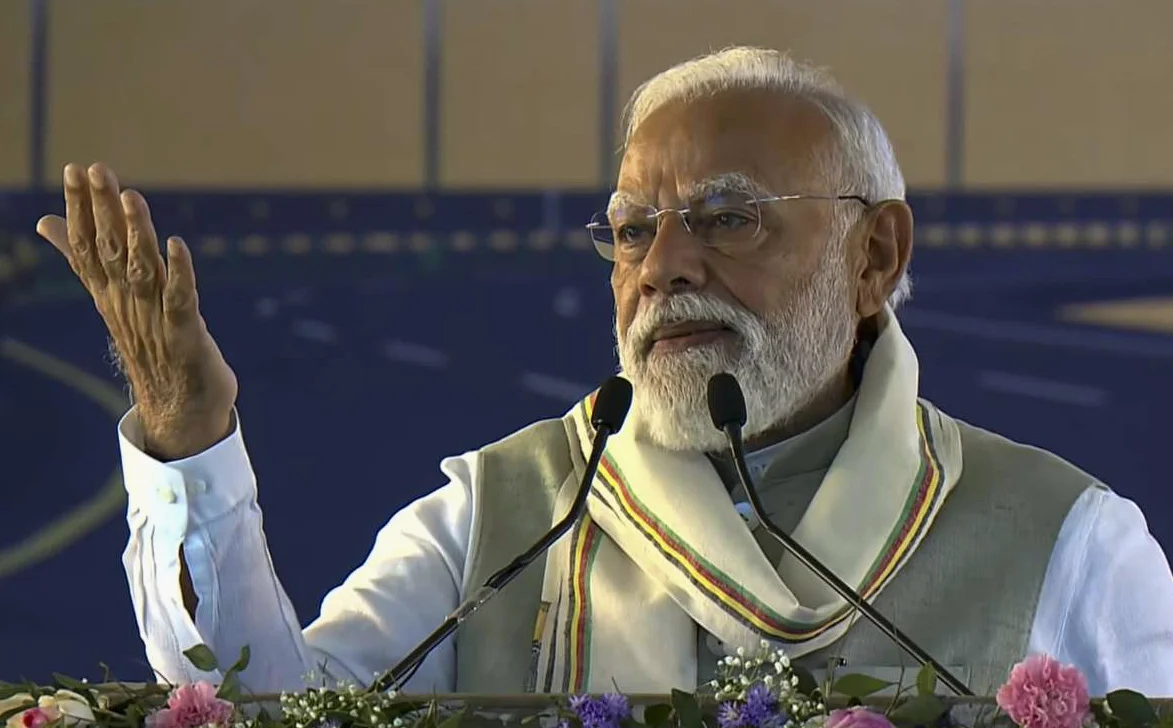
Prime Minister Narendra Modi on Saturday launched a series of development initiatives worth Rs 23,550 crore in Silchar, Assam, during a public meeting where he also criticized the Congress party for its alleged role in shaping India’s northeastern borders during the country’s independence.
Infrastructure Projects Aim to Boost Connectivity
The projects include a Rs 22,864-crore access-controlled expressway connecting Silchar in Cachar district to Shillong in Meghalaya. This 166-km four-lane highway is the first of its kind in the Northeast and is expected to reduce travel time between Guwahati and Silchar from 8.5 hours to approximately 5 hours.
During the ‘bhoomi poojan’ ceremony, Modi emphasized the strategic importance of the expressway, stating it would enhance regional connectivity and economic opportunities. Officials noted that the project would cut the distance between the two cities by 43 km, significantly improving logistics and transport efficiency in the region.
The expressway is part of a larger infrastructure push in the Northeast, where the government has been investing heavily to address long-standing development gaps. According to the Ministry of Road Transport and Highways, the project is expected to generate thousands of jobs and boost local industries.
Modi Criticizes Congress for ‘Creating Panic’
Addressing the public meeting, Modi accused the Congress of failing to act as a responsible political party during times of global uncertainty. He claimed the party had created panic among the people and had not provided any vision for Assam or the nation.
“The Congress should have performed the role of a responsible political party, but it failed to do so. It is trying to create panic among the people,” Modi alleged, according to a report.
He further accused the Congress of misleading the youth of Assam into paths of violence and terrorism. “Where Congress stops thinking, we start working,” he said, highlighting the BJP’s focus on development for those left behind.
Modi also criticized the Congress for its alleged role in drawing India’s borders during independence, which he said cut off the Barak Valley’s access to the sea. He claimed that the Congress had left the Northeast to fend for itself and played a major role in weakening the region’s economic and strategic position.
Historical Allegations and Regional Impact
Modi’s remarks come amid growing political tensions in the Northeast, where the Congress has historically held significant influence. The Barak Valley, a region in Assam, has long been a focal point of political and economic debates due to its strategic location and historical trade routes.
“Barak Valley was once a major hub of trade and commerce. Just as Congress left the North-East on its own, in a similar way, it played a major role in weakening Barak Valley,” Modi stated, according to the report.
Analysts have noted that Modi’s speech reflects a broader narrative of the BJP government emphasizing development as a tool for political consolidation in the Northeast. The region has seen significant investment in infrastructure and connectivity in recent years, with the aim of reducing economic disparities and supporting regional integration.
According to a recent economic survey, the Northeast region has been growing at a faster rate than the national average, driven by improved infrastructure and increased investment. The government has set a target of achieving 8% annual GDP growth in the region by 2027.
Future Developments and Political Landscape
Modi’s visit to Assam and the revealing of major infrastructure projects are expected to have a lasting impact on the region’s political and economic landscape. The government has indicated that more projects are in the pipeline, with a focus on improving transportation, energy, and digital infrastructure.
“The government is committed to ensuring that the Northeast becomes a hub of opportunities for the youth,” said an official at the event. “These projects are just the beginning of a larger development agenda for the region.”
With the upcoming state elections in several Northeastern states, Modi’s focus on development is likely to be a key campaign strategy. Political analysts suggest that the BJP’s emphasis on infrastructure and economic growth could strengthen its position in the region.
What remains to be seen is how the Congress and other regional parties will respond to the government’s development agenda. With the region’s economy growing and infrastructure improving, the political dynamics in the Northeast are set to evolve in the coming months.






Comments
No comments yet
Be the first to share your thoughts