

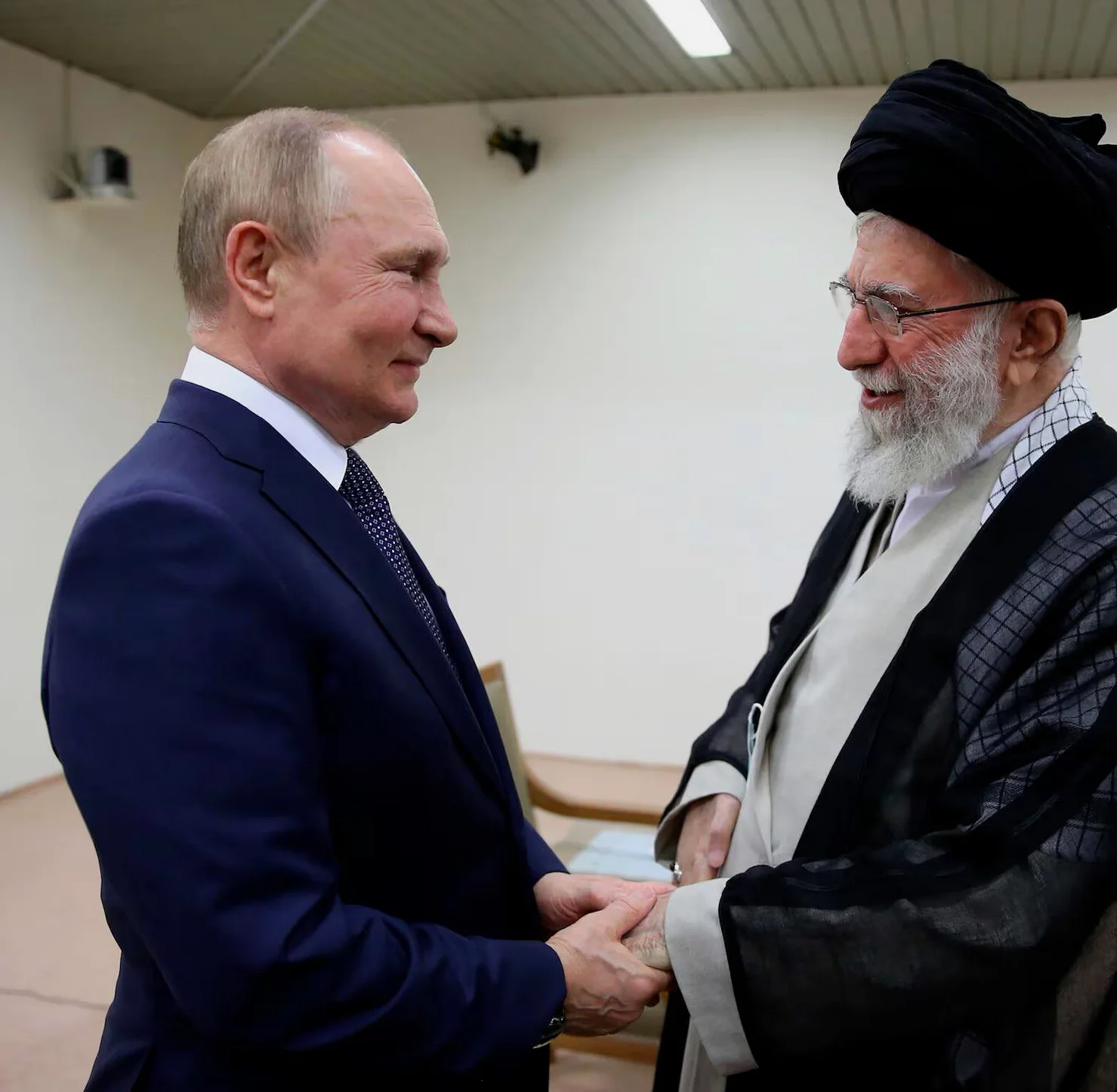
Russian President Vladimir Putin has extended his condolences to Iranian President Masoud Pezeshkian over the assassination of Supreme Leader of Iran Ali Khamenei and members of his family, describing the attack as a ‘cynical violation of all norms of human morality and international law.’
Putin’s Statement on the Attack
In a message to Pezeshkian, Putin said, ‘Please, accept my deepest condolences on the assassination of Supreme Leader of the Islamic Republic of Iran Seyyed Ali Khamenei and members of his family.’ He called for the attack to be condemned globally and emphasized the need for international unity in response to such violence.
Putin further praised Khamenei’s role in strengthening Russia-Iran relations, stating, ‘In our country, Grand Ayatollah Khamenei will be remembered as an outstanding statesman who made an enormous personal contribution to the development of friendly ties between Russia and Iran and to raising them to the level of a thorough strategic partnership.’
Significance for Global Relations
The assassination of Supreme Leader of Iran Ali Khamenei marks a major turning point in the region’s political landscape. As one of the most influential figures in the Middle East, Khamenei’s death is expected to have far-reaching consequences for Iran’s domestic and foreign policy.
Analysts note that Khamenei’s leadership had been key in maintaining Iran’s strategic alignment with Russia, particularly in the context of regional conflicts and sanctions. His death could lead to a power vacuum and potential shifts in Iran’s foreign policy, affecting ongoing negotiations and alliances.
According to the Iranian government, the attack occurred in Tehran on March 1, 2026, with several members of Khamenei’s family also reported to have been killed. The incident has sparked immediate calls for international solidarity and condemnation.
What Analysts Say About the Aftermath
Experts warn that the assassination could destabilize the region further, given Iran’s role as a key player in Middle Eastern politics. Dr. Reza Farahani, a Middle East analyst, stated, ‘The death of Supreme Leader of Iran Ali Khamenei is a seismic event. It could trigger a power struggle within Iran and potentially lead to a more aggressive stance in regional conflicts.’
Meanwhile, Russian officials have reiterated their commitment to supporting Iran during this difficult time. Putin’s message to Pezeshkian emphasized that Russia would stand by Iran’s side, echoing previous statements about the importance of the Russia-Iran partnership in countering Western influence.
The attack comes at a time of heightened tensions in the Middle East, with ongoing conflicts in Syria, Lebanon, and Israel. The loss of Khamenei, a unifying figure in Iranian politics, may lead to a period of uncertainty and internal power shifts.
According to the Iranian Ministry of Foreign Affairs, a state of mourning has been declared, with public events and services planned across the country. The leadership is expected to hold an emergency session to address the immediate aftermath of the assassination.
International reactions have been swift, with several countries expressing shock and condemnation. The United Nations Security Council has convened an emergency meeting to discuss the incident, highlighting the global concern over the attack.
As the situation develops, the international community is watching closely to see how Iran will respond and whether the assassination will alter the dynamics of regional alliances and conflicts.

Comments
No comments yet
Be the first to share your thoughts