

 BBC
BBC 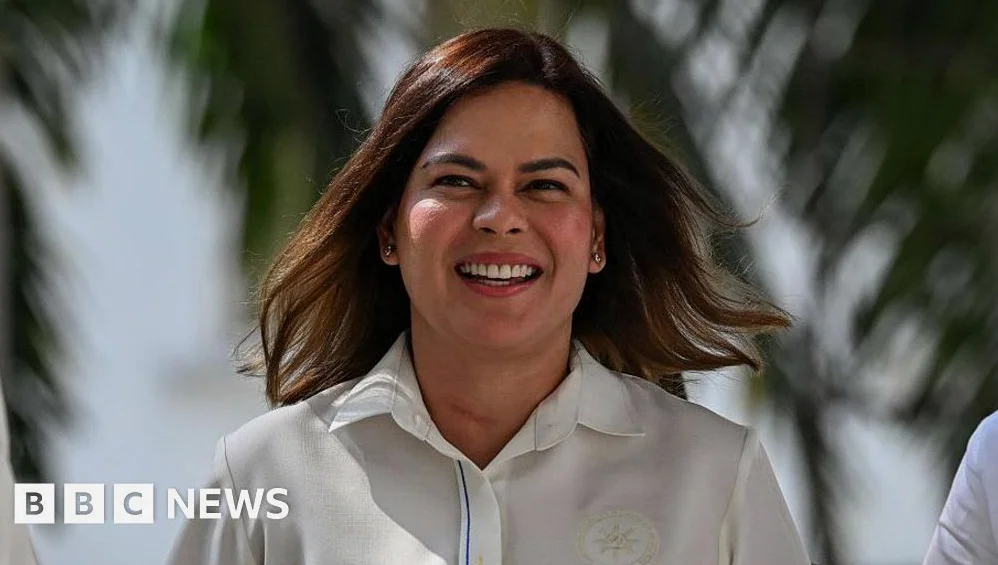
Public hearings on the impeachment case against Philippine Vice-President Sara Duterte have started in Congress, according to BBC; the proceedings are part of an ongoing feud between the Duterte and Marcos families, two of the country’s most powerful political dynasties.
Background of the Impeachment Case
Sara Duterte. 47, is accused of misusing public funds and threatening to kill President Ferdinand Marcos Jr — If convicted, she will be removed from office and barred from running in future elections. Duterte denied the allegations in a written reply, calling the hearings a political ‘fishing expedition’.
Vice-President Sara Duterte is the daughter of former president Rodrigo Duterte, who is currently detained by the International Criminal Court at The Hague, as the court is determining whether he should stand trial for crimes against humanity committed during his ‘war on drugs’. Duterte’s alliance with Marcos. Formed for the 2022 elections, was hailed as a ‘political dream team’ and they won by a landslide.
However, the alliance between the children of two former strongmen presidents soon unraveled as they pursued separate political agendas. As vice-president, Duterte has no official duties aside from succeeding Marcos in case he is unable to finish his term. The president and vice-president are elected separately in the Philippines, with the president limited to a single six-year term while the vice-president can run for president at the end of their term.
Political Rivalry and Personal Ambitions
Historically, this dynamic has resulted in friction between the two officials. A single-term president would want to hold as much influence during their term, while the vice-president would use their term as a springboard for a presidential campaign if the presidency is their ultimate goal.
Duterte announced her candidacy for president in the 2028 election a few weeks before the House impeachment hearings started. The first sign of a crack in their alliance came when Duterte publicly said she wanted to be the defence secretary – and she was made education secretary instead.
She served in that position for two years, and the alleged misuse of millions of pesos in public funds is linked to that time. She has denied wrongdoing and decried the charge as political harassment. At the height of the inquiries, which began in 2024, Duterte said in an explosive late-night live stream that she told one ‘person’ that ‘if I get killed, go kill BBM [President Marcos], [First Lady] Liza Araneta, and [House Speaker] Martin Romualdez.’
Legal Process and Recent Developments
Under Philippine law, officials like the president, vice-president, and chief justice of the Supreme Court can be impeached by the House of Representatives if they commit an impeachable offence – culpable violation of the constitution, treason, graft and corruption, bribery, high crimes, and betrayal of public trust.
Once impeached, the case is transmitted to the Senate for trial, which would result in an acquittal or a conviction – in which case, the official will be removed from office and disqualified from running in elections. Sara Duterte was impeached by the House in February 2025, also for alleged corruption and threats to the President. However, it was struck down by the Supreme Court six months later on technical grounds – multiple impeachment proceedings cannot proceed in a single year.
The high court ruling meant that Duterte was immune from impeachment for one year from February 2025. Cases were filed promptly after that one-year prohibition expired. Civil society leaders, Catholic priests, and left-wing groups filed the complaints, which were endorsed by members of the House.
On 25 March, the House Committee on Justice started hearings on the case and will look at evidence against Duterte as well as her written response to the charges. The vice-president has been invited to appear but it is unclear if she will attend. The committee’s findings will be forwarded to the House plenary for a vote, where the approval of one-third of its members is needed to forward the Articles of Impeachment to the Senate for trial.
The country’s 24 senators will serve as judges while the chief justice of the Supreme Court will sit as the trial’s presiding officer. A two-thirds majority is required for conviction. Impeachments in the Philippines have marked periods of political turmoil. In late 2000, then President Joseph Estrada was impeached for alleged corruption.
Estrada’s trial at the Senate gripped the nation and ended abruptly after his lawyers blocked evidence of his alleged secret bank accounts. That sparked a military-backed uprising that toppled his government. Since the restoration of democracy in 1986, only one impeachment process was completed – that of former Supreme Court chief justice Renato Corona, who in 2012 was convicted of betrayal of public trust, which stemmed from misdeclaration of his wealth.
What is at Stake and Possible Outcomes
Sara Duterte’s political future is on the line as a conviction in the Senate will disqualify her from running for president in 2028. She is seen as the strongest contender to succeed Marcos. A survey by respected pollster Pulse Asia in March showed the vice-president with a 55% approval rating compared to the president’s 36%.
In the 2025 mid-term elections – considered as a barometer of public support – senatorial candidates allied with Marcos did far worse than expected compared to Duterte’s allies. If Duterte is shut out of the 2028 presidential race, analysts say Marcos will have wider scope to push for a friendlier successor, one that will not harbor a political vendetta against him.
If Duterte survives impeachment, analysts say she could come out stronger. However, protracted impeachment proceedings that are carried live on television and the internet risk affecting public support for her. How are congressmen and senators expected to vote?
Historically, members of the House of Representatives are friendlier to the president and in 2024, the House voted to impeach Duterte and transmitted the case to the Senate for trial. It is in the Senate where the outcome will be harder to predict.
Unlike House members who are elected by district and who depend on the president’s office for funding, the country’s 24 senators are elected on a national level. Philippine senators are considered individual republics with their own political agendas and allegiances and that should be taken into consideration in any vote on Duterte’s case, analysts say.
Ultimately, what is at stake is power beyond 2028. The Duterte and Marcos families both succeeded in rallying Filipinos around their respective narratives and regional affiliations – which run strong in the nation of 7,100 islands. Marcos billed himself as the ‘tiger’ of the Ilocano-speaking north who pledged to restore the Philippines to its ‘golden age’, when his father, the late dictator Ferdinand Marcos Sr. was in office.
Duterte, on the other hand, positioned herself as the ‘eagle’ from the Visayan-speaking country’s south, who would continue her father’s fight for ordinary folk who had been shut out by Manila’s oligarchs and political elite. Four years ago, they were the unstoppable dream team, now they are the bitter rivals in a drawn out battle where only one survives.






Comments
No comments yet
Be the first to share your thoughts