

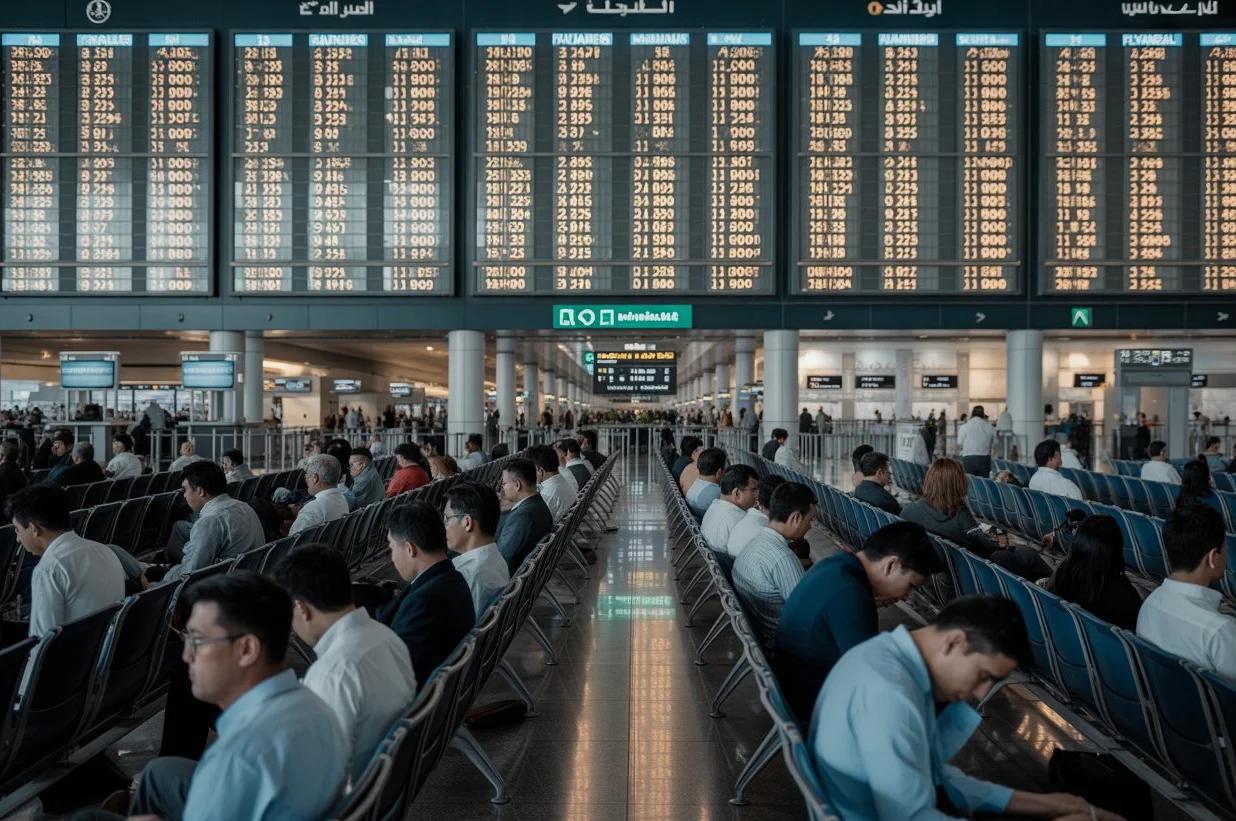
Thousands of passengers were left stranded across Saudi Arabia as major airports in Riyadh, Jeddah, Dammam, and Medina reported 378 flight delays and 148 cancellations over the weekend. The disruptions, which affected airlines including Saudi Airlines, Emirates, Flyadeal, and Air Arabia, caused significant chaos for travelers ranging from families on holiday to business professionals and pilgrims on religious journeys.
Flight Delays and Cancellations Across Major Airports
The largest impact was recorded at King Khalid International Airport in Riyadh, where 147 flights were delayed and 59 were canceled. King Abdulaziz International Airport in Jeddah followed closely, with 137 delays and 45 cancellations. King Fahd International Airport in Dammam reported 58 delays and 32 cancellations, while Prince Mohammad Bin Abdulaziz Airport in Medina saw 36 delays and 12 cancellations.
The General Authority of Civil Aviation (GACA) confirmed it is investigating the cause of the disruptions and working with airlines to restore normal operations. In a statement, GACA emphasized that passenger safety remains the top priority and urged travelers to check real-time flight information and contact their airlines directly for updates.
Impact on Travelers and Airports
Crowded terminals and long queues filled the departures and arrivals halls at King Khalid International Airport for much of the weekend. Travelers reported confusion as boarding times and schedules changed frequently, adding to the stress for those with connecting flights.
Families heading abroad for holidays were among those most affected, with one father of three telling reporters he was caught off guard by the repeated delays without clear updates. Another passenger traveling for urgent medical care overseas described the uncertainty as adding to the emotional strain of an already stressful journey.
At King Abdulaziz International Airport, travelers bound for Europe, Asia, and Africa gathered in concession areas, seeking respite as flight boards fluctuated between cancellation notices and delayed departure times. Flight information screens displayed a constantly changing picture, reinforcing the tenuous nature of air travel under the current conditions.
Efforts to Mitigate the Crisis
Airport lounges and ground staff provided meals, water, and temporary accommodations in some cases, but the disruption triggered long lines at airline customer service desks as travelers scrambled for answers and alternatives. Major carriers operating within the Kingdom, including Saudi Airlines, Flyadeal, and international partners, issued statements reassuring passengers that all efforts were underway to re-route, compensate, or refund impacted travelers.
Airport operators at all four affected hubs worked through the night updating flight information, coordinating ground crews, and assisting stranded passengers. At King Fahd International Airport in Dammam, arrivals and departures displayed ongoing rescheduling, but airport management said additional staff had been deployed to assist passengers and manage the unprecedented backlog.
At Prince Mohammad Bin Abdulaziz Airport, one of the busiest gateways for religious travel to Medina, airport authorities reported a surge in inquiries from pilgrims whose itineraries were affected. The airport’s customer care teams set up additional help desks and phone lines to manage the influx of passengers seeking assistance.
The ripple effect of these disruptions did not remain confined within Saudi Arabia. Airlines based in the UK, Europe, India, and Asia also faced schedule knock-on effects as aircraft rotations and crew assignments were altered. Some international carriers adjusted arrival and departure schedules at their Saudi gateways, while others offered flexible rebooking options for passengers whose onward connections were impacted.
In Europe, travel monitoring organizations issued advisories warning travelers bound for or departing from the Kingdom to expect delays and to factor extra time into their itineraries. Travel service providers and tour operators began informing clients of potential disruptions affecting connecting flights and return journeys to and from Saudi Arabia.
Experts suggest that this disruption stemmed from complex scheduling pressures, regional constraints on airspace capacity, and logistical backlogs exacerbated by high passenger demand. Saudi aviation analysts emphasized that such widespread disruption points to deeper infrastructure and capacity stress, despite the Kingdom’s rapid expansion of its aviation system in recent years.
Authorities and airlines are urging passengers to stay in contact with their airlines and to regularly check real-time flight information before traveling to airports. Saudi airports have also launched additional mobile customer service teams to engage with passengers directly and distribute updates via SMS and airport apps.
For many travelers, the latest spate of delays and cancellations across Saudi Arabia’s major airports served as a stark reminder of the fragility of modern air travel. Families were forced to adjust celebrations, pilgrims postponed spiritual departures, and business travelers rearranged crucial meetings. Yet amidst the frustration and uncertainty, countless stories of patience, solidarity, and shared resilience emerged.
As authorities, airline teams, and airport staff continue working around the clock to restore normal operations, there remains a collective sense of careful optimism—rooted in the belief that every disruption is temporary, but every journey is meaningful.






Comments
No comments yet
Be the first to share your thoughts