

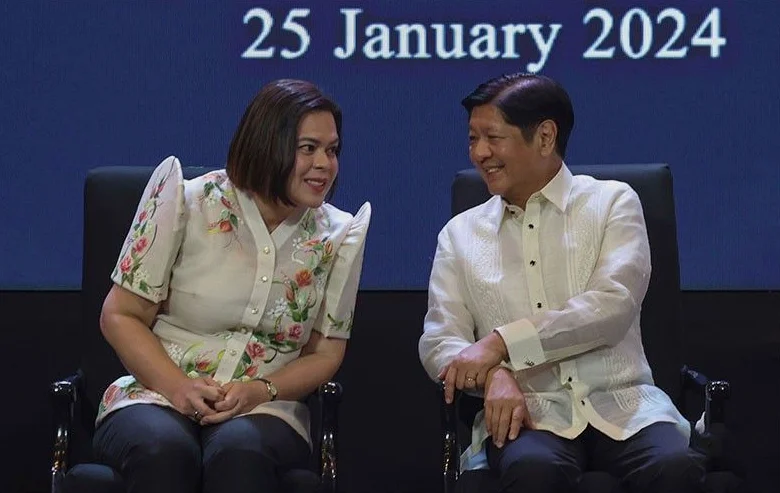
MANILA — Divergent approaches to the Philippines’ territorial clash with China in the South China Sea are widening the split between President Ferdinand R. Marcos Jr. and Vice President Sara Duterte-Carpio. GlobalSource Partners analysts Diwa C. Guinigundo and Wilhelmina C. Mañalac highlighted the issue in a report dated Feb. 18.
The dispute adds a “fundamentally different dimension” to tensions between the two leaders, the analysts wrote. Marcos has adopted an assertive posture. He emphasizes defending sovereignty through legal claims, public statements against coercion and military pushback. Marcos also seeks broader international backing.
Duterte-Carpio, daughter of former President Rodrigo Duterte, favors a different path. Her administration stressed one-on-one talks with Beijing and economic ties. It largely set aside the 2016 international arbitration ruling that invalidated China’s expansive sea claims.
Such differences carry weight beyond domestic politics. “Alliance structures around the United States or China; defense posture against big power bullying; investor perceptions about strategic peace and viability; and regional credibility” all face risks, Guinigundo and Mañalac stated.
The analysts pointed to a shifting regional landscape. Great-power rivalry between the U.S. and China, coupled with maritime security challenges, places the Philippines at a crossroads. Unlike past Marcos-Duterte frictions, this one ties directly to the country’s stance in that order.
Manila’s waters have seen repeated confrontations. Chinese coast guard vessels have blocked Philippine resupply missions to outposts like Second Thomas Shoal. Marcos responded by boosting military ties with the U.S., Japan and Australia. New defense pacts allow expanded American access to Philippine bases.
Duterte-Carpio has stayed quieter on recent incidents. Her office did not immediately comment on the report. Marcos’ team has framed the strategy as essential for national security.
Investors watch closely. The Philippines relies on stable seas for trade routes carrying electronics, garments and other exports. Uncertainty could dent confidence in the archipelago economy, already handling inflation and post-pandemic recovery.
Political observers see the divide as more than policy. The once-tight Marcos-Duterte alliance, forged in the 2022 election, has frayed. Public spats over budgets and confidential funds already strained ties. The sea row injects geopolitical stakes.
Guinigundo, a former central bank deputy governor, and Mañalac, an economist, base their analysis on Manila’s pivot. Marcos’ government filed diplomatic protests against over 100 Chinese incursions last year alone. Duterte’s era saw fewer such actions but warmer Beijing summits.
The report urges clarity. A muddled stance could erode deterrence and alliances. As U.S.-China tensions simmer, the Philippines’ choices draw global scrutiny.





Comments
No comments yet
Be the first to share your thoughts