

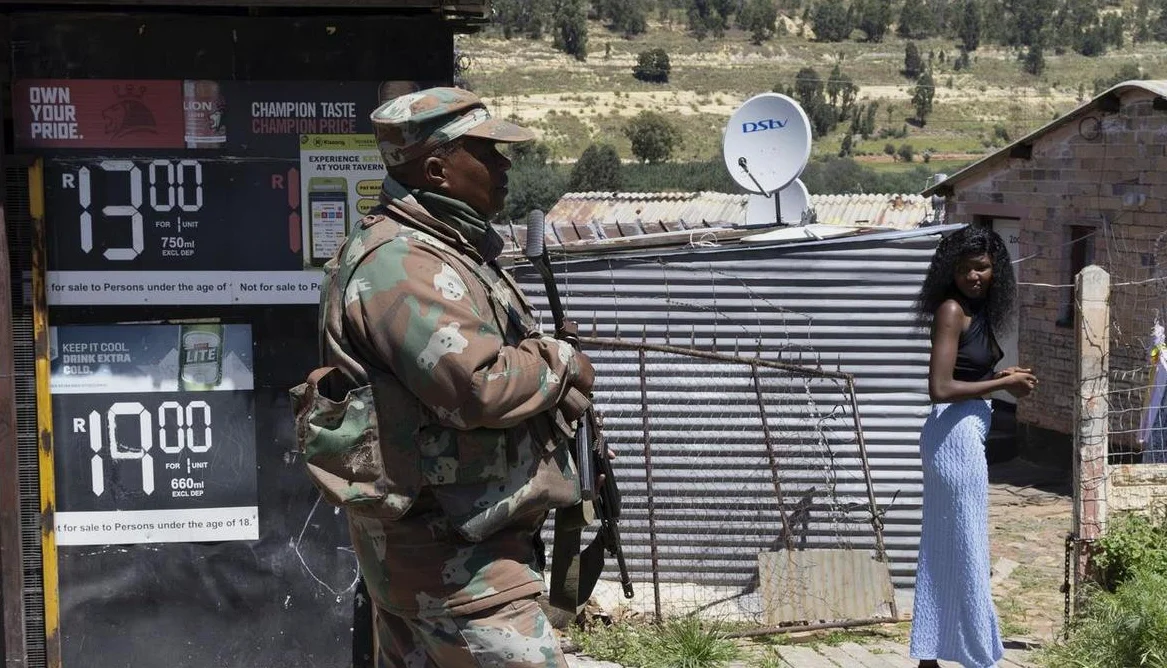
Soldiers have taken to the streets of South Africa’s largest city, Johannesburg, in a coordinated effort to support local police in addressing the escalating threat of gang violence and illegal mining. This deployment marks the first major use of military forces since President Cyril Ramaphosa announced in his annual address last month that he would deploy the army against organized crime, which he described as the greatest threat to democracy and economic development in the country.
Deployment in Riverlea and Westbury
The military presence was most visible in the Riverlea and Westbury suburbs of Johannesburg, where soldiers jumped from vehicles and entered apartment blocks. Military vehicles moved through the neighborhoods as part of a broader operation aimed at curbing violence and restoring a sense of security among residents.
Residents in the area expressed relief at the sight of soldiers patrolling their streets. Pearl Hilma, a resident of Riverlea, told the Associated Press that she supports the crackdown, saying, ‘There’s lots of gangsterism as well as gunshots every night in our neighborhood.’ The presence of the military is seen as a necessary measure to address the growing fear of violence that has plagued the area for months.
Some of the buildings in the area have graffiti messages denouncing crime, with one near a local school reading, ‘No to Guns, Pray for our Community.’ The message reflects the deep concern among residents about the safety of their children and the overall stability of the neighborhood.
Government Plans and Military Role
According to reports, the deployment is part of a broader strategy by the South African government to combat organized crime across the country. President Ramaphosa announced in a notice to the Speaker of parliament that 550 soldiers would be deployed initially in the Gauteng province, which includes Johannesburg, with the operation expected to last until the end of April.
The government has also outlined plans for a wider deployment across five of the country’s nine provinces. Police officials submitted details to parliament indicating that the military will focus on illegal mining in the Gauteng, North West, and Free State provinces, while addressing gang violence in the Western Cape and Eastern Cape provinces.
The deployment is expected to last more than a year in certain areas, according to police officials. The military will operate under police command during the operation, ensuring coordination between the armed forces and law enforcement agencies.
Criminal Statistics and Past Deployments
South Africa has long struggled with high rates of violent crime. Police reported 6,351 homicides from October to December 2025, an average of nearly 70 per day in a country with a population of about 62 million people. In addition to homicides, there are also high numbers of attempted murders and violent assaults, highlighting the severity of the crisis.
The government has previously deployed the military to address crime and disorder, notably in 2021 when riots and looting in two provinces, sparked by the imprisonment of former President Jacob Zuma and frustrations over the country’s response to the COVID-19 pandemic, led to more than 350 deaths.
Ramaphosa emphasized that the decision to deploy the army was carefully considered, given its historical use during the apartheid era to suppress pro-democracy protests. However, he stated that the current situation has made it ‘necessary due to a surge in violent organized crime that threatens the safety of our people and the authority of the state.’
Residents like Yasin Botha have welcomed the military’s presence, saying it provides reassurance in the face of ongoing violence. ‘Currently, I feel unsafe because we don’t know when the next shooting is going to happen and we don’t know who it is targeted at,’ Botha said. He believes that the combination of police and military forces will lead to a quicker response when incidents occur.
The deployment comes at a time when the country is grappling with deepening social and economic challenges. High unemployment, inequality, and corruption have contributed to the rise in organized crime, which has become a major threat to public safety and the rule of law.
As the military operation unfolds, the government faces the challenge of ensuring that the deployment achieves its goals without further destabilizing the communities it aims to protect. The success of the initiative will depend on the coordination between military and police forces, as well as the broader efforts to address the root causes of crime in the country.
The next phase of the operation is expected to include expanded deployments across other provinces, with the government planning to submit updated reports to parliament on the progress and outcomes of the military intervention.



Comments
No comments yet
Be the first to share your thoughts