

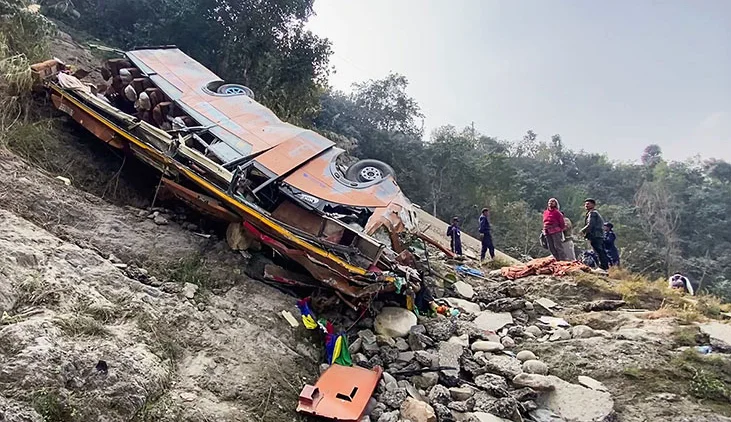
In the early hours of Monday morning, a bus carrying 44 passengers veered off the road in Dhading District, plunging over 200 metres into the icy waters of the Trishuli River. The crash, which claimed 19 lives and injured 25 others, included three foreign nationals — a British tourist, a Chinese woman, and an Indian man — among the dead. This tragedy, reminiscent of a similar disaster in July 2024, highlights the persistent dangers faced by travelers and locals alike in Nepal’s rugged terrain.
The Tragedy Unfolds
The bus was en route from Pokhara, a popular tourist hub, to Kathmandu, the capital. The accident occurred in the early hours, when visibility was low and the road conditions were treacherous. Senior local police officer Prakash Dahal confirmed the fatalities, stating that all victims had been identified. Among them was Dominic Stewart, a 23-year-old British tourist who had recently completed the Annapurna Circuit trek. His family described him as ‘a very loving and caring young man who was happiest trekking.’
Despite the efforts of rescue teams, the recovery operation was completed by dawn. The injured, including a Chinese citizen and a New Zealander, were taken to nearby hospitals. However, the incident has raised serious concerns about the safety of travel in Nepal, particularly on the roads leading to the Trishuli River, a vital artery for tourism and local transport.
A Pattern of Disasters
This is not the first time the Trishuli River has been the site of a catastrophic accident. In July 2024, two buses with over 50 people each were swept off the highway into the same river after a landslide. The pattern suggests that the area is particularly prone to such disasters, exacerbated by poor road infrastructure, reckless driving, and inadequate vehicle maintenance.
Experts point to the combination of steep slopes, narrow roads, and unpredictable weather as major contributors to the high incidence of road accidents in Nepal. The Himalayan terrain, while breathtaking, poses significant challenges for transportation. The Trishuli River, which flows through the region, is a critical route for both tourists and locals, but its proximity to the roads increases the risk of fatal accidents.
The Role of Tourism
Nepal has long been a magnet for adventure seekers and cultural explorers. The country is home to some of the world’s highest mountains, including Mount Everest, and offers a wide range of activities such as paragliding over Pokhara, whitewater rafting on the Trishuli River, and bungee jumping from high gorges. However, the popularity of these activities has also increased the number of tourists in the region, often at the expense of safety.
Despite the risks, Nepal continues to promote itself as a top travel destination. In 2026, the country is highlighting its majestic mountains, ancient temples, and wellness retreats, positioning itself as a must-visit for travelers seeking both thrill and tranquility. Yet, the recent tragedy raises questions about the balance between promoting tourism and ensuring the safety of those who visit.
Expert Perspectives
Transportation experts warn that the current road infrastructure in Nepal is ill-equipped to handle the increasing number of vehicles, especially in high-risk areas like Dhading District. ‘The roads are not only narrow but also poorly maintained, which makes them extremely dangerous during the monsoon season and in winter,’ said Dr. Anjali Shrestha, a transportation engineer based in Kathmandu.
According to Dr. Shrestha, the lack of proper safety measures, such as guardrails and emergency response systems, contributes significantly to the high fatality rate in such accidents. ‘We need a thorough approach that includes both infrastructure improvements and stricter enforcement of traffic laws,’ she added.
Local authorities have acknowledged the need for action. In the wake of the recent crash, there have been calls for increased investment in road safety and better emergency response systems. However, progress has been slow, and the tragedy serves as a stark reminder of the urgent need for change.
Looking Ahead
The incident has also drawn international attention, with the British Foreign Office confirming support for the family of Dominic Stewart, the British tourist who died in the crash. The tragedy has sparked discussions about the safety of travel in Nepal and the need for more stringent measures to protect both tourists and local residents.
As Nepal continues to promote itself as a premier travel destination, the events surrounding the Trishuli River crash serve as a sobering reminder of the risks associated with its natural beauty. The country must address these challenges head-on to ensure that the thrill of adventure does not come at the cost of human lives.
The Trishuli River, once a symbol of Nepal’s natural splendor, now stands as a grim testament to the dangers that lurk in the shadows of its beauty. For those who visit, the river’s icy waters are a reminder that the path to adventure is fraught with peril, and the need for safety cannot be ignored.






Comments
No comments yet
Be the first to share your thoughts