

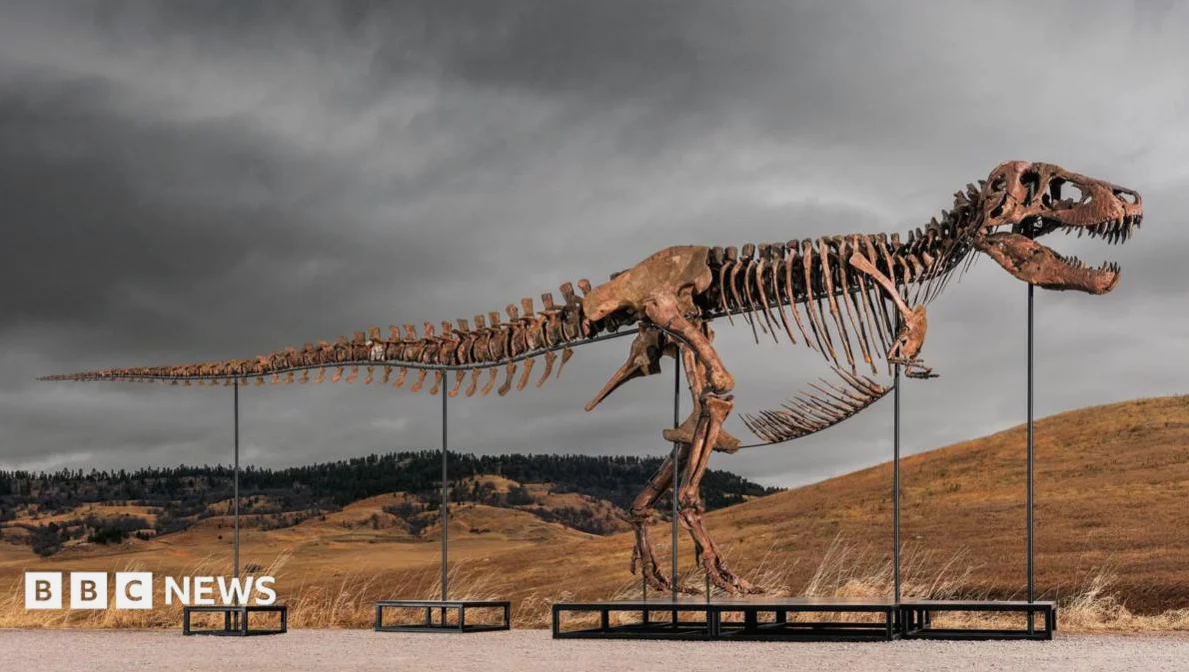
A Tyrannosaurus rex skeleton nicknamed Gus has sold for $50.1 million at auction, making it the most expensive dinosaur ever sold; the sale occurred at Sotheby’s in New York, with a winning bid placed over the phone. The presale estimate was between $20 and $30 million.
A nearly complete and scientifically significant specimen
Gus the T. rex is 38 feet long and 12.5 feet tall, with a skull measuring 54 inches, making it one of the largest T. rex specimens ever found. It includes 183 fossil bone elements. Making it about 61% complete by bone count, or 75% to 80% complete by mass. The skull alone has about 82% of the original bones represented, and the skeleton includes rarely found components such as the wishbone, a complete pelvis, and both feet.
Gus was discovered in 2021 on land owned by the late Gary ‘Gus’ Licking, a cattle rancher from Harding County, South Dakota, though he died in 2022, one year into the excavation of the fossil. The skeleton was named in his honor.
Private ownership and scientific concerns
Paleontologists generally believe that once a fossil ends up in private hands, it is lost to science; Scientific journals will only publish research conducted on specimens held in publicly accessible collections. If a fossil is privately held. Studies can’t be reliably reproduced, an important standard for verifying scientific findings.
Gus was previously displayed in New York from July 1 to 14, 2024, before the auction — the previous record for a fossil auction was held by Apex the Stegosaurus, bought in 2024 by billionaire Ken Griffin for $44.6 million. That specimen is currently on a four-year loan at New York’s Museum of Natural History.
Global interest and a first for Europe
While Gus was sold in the U.S., another T. rex, named Trinity (TRX-293), was being prepared for a European auction in Zurich. Trinity arrived in Switzerland in December 2022 in nine large wooden boxes and is believed to be the first T. rex ever to touch Swiss soil. It was described as a “gigantic piece of Ikea furniture” due to its modular assembly method.
Europe has seen T. rex specimens on loan before—King Kong in Munich, Tristan Otto in Berlin, and Trix in the Netherlands,but no T. rex has ever been auctioned there. Starting in late March. Trinity was displayed at the Tonhalle in Zurich for three weeks before the auction, it is expected to be the world’s third T. rex to go under the hammer.
T. rex fossils are typically found in the Hell Creek Formation, a legendary geological boneyard that stretches across Montana, Wyoming, and the Dakotas. The first T. rex skeleton was discovered there in 1902, and the name T. rex was given to the species based on fossils from this area.
The T. rex lived during the late Cretaceous period, around 67 million years ago, a time of warm climate, high sea levels, and rich coastal floodplains. These conditions allowed large herbivorous dinosaurs like Triceratops and Edmontosaurus to flourish, creating an network that supported top predators like the T. rex.
Today, T. rex is one of the most well-known dinosaurs globally, partly due to its appearance in the 1993 film Jurassic Park. The movie’s iconic scene,where a T. rex escapes its enclosure and attacks a tour vehicle,has become one of the most famous in film history. The dinosaur’s massive skull, long sharp teeth, and powerful bite, along with excellent vision and sense of smell, made it a top predator.






Comments
No comments yet
Be the first to share your thoughts