

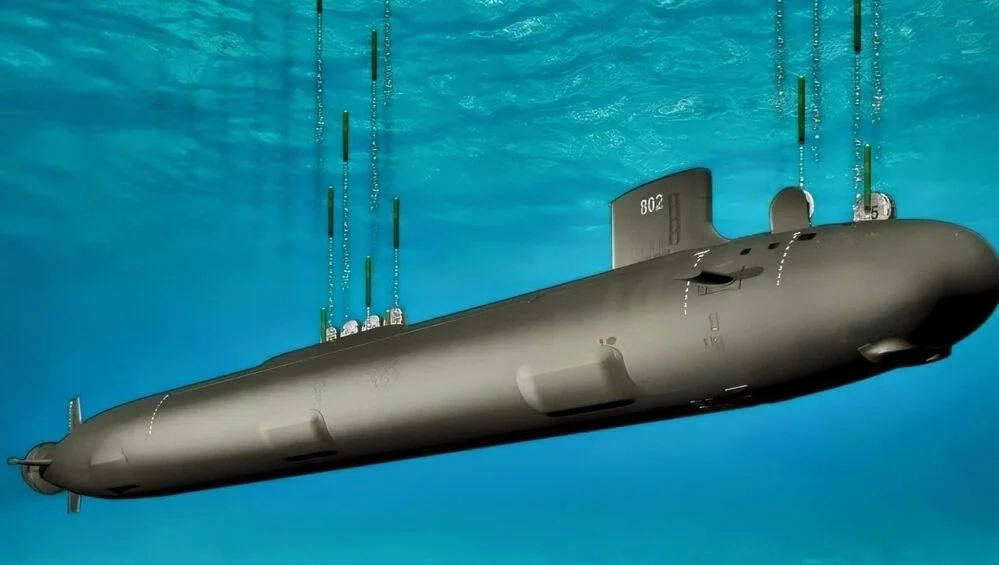
The U.S. Navy has announced notable advancements in the construction of its Columbia-class ballistic missile submarines, a critical component of the nation’s nuclear deterrence strategy. Rear Adm. Todd Weeks, Program Executive Officer for Strategic Submarines, confirmed at the 2026 WEST conference in San Diego that the lead vessel, USS District of Columbia (SSBN-826), is now approximately 65% complete. This marks a significant shift from years of delays and cost overruns that had plagued the program.
Progress on the Lead Submarine
The USS District of Columbia, the first of the Columbia-class submarines, is being built under the A-26 acceleration plan, which aims to streamline the construction process. According to Weeks, all 26 modules required for the submarine have been delivered to the final assembly yard in Groton, Connecticut. The last module, the bow section, was delivered just before Thanksgiving 2025 via barge from HII to General Dynamics Electric Boat (GDEB).
“We achieved that,” Weeks stated, emphasizing the successful execution of the A-26 plan. The Navy now expects the pressure hull of the lead ship to be complete by the end of 2026. The submarine is scheduled to enter the water in 2027 and be delivered to the fleet in 2028.
Status of Other Submarines
The progress on the lead submarine is mirrored by developments in the construction of the next two vessels, USS Wisconsin (SSBN-827) and USS Groton (SSBN-828). According to Weeks, the USS Wisconsin is about 35% complete and is one of only two U.S. Navy ships under construction that are on schedule. The USS Groton is at approximately 10% completion but is seeing a significant ramp-up in production.
“We’re seeing good ramp-up there,” Weeks noted. The full serial production of the 12 Columbia-class submarines is projected to begin by 2031, ensuring a steady replacement for the aging Ohio-class submarines currently in service.
Significance for National Security
The Columbia-class submarines are vital to maintaining the United States’ nuclear deterrence capability. Each submarine is armed with Trident II D5 ballistic missiles, capable of carrying multiple warheads. The replacement of the Ohio-class submarines, which have been in service since the 1980s, is essential to maintaining the strategic balance and ensuring the United States’ ability to project power globally.
The delays in the Columbia-class program have raised concerns among defense analysts and policymakers. However, the recent progress has provided a much-needed boost to confidence in the program. The successful delivery of the lead submarine in 2028 will be a critical milestone in the Navy’s modernization efforts.
The U.S. Navy has faced similar challenges in the past with major defense programs, such as the Littoral Combat Ship (LCS) and the F-35 Joint Strike Fighter. These programs have also experienced delays and cost overruns, but the Navy has managed to overcome these obstacles through improved project management and collaboration with industry partners.
“We sat down with our shipbuilding partners, and we realized that we were not where we needed to be on District of Columbia,” Weeks said. “We were not making the progress we needed to. Together with our shipbuilders, we embarked upon a bold plan that we called the A-26 acceleration plan and the goal was to be able to deliver every single one of the [26] modules that makes up [District of] Columbia, to deliver all those modules to the final assembly yard in Groton by the end of by the end of last year… We achieved that.”
With the Navy now on track to deliver the lead Columbia-class submarine in 2028, the focus will shift to ensuring that the subsequent vessels are constructed on time and within budget. The success of the A-26 plan will be a key factor in determining the overall viability of the Columbia-class program.
The Navy’s leadership, including Rear Adm. Todd Weeks, has emphasized the importance of maintaining a strong nuclear submarine fleet. The Columbia-class submarines are designed to be more advanced than their predecessors, with improved stealth capabilities, better propulsion systems, and enhanced combat systems.
As the construction of the Columbia-class submarines continues to gain momentum, the Navy is also working to ensure that the program remains within budget. The total cost of the Columbia-class program is estimated to be around $12 billion, with each submarine costing approximately $1 billion. This cost is a significant investment, but it is necessary to maintain the United States’ strategic deterrence capability.
The successful delivery of the lead submarine in 2028 will be a critical milestone for the Navy. It will mark the beginning of a new era in undersea warfare and reinforce the United States’ position as a global leader in naval technology and strategic deterrence.






Comments
No comments yet
Be the first to share your thoughts