

 BBC
BBC 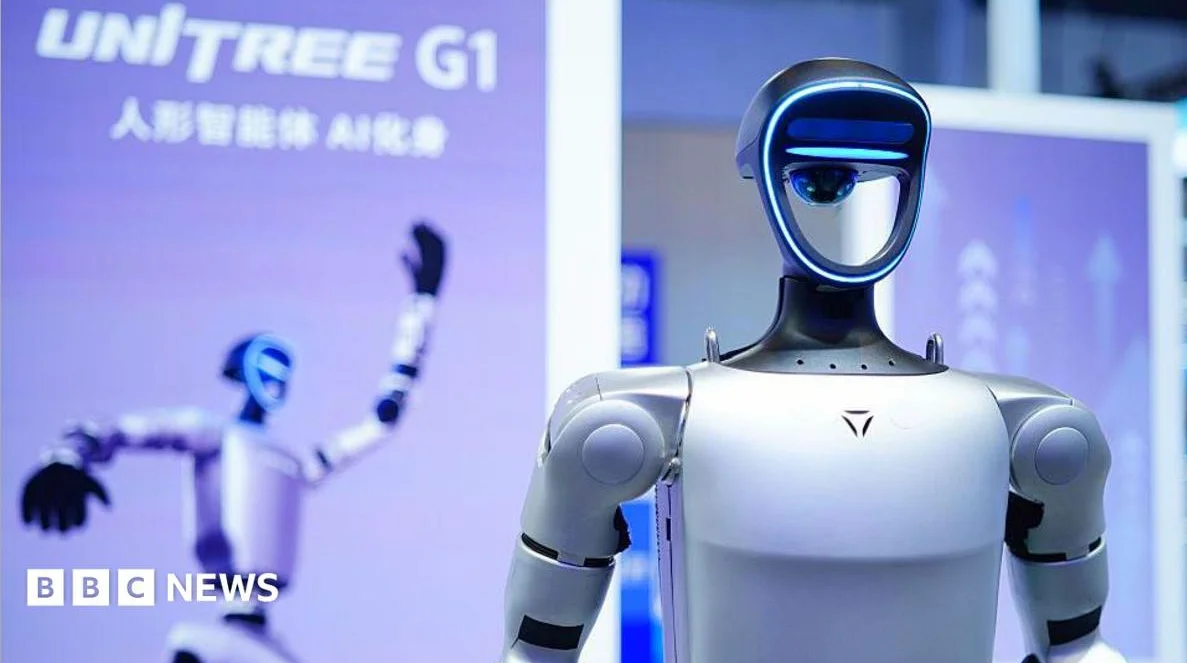
Unitree Robotics, officially known as Yushu Technology Co Ltd, debuted on the Star Market in Shanghai on Wednesday; its shares ended the day up by over 460%, a strong signal of investor confidence in the firm’s potential. The company’s shares were offered at 150.80 yuan (£16.50; $22.36) and closed at 845 yuan, reflecting a significant increase in value.
Unitree’s Role in China’s Robotics Ambitions
Unitree’s listing marks a significant milestone in Beijing’s push to lead in the global robotics industry. Founded in 2016, the company has become a key player in the sector, manufacturing devices ranging from sensors and automated arms to four-legged and humanoid robots. Last year, Unitree shipped more than 5,500 humanoid robots, driven by growing demand for advanced robotics technology.
According to the state-run China Daily, the number of Chinese robotics firms increased more than threefold between 2020 and 2024, while the government considers robotics a strategic priority, aiming to use the technology to address challenges like an aging population and labor shortages. Fei Qin, an associate professor at the University of Bath, noted that robots could provide a solution to these issues by performing tasks typically done by human workers.
Unitree’s Financial Performance and Market Position
Unitree has achieved profitability, delivering a net profit of 278 million yuan in 2025, and it stands out in the sector as one of the few profitable companies. The firm competes with major global players by offering similar features at lower prices — For example, Unitree’s robot dogs start at $2,700, a fraction of the roughly $70,000 price for Boston Dynamics’ Spot robot.
Harold Soh, a researcher from the National University of Singapore, noted that while US-made robots often feature more user-friendly software, the cost advantage of Chinese manufacturers like Unitree is hard to ignore. Unitree’s G1 model, a child-sized humanoid robot, is priced at $13,500 and has been available since 2024.
The firm’s robots gained widespread attention in February when they performed martial arts moves during China’s Spring Festival Gala; the display, which was broadcast live, demonstrated the company’s technological capabilities and captured the public’s imagination. David Hsu, a robotics researcher, said the performance was an indication of the industry’s rising prominence.
Investor Interest and Future Prospects
Unitree’s stock market debut is seen as a bellwether for the humanoid robotics sector. Jack Pearson from investment firm RoboStrategy noted that the listing gives investors a rare opportunity to participate in a growing industry and could set a benchmark for other manufacturers. The success of Unitree’s IPO also marks a turning point for China’s robotics sector, as it occurs amid U.S. restrictions on imports of foreign-made robots.
The company’s IPO follows the listing of smaller rival UBTech Robotics on the Hong Kong stock market in 2021, while UBTech recently revealed what Chinese state media described as a “hyper-realistic” robot designed to offer emotional support and everyday interaction. More robot makers, including Leju Robotics and AgiBot, are expected to follow suit with stock market listings in the coming months.
Despite the optimism, some experts have raised concerns about the practical applications of humanoid robots outside industrial and commercial settings. Soh pointed out that robots are still years away from being effective in homes, as developers must address issues like battery life, privacy safeguards, and reliability. Initially, the market is expected to focus on robots in factories and hospitals.
The competition between the U.S. and China in robotics and AI has intensified; In July, the Trump administration announced a ban on new Chinese-made humanoid and quadruped robots over national security concerns. Beijing rejected the move, accusing Washington of politicizing trade issues; the U.S. has also imposed restrictions on other Chinese technologies, including AI models and electric vehicles.
Christine Wan from the Peterson Institute for International Economics noted that Chinese firms are becoming more deeply embedded in global manufacturing, making it difficult for other countries to reduce their reliance on Chinese suppliers. Meanwhile, U.S. companies like Amazon and Tesla have announced plans to use humanoid robots in their operations. Musk’s Tesla revealed plans to produce Optimus humanoid robots at its California plant, while Boston Dynamics is expected to deploy human-like machines in Hyundai’s factories in two years.





Comments
No comments yet
Be the first to share your thoughts