

 BBC
BBC 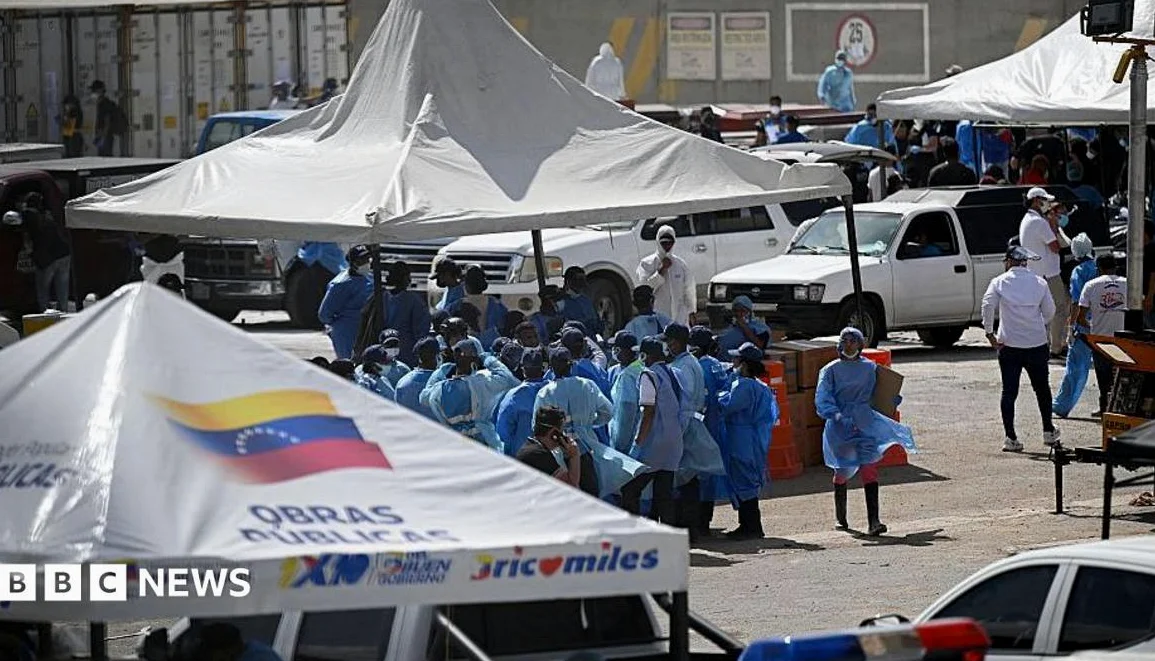
No one speaks. Some stare blankly into space, others check their phones, reading the news or answering messages. Just a few metres away, armed personnel from the Bolivarian Armed Forces control access to the site. “I’m afraid of what I’m going to see in there, but it’s the only way to end this agony,” a woman says before passing through the gate. She has been searching for her nephew for nearly a week. “I’ve looked for him everywhere: in the building, in the hospitals, I’ve spoken to everyone… and no one knows anything.”
Makeshift morgue scenes
Inside, the smell of decomposition is the first thing that greets you. Some family members cover their mouths with their hands. Most wear cloth masks, which offer little relief. Within minutes, many stop reacting. They seem to grow used to it. Nearby, hundreds of bodies lie in rows, wrapped in plastic bags and exposed to the sun. In the sweltering heat, decomposition is rapid. The bodies are arranged according to when they were recovered. At one end of the site, a tent offers free cremation services. At the other, forensic specialists use dental records to help identify victims whose bodies have become difficult to recognise.
Families face two options. Those who think they can identify a loved one by their clothing are taken to one area. Most relatives, however, are directed to two television screens. There, a different ordeal begins. More than 1,000 images of bodies flash across the screens in a sequence that feels endless. Many are swollen, have darkened skin or bear the marks of injuries, making identification difficult. Families search for any trace that might help identify their loved ones — a tattoo, a bracelet, a piece of clothing, or an item from their home. Sometimes there is a pause, a moment of hope.
International rescue operations
A team of firefighters from Scotland has been deployed to Venezuela to help communities impacted by two devastating earthquakes. Gavin Brown, Ian Hodgson and Brian Richards travelled to South America as part of the UK’s search and rescue operation after the twin earthquakes struck on 24 June. More than 2,000 people have died in the disaster and tens of thousands are still missing. The UK crew, which consists of 68 firefighters and staff from 14 fire and rescue services, has also been joined by emergency service personnel from other countries in an attempt to locate survivors in the rubble.
Brown, Hodgson and Richards left the UK last Friday and have been working in Venezuela for the past week. They have been providing specialist technical expertise where it is needed most during search and rescue operations. “We have various types of equipment we can use for sound, vibration and drones,” Buchan said. “They are all trained in breaking and breaching which allows us to tunnel into a building, breaking our way through any barriers or walls.” Speaking from Venezuela, Ian Hodgson said the crew has been using listening devices to detect “saveable lives” and identify how far away the person is, how long it will take to reach and what resources are required.
Adapting to a fast-changing situation
But he said the situation on the ground had been changing fast based on information from local police forces and neighbouring teams. “We have to be open to change and able to adapt quickly,” said Hodgson, a crew commander based at North Anderson Drive station in Aberdeen. Families continue their agonising task of identification at the makeshift morgue, while international rescue teams work tirelessly to locate survivors in the rubble. The scale of the disaster has overwhelmed local authorities, leaving many to rely on outside assistance to bring some order to the chaos.

Comments
No comments yet
Be the first to share your thoughts