

 BBC
BBC 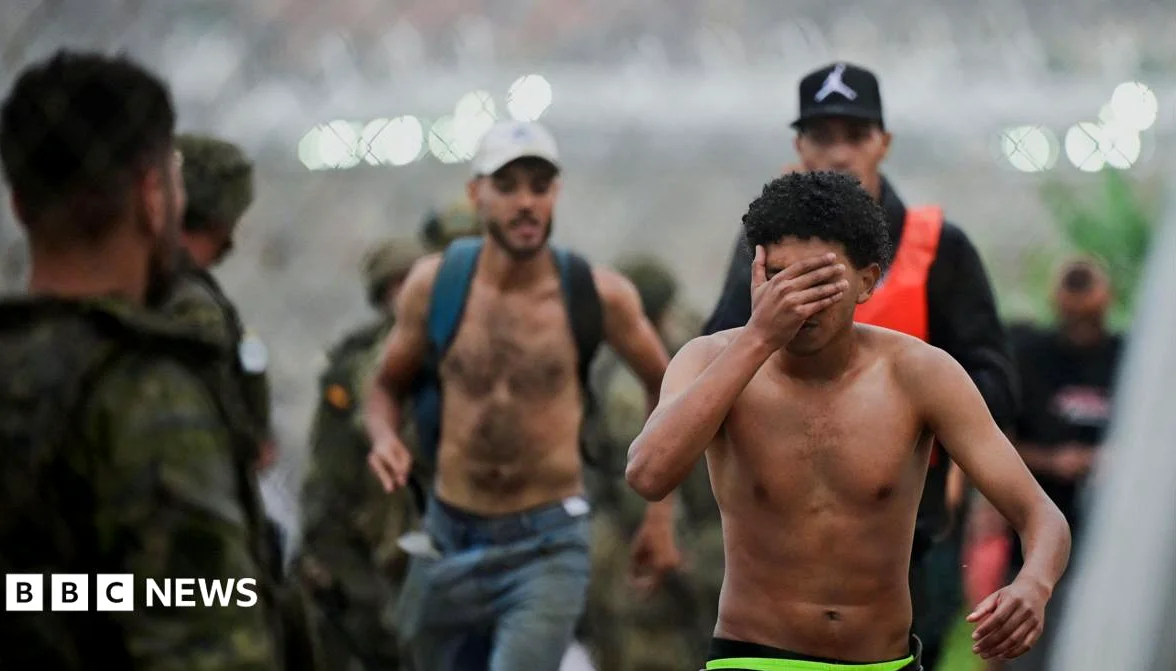
About 49,000 migrants have crossed into Spain’s North African territory of Ceuta from Morocco in the last 24 hours via land and sea, according to officials. At least 24 people died while trying to reach the territory – some swimming to cross into Spain. This comes after Spain’s Supreme Court ruled this month that migrants stopped at sea while trying to reach Ceuta or Melilla, another Spanish exclave, cannot be summarily returned to Morocco.
Spain Deploys Armed Forces to Back Security
Prime Minister Pedro Sánchez described the situation as an “attack” and said the government was working to return all illegal migrants to Morocco “as soon as possible.” Several European leaders have expressed concern, some promising to tighten border controls. Spain has now deployed its armed forces to strengthen security in Ceuta and at its sister city of Melilla, where between 300 to 400 crossings were also reported overnight.
Chaos and Fear in Ceuta
Speaking on Friday during a visit to Ceuta, the prime minister condemned the crossings and said it was an attack on Spain’s territorial integrity. Sánchez added that the government would be looking at reinforcing the border with Morocco. The prime minister blamed the dangerous events on criminal networks manipulating the Supreme Court’s recent ruling, adding that incorrect information had “spread like wildfire in recent hours.”
It’s not clear where the Moroccan border guards were at this point and why the groups of migrants were not dispersed or stopped. One migrant told Reuters news agency that he was returning to Morocco, adding: “It’s not good at all, and it’s not fun either. I mean, people are dying here. I beg you, please, if you haven’t come yet, don’t come. Don’t do it.”
Local media reported chaos on the streets of Ceuta since Thursday, with one resident telling Spain’s ABC that people were scared. “Nobody is going out on the street. They’re afraid. This is stronger and more aggressive than what we’ve experienced before,” a hospital security guard told the Spanish site.
European Responses and Diplomatic Tensions
Italy’s right-wing Prime Minister Giorgia Meloni was very quick to comment on events in Ceuta, calling the images from there “shocking” and writing on social media that such “uncontrolled immigration” was a security threat to Europe. She said Italy would consider suspending the Schengen zone agreement with Spain on free movement, although it’s unclear what that means in practice given that the two countries are not neighbours and undocumented migrants are unlikely to board flights.
Italy’s foreign ministry later clarified their response called for the suspension of the Schengen agreement with Spain at the Italy-Spain border, rather than for Spain to be excluded overall from the agreement. In any case, the migrants who have arrived in Ceuta are now stuck there – not on the Spanish mainland.
Spain’s foreign minister said such remarks were “improper” for “a partner and friendly country from which we expect European solidarity and not partisan demagoguery.” He also summoned the Italian ambassador to Madrid on Friday. EU chief Ursula von der Leyen said the images out of Ceuta were “unacceptable” and must “stop immediately.” Finland’s Interior Minister Mari Rantanen backed Meloni’s proposal, and said Spain had failed to protect its border, while German Chancellor Friedrich Merz demanded Morocco “take back illegal migrants immediately.”

Comments
No comments yet
Be the first to share your thoughts