

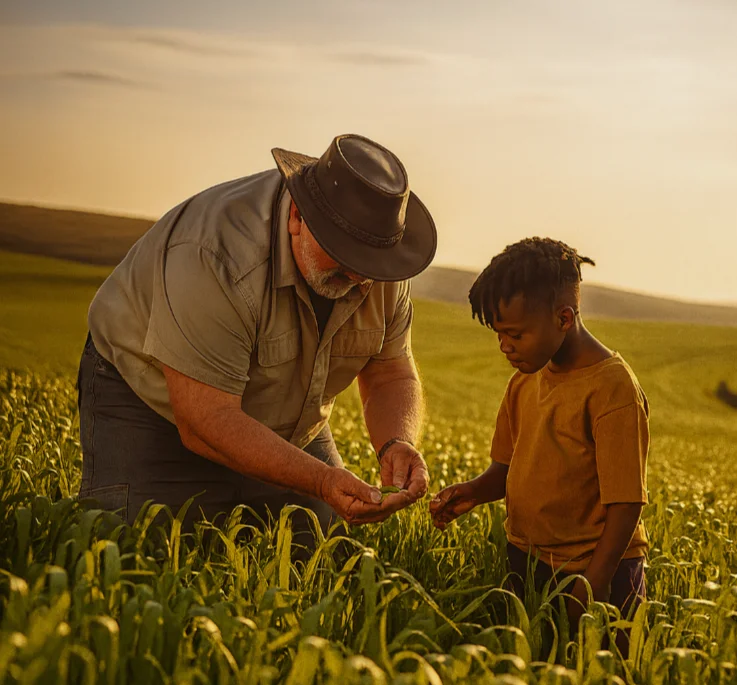
NAPLES, Western Cape — Agri Dwala operates across roughly 580 hectares in the Overberg region, producing key crops and livestock that bolster South Africa’s agricultural output. The enterprise, entirely owned by black South Africans, traces its roots to a group of farmworkers who evolved into a capable management team under the guidance of veteran farmer Kosie van Zyl.
Van Zyl, whose own farming path started with land access provided by a mentor years ago, emphasized daily involvement and shared duties over short-term training. This method propelled individuals like Daniel Pieters, who amassed nearly two decades of expertise after completing agricultural studies, into leadership roles. Younger talent, such as Antonio Vywer with his formal qualifications and drive, now carries forward that accumulated knowledge.
Partnerships fueled early growth. Pioneer Foods, now integrated into PepsiCo Southern Africa, assisted Agri Dwala in securing 316 hectares during its startup phase. That foothold enabled formalization and scaling. PepsiCo’s procurement arm still purchases the farm’s wheat, according to company statements, aligning with goals to boost local sourcing and support emerging producers.
South Africa’s farming sector grapples with climate shifts, soaring input prices and heavy wheat imports. Agri Dwala counters these pressures through ongoing training, seasonal knowledge exchanges and sustainable practices, officials with the enterprise said. Such steps build resilience in local production.
The model highlights inclusive ownership in a field long marked by barriers. Real mentorship, steady markets and opportunity turn workers into owners, broadening participation. Communities gain as operations stabilize and expand.
Van Zyl’s philosophy echoes his beginnings: progress comes from sustained experience, not fleeting aid. Agri Dwala embodies this, fortifying the food supply chain while nurturing the next generation of farmers. Its output reaches markets via partners like PepsiCo, ensuring economic loops that sustain the operation.
From humble labor roots, the team now oversees planting, harvesting and sales cycles. Pieters and Vywer exemplify the handover, applying lessons from veterans to innovate amid challenges. PepsiCo representatives note the partnership’s mutual benefits, with reliable wheat supplies meeting corporate sustainability targets.
As demands for domestic grain rise, Agri Dwala’s approach offers a blueprint. Investments in people yield dividends in productivity and adaptability. The farm’s trajectory highlights how community-driven efforts, backed by strategic alliances, reshape agriculture’s landscape in post-apartheid South Africa.





Comments
No comments yet
Be the first to share your thoughts